
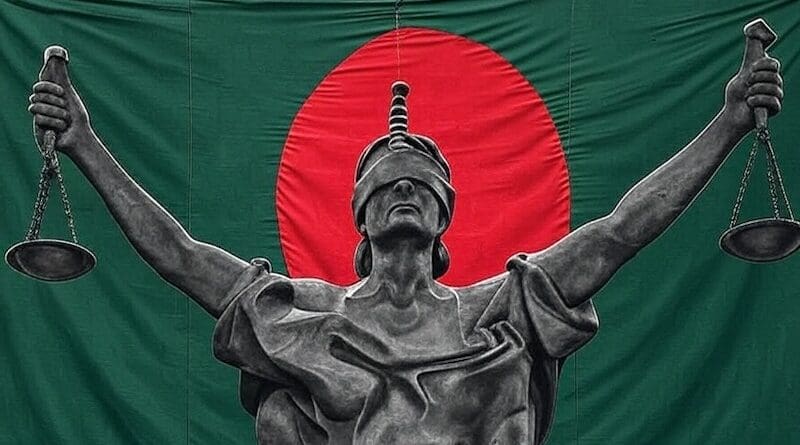
Sheikh Hasina’s Death Sentence Exposes A Tribunal Engineered For Retribution – OpEd
The death sentence handed to Sheikh Hasina does not resemble a judicial verdict. It resembles a political execution carried out in the name of law, sanctioned by an unelected authority, and delivered through a tribunal reshaped for one purpose: to eliminate a former prime minister who once challenged the very networks now sitting in judgment over her.
For millions of Bangladeshis who have lived through military coups, caretaker governments, and political upheavals, the verdict feels brutally familiar—but also unprecedented. This time, the demolition of due process was not accidental. It was designed. The legal architecture was torn down and rebuilt in haste, not to uncover truth but to silence a political rival and rewrite the nation’s memory.
This was not justice collapsing under pressure. This was justice methodically strangled.
A Tribunal Engineered to Guarantee Conviction
The interim administration of Muhammad Yunus made no attempt to hide its intentions. The International Crimes Tribunal—established to bring justice for the atrocities of 1971—was rapidly transformed through executive ordinances that rewired its very foundation. These changes were not debated, scrutinized, or reviewed by any elected body. They were imposed.
Investigators were granted sweeping powers to search and seize without judicial oversight. Defense preparation time was cut from six weeks to three, making it virtually impossible for any legal team to examine evidence, summon witnesses, or mount a coherent defense. Prosecutors were given the extraordinary authority to issue their own search warrants, bypassing the tribunal entirely.
Worst of all, the tribunal was told it no longer needed to follow “technical rules of evidence.” That phrase—dry, bureaucratic, seemingly innocuous—effectively meant that hearsay, unverified recordings, speculative testimony, and politically convenient claims would all be admissible.
A court that discards evidence standards is not seeking truth. It is seeking a target.
Turning Criminal Charges Into Political Exile
The interim administration did not stop at procedural sabotage. It amended the ICT Act to bar anyone charged—not convicted—from participating in elections or holding public office. In effect, a simple accusation became a political death sentence, capable of removing rivals without requiring proof.
Such maneuvers reveal the true purpose of the amendments. The tribunal was reconfigured not to adjudicate crimes but to redesign the political landscape. The verdict against Hasina thus served a dual goal: discredit the former prime minister and simultaneously clear the path for those who could never defeat her at the ballot box.
This is not law. This is political surgery disguised as justice.
Experts Warned: This Was the Road to Victor’s Justice
Legal scholars saw the writing on the wall long before the verdict. Md. Mostafa Hosain warned that the tribunal’s expanded power and weakened safeguards risked turning it into a platform for “victor’s justice.” David Bergman cautioned that a tribunal operating under an unelected authority, with such sweeping authority, could only drift toward political weaponization.
Their warnings did not merely predict flaws—they predicted the very architecture of Hasina’s downfall.
Human Rights Watch, Amnesty International, and other organizations repeatedly criticized the ICT for its vague definitions, flawed evidentiary rules, and limited defense rights. These concerns were not abstract. They were clear indicators that the tribunal could be used for political persecution.
In Hasina’s case, those concerns were not hypothetical. They became reality.
A Judiciary Packed with Loyalists, Not Independent Judges
Perhaps the gravest flaw of the process lies in the tribunal’s composition. Judges were appointed and confirmed within days of the verdict, suggesting not impartiality but intention. Their selection appeared driven not by qualification but by political loyalty.
The prosecution team was no different. Several senior prosecutors held past affiliations with Jamaat-e-Islami or its legal networks—groups whose leaders Hasina herself prosecuted for genocide. Others had ties to political parties aligned with Jamaat’s youth wings. One had even previously led the defense team for Jamaat war criminals.
This is not merely a conflict of interest. It is a complete inversion of justice.
When those who once defended perpetrators of historic atrocities now prosecute the leader who brought them to trial, the process ceases to be credible.
It becomes a political farce.
A Trial in Absentia That Violated Every International Standard
Trials in absentia are considered extraordinary measures, permissible only in narrow circumstances and bound by strict standards. None of those standards were met here.
Hasina was denied meaningful legal representation. Her defense team lacked time, access, and resources. They were prevented from adequately cross-examining witnesses. Attempts to introduce rebuttal evidence were dismissed outright or labeled “irrelevant.” Requests for expert testimony were denied without explanation.
International human rights norms require that defendants tried in absentia receive an automatic right to retrial. Hasina was denied that option. The tribunal offered no assurance that she could ever contest the charges should she return.
This was not a trial. It was a performance with a foregone conclusion.
A Case Built on Fragile, Unverified, and Politicized Evidence
The prosecution’s case revealed just how thin the foundation of the verdict was. Of 81 listed witnesses, only 54 testified. Nearly half of them were not eyewitnesses but “expert” witnesses offering opinion rather than fact. The core evidence included:
- unverified audio clips
- testimonies based on memory from decades earlier
- claims from individuals who received leniency or promises in exchange
- political statements reframed as criminal admissions
When the defense raised concerns that some of the recordings may have been manipulated, the tribunal refused to order forensic analysis—a refusal that would be unthinkable in any serious court.
Statements contradicted each other. Timelines collapsed under scrutiny. Some witnesses altered their accounts mid-testimony. Others relied on secondhand stories, social media rumors, or personal interpretations of political speeches.
This was not evidence. This was an assembly of politically convenient fragments stitched into a narrative by an eager prosecution and an unquestioning tribunal.
A Court That Operated in a Constitutional Vacuum
The ICT exists under the shadow of Article 47(3), which strips defendants of fundamental rights guaranteed by the Constitution. No equal protection. No full fair-trial guarantees. No constitutional shield from state overreach.
The Dhaka Tribune highlighted how this makes the ICT uniquely susceptible to political manipulation. In Hasina’s case, this meant she had fewer rights than an ordinary citizen accused of a minor crime. It meant her fate was determined by a court designed to be beyond constitutional scrutiny.
A judiciary without constitutional restraint is not a judiciary. It is an arm of political power.
Additional Flaws That Underscore the Tribunal’s Collapse
Beyond the major concerns, several additional systemic failures further undermine the verdict:
• Withholding of Exculpatory Evidence: Defense lawyers reported that several pieces of potentially exculpatory evidence were withheld by investigators.
• Witness Intimidation:Multiple defense witnesses refused to testify after receiving threats or facing sudden “administrative complications,” such as investigations into their finances or travel restrictions.
• Procedural Ambushes:Hearings were scheduled with little notice, preventing the defense from adequately preparing.
• Sudden Mid-Trial Amendments: Rules were changed mid-proceeding, including expansions of admissible evidence and reductions in the burden of proof.
• Denial of International Observers:Requests from global legal observers were rejected, often without explanation. Transparency was treated as a threat.
• Political Statements by Prosecutors: Key prosecutors issued public remarks about Hasina’s guilt before the verdict, violating norms of prosecutorial neutrality.
Each of these flaws might raise alarm in isolation. Together, they paint a damning picture of a tribunal that abandoned the pursuit of truth.
A Global Outcry That Exposes the Verdict as Political
International responses have been immediate and damning. Amnesty International stated that while victims of violence deserve justice, Hasina’s execution “serves retribution, not accountability.” More than a hundred journalists labeled the verdict “retaliatory and orchestrated.” One thousand and one academics called the tribunal a “kangaroo court.” Civil-society groups from the U.S., Europe, and Asia have warned that Bangladesh is risking its democratic future.
When voices across the ideological spectrum converge on the same conclusion, the truth is usually unmistakable.
This verdict does not stand on evidence. It stands on political will.
Bangladesh Now Faces a Disturbing Historical Reversal
The irony is almost unbearable. Sheikh Hasina came to power in 2008 promising justice for the victims of 1971. She delivered on that promise, prosecuting the leaders of Jamaat-e-Islami responsible for the genocide. Today, individuals connected to those same networks hold positions of authority in the tribunal that condemned her.
History has not merely been forgotten. It has been rewritten—and weaponized.
When Justice Is Rewritten, Democracy Is Endangered
Bangladesh stands at a perilous crossroads. A judiciary reshaped by decree cannot protect the innocent. A tribunal that modifies rules to suit political goals cannot command respect. And a court that delivers a death sentence through a process rife with coercion, secrecy, and political bias cannot claim legitimacy.
The verdict against Sheikh Hasina is not just a miscarriage of justice. It is a warning to the nation.
It warns that courts can become tools of the powerful. It warns that political vengeance can masquerade as law. And it warns that a country built on the promise of justice can lose its moral compass when truth becomes dangerous.
If justice can be rewritten for one leader, it can be rewritten for anyone.
References
- The Daily Star – Amendment to ICT act: Investigators can now search, seize docs sans tribunal’s permission
https://www.thedailystar.net/news/bangladesh/news/amendment-ict-act-investigators-can-now-search-seize-docs-sans-tribunals-permission-3822181 - Bdnews24 – Bangladesh amends ICT Act to strengthen tribunal powers
https://bdnews24.com/bangladesh/775656a09876 - TBS News – ICT Amendment Ordinance: Accused deemed ineligible to contest elections
https://www.tbsnews.net/bangladesh/ict-amendment-ordinance-accused-deemed-ineligible-contest-elections-1254806 - The Daily Star – ICT Act amendment bars those charged from elections and govt jobs
https://www.thedailystar.net/news/bangladesh/news/ict-act-amendment-bars-those-charged-elections-and-govt-jobs-3978461 - TOAEP Policy Brief – The International Crimes Tribunals of Bangladesh: Past, Present and Future (Policy Brief No. 160)
https://www.toaep.org/pbs-pdf/160-hosain/ - Prothom Alo English – Opinion piece
https://en.prothomalo.com/opinion/op-ed/58oo4vr47p - Jurist – Human Rights Watch urges Bangladesh to reform International Crimes Tribunal Act
https://www.jurist.org/news/2024/10/human-rights-watch-urges-bangladesh-to-reform-international-crimes-tribunal-act/ - Human Rights Watch – Bangladesh: Hasina Found Guilty of Crimes Against Humanity
https://www.hrw.org/news/2025/11/17/bangladesh-hasina-found-guilty-crimes-against-humanity - Firstpost – Story behind Sheikh Hasina’s death sentence: Yunus packed tribunal with Jamaat-picked judges
https://www.firstpost.com/world/bangladesh-sheikh-hasina-verdict-death-sentence-international-crimes-tribunal-judges-chief-prosecutor-muhammad-yunus-13952082.html - BDDigest – Concerns Over Political Ties and Inadequate Qualifications of Judges and Prosecutors at ICT
https://en.bddigest.com/concerns-over-political-ties-and-inadequate-qualifications-of-judges-and-prosecutors-at-international-crimes-tribunal/ - The Daily Star – Advocate Tajul Islam made ICT chief prosecutor
https://www.thedailystar.net/news/bangladesh/crime-justice/news/advocate-tajul-islam-made-ict-chief-prosecutor-3696896 - OpIndia – Jamaat-aligned lawyer made chief prosecutor of International Crimes Tribunal in Bangladesh
https://www.opindia.com/2024/09/jamaat-aligned-lawyer-made-chief-prosecutor-of-international-crimes-tribunal-in-bangladesh/ - Bangla Outlook – Advocate Tajul Islam returning as Chief Prosecutor at ICT
https://en.banglaoutlook.org/news/234672 - Amnesty International – Bangladesh: Justice for victims of 2024 massacre not served by death sentence against Sheikh Hasina
https://www.amnesty.org/en/latest/news/2025/11/bangladesh-justice-for-victims-of-2024-massacre-not-served-by-death-sentence-against-sheikh-hasina/ - TBS News – What international rights groups have to say about verdict against Hasina
https://www.tbsnews.net/bangladesh/what-international-rights-groups-have-say-about-verdict-against-hasina-1288796 - Dhaka Tribune – Fundamental rights are absent in the International Crimes Tribunal
https://www.dhakatribune.com/opinion/op-ed/358941/fundamental-rights-are-absent-in-the-international - Crisis Group – A New Era in Bangladesh? The First Hundred Days of Reform
https://www.crisisgroup.org/asia/south-asia/bangladesh/344-new-era-bangladesh-first-hundred-days-reform

Like what you read?
Please consider supporting Eurasia Review. Thank you for your consideration!
