
India: Old Arms And Armouries Dazzle Visitors At New Gallery Of The City Palace Museum, Udaipur In Rajasthan – OpEd
In the conservation of Saleh Khana lies a fascinating story of years of documentation, identifying structural damages and then taking up the enormous civil engineering challenge of creating new openings in the 16th century palace
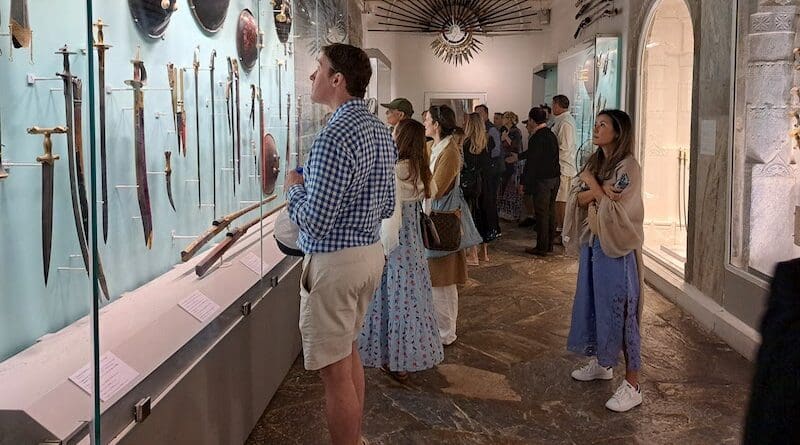
When professionals from United Kingdom and different institutions of India were engaged in refurbishing the oldest portion of Udaipur’s iconic City Palace Museum, they may not have realized they were truly making history. The ‘Arms and Armouries’ gallery at Saleh Khana has come alive, reflecting hi-tech conservation processes and traditional swordsmithy of Mewar, Rajasthan. Undoubtedly, it is a ‘first’ for museums in India, explained the curatorial team working since 2017 on this challenging project.
Saleh Khana, for those who have not yet visited the picturesque ‘city of lakes’ in Rajasthan, is the oldest portion of The City Palace in Udaipur. It was built in the 1560’s by Maharana Udai Singh II, in whose name ‘Udaipur’ as a ‘city of peace’ was established along the scenic shores of Lake Pichola surrounded by hills. Saleh Khana is a vast hall with very thick and massive load bearing walls, large arches and corbelled ceiling, quite an engineering marvel of its times. Initially it was used as Maharana Udai Singh’s living quarters till Rai Angan, the central courtyard of the Mardana Mahal was created with the Maharana’s private residential area at Nikka ki Chopad.
Saleh Khana served a waiting room for the Royal visitors, particularly the nobles of Mewar, who came from their ‘Thikanas’ or estates to call on the Maharana. They deposited their arms here before their audience with the Maharana. Outside in the foyer one can still notice a small recess or a ‘Bha-kari’ in local dialect, where the attendants called ‘charnias’ would be waiting to collect footwear of the visitors, clean and keep it ready for the return journey of the guests. Later this hall was also used as a ‘Farrash Khana’, where The City Palace housekeeping items were stored. In 1883, Maharana Sajjan Singh shifted the Palace armoury into this historic hall.
“The architectural style of Saleh Khana is fascinating from every perspective,” said Dr Shikha Jain of DRONAH, architectural conservation consultant and former Principal Coordinator for conservation works of the Maharana of Mewar Charitable Foundation (MMCF). The architectural form and style reflected the earlier palaces of Maharana Kumbha (period of reign 1433-1468 CE) at Chittorgarh and Kumbhalgarh and the more contemporary ones at Gogunda and Moti Magri. The hall has a rugged, cave-like appearance with heavy stone walls, arcuated ceiling and minimal ornamentation. The exterior has the typical projected opening in the centre. The initial gokhda (projected window) that resembled its precedents in style had been closed in the 17th century with a small central cusped arch. “As the earliest fabric of The City Palace, Udaipur retaining its original form, the Saleh Khana is of very high architectural value,” she noted.
Now six centuries after the city’s foundation was laid, Saleh Khana has witnessed the coming together of world-class professionals and traditional ironsmiths giving the arms and armoury gallery a new lease of life in the twenty-first century. Howard Ricketts, armoury and photography expert from London, was the curator overseeing the thematic display of arms and armoury, travelling between continents and giving Udaipur the benefit of his years of experience.
The curatorial challenge was to give Museum visitors a journey through time, with historic artefacts revealing different stories of their origin, use and significance which are often lost to modern audiences. The gallery is displaying various swords, daggers, guns, pistols, rifles, assegai spears, shields, maces and axes from different time periods and from different parts of the world.
It is Maharana Pratap, the 16th century CE Warrior-King of Mewar, to whom is dedicated the first hall of the ‘Arms and Armouries’ gallery. The legendary Maharana not only resisted the imperial might of the Mughal Empire but came to personify the value system of honour, sacrifice, self-reliance and independence which remains the guiding light for the House of Mewar. “Even though centuries have passed, Maharana Pratap remains an iconic heroic personality whose popularity has transcended time. He continues to inspire us in every way,” said Dr Lakshyaraj Singh Mewar of Udaipur, the young Trustee of the Maharana of Mewar Charitable Foundation (MMCF) and a direct descendant of the great Maharana.
Back in the 1820’s chroniclers like Col James Tod waxed eloquent on the popularity and image of Rana Pratap writing in his ‘Annals and Antiquities of Rajasthan’: “The brilliant acts he achieved during the period live in every valley; they are enshrined in the heart of every true Rajput, and many are recorded in the annals of conquerors. To recount them all, or relate the leadership he sustained, would be to pen what they would pronounce a romance who had not traversed the country where tradition is yet eloquent with his exploits, or conversed with the descendants of his chiefs, who cherish a recollection of the deeds of their forefathers, and melt, as they recite them, into many tears.” The homage to Maharana Pratap at the Saleh Khana is made through paintings, photographs, arms and armouries, the statuesque presence of his horse Chetak. Rarely do artefacts, emotions, literature and history come together in an authentic heritage setting as in this gallery.
Dr Lakshyaraj Singh Mewar, when he refers to Maharana Pratap in public often quotes Pandit Shri Narendra Mishra, one of India’s greatest living ‘veer-ras’ (heroic and brave sentiments) poets who said, “Rana Pratap emerges in an age when the entire Kshatriya identity or asmita was lost, drowned as it were in a sea of convenience-seeking. When there was shameless slavery to dependence, Pratap rises as a synonym of self-respect and self-pride. He was instrumental in breathing new life into the concepts of self-respect and independence.”
It was in September-October 2019 that the first phase of mounting and installation of the arms and armoury began at the Saleh Khana, before the pandemic overshadowed the developmental activities. Plowden and Smith, a renowned firm from United Kingdom, were commissioned to bring their global expertise to the City Palace Museum. “In fact, it was probably the first time in India that a museum had resourced an international firm for mounting and installation of objects,” explained the curatorial team, proud and satisfied that the ‘Arms and Armouries’ gallery showcases an all-round brilliance and attention to detail.
In an earlier media interaction, the Chairman and Managing Trustee of MMCF, Shriji Arvind Singh Mewar said, “Restoration of arms and armoury or its display are not a one-time activity. These are works in progress. What you restore today needs equal attention and care a couple of years down the line.” Shriji had been working closely with Howard Ricketts for several years, drawing up detailed plans and facilitating tasks finally undertaken by Plowden and Smith. He also acknowledged that conservation, especially of arms, armouries and metal objects, has not been given its due in museums across India, probably due to the scarcity of professionals who can do justice to such artefacts.
It is to the credit of MMCF that to fill this gap in both technology and personnel, a Conservation Lab was established at the Chota Darikhana within the Museum premises. The lab utilised expertise of New Delhi-based Centre for Art Conservation & Research Experts (CARE). Dr Vandana Singh, an experienced conservator and managing director of CARE, led a team of three assistant conservators who conserved and restored over 700 artefacts including swords, firearms and objects of warfare.
“Every process of the conservation has been documented and computerised for ease of access and reference,” explained Dr Vandana. To make the complex sound simple, she said, “in our work, we have to use conservation grade materials besides following the standard norms of conservation which we have been practising for years. These conservation grade materials are reversible. Our focus is to maintain the originality and integrity of the artefact we are conserving.” What has been equally fascinating to note is that Dr Vandana and team were constantly engaging with traditional swordsmiths, gunsmiths and armoury experts to incorporate their techniques. “We used the best nano materials, fine grade powders and adhesives. At the same time, traditional tools and techniques of swordsmiths were also being utilized,” she said, highlighting how the unique synergy had been achieved at the Conservation Lab.
In the architectural conservation of Saleh Khana lies a fascinating story of years of documentation, identifying structural damages and then taking up the enormous civil engineering challenge of creating new openings in the 16th century palace. Said Dr Mayank Gupta, CEO of the MMCF, “Our teams worked on a new structural system in the hall with five openings in those thick and massive walls: two openings were through walls that were 800 mm thick, the other two were 1200 mm thick and the last and biggest one was 1800 mm thick.”
Structural analysis and execution were carried out by several teams working in tandem: PM and Associates, Faridabad of Dr. Pankaj Mishra; Ushta Infinity, Vadodara of Mr. Kaizad Engineer; Dr. Shikha Jain of DRONAH and Er. Rahul Shukla and Ar. Omkar Adhikari of the Project Department of The City Palace Museum; Dr. Arun Menon of Indian Institute of Technology, Madras provided structural expertise and advise. “Other conservation works included removal of deteriorated lime plaster, cleaning of stone and lime from the corbelled roof and stone gokhdas. After this, new lime plaster or araish work was performed. Lime finishing in Jhinki and Dobara (stages of araish work) were carried out. All the floral or geometrical motifs were retained during this stage. The araish work was performed using traditional methods and materials by skilled masons and artisans from the region of Mewar,” said Dr Hansmukh Seth, who leads the curatorial team.
For the lay visitors, the artefacts now displayed at the Saleh Khana have been restored to its original finery. They marvel at the sharpness of the swords’ edges, intricate designs on the body armours, and glorious colours of scabbards creatively displayed in the gallery. As they stream out, with many of them awe-struck by the dazzling display, another glorious chapter in the history of centuries-old Saleh Khana has already begun.

Like what you read?
Please consider supporting Eurasia Review. Thank you for your consideration!
