
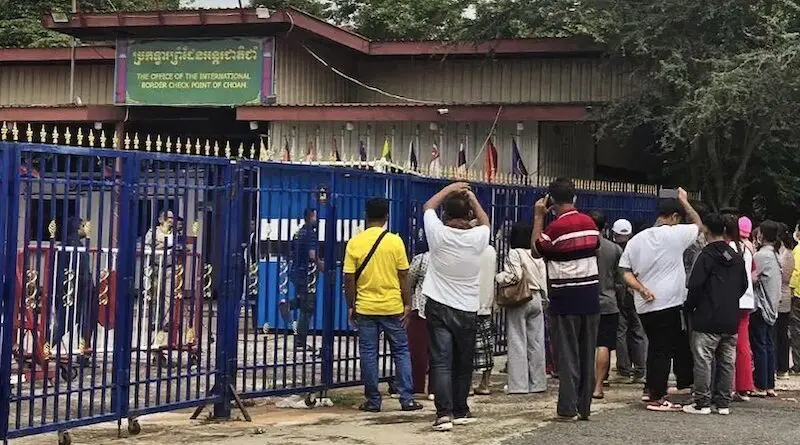
Lines of Contention: Why ASEAN Must Lead In Resolving The Thailand-Cambodia Border Dispute – OpEd
The inability to define the Thailand-Cambodia border line persists due to nationalist manipulation combined with weak regional conflict resolution systems, which endangers ASEAN’s core peace and cooperation values. The organisation needs to adopt a more active dispute resolution method for this situation.
Thailand and Cambodia share historical ties which have repeatedly been affected by their prolonged border conflict. The International Court of Justice (ICJ) made a ruling regarding Preah Vihear Temple sovereignty in 1962, yet this decision did not resolve the neighbouring undemarcated territories, which led to new tensions. Recent events show how dangerous the situation remains in this essential Southeast Asian sub-region because of military clashes and diplomatic deteriorations, and economic sanctions. The current crisis results from multiple complex issues which continue to persist.
The conflict centres on the 817-kilometre border that Thailand and Cambodia share, which includes an important 817-kilometre portion that remains without clear boundaries. Both countries claim sovereignty over particular regions surrounding important historical Khmer temples such as Prasat Ta Muen Thom and Ta Krabey, which matter to their respective nations. The lack of defined territorial borders continues territorial conflicts, which justifies both military and small-scale border clashes. The ICJ ruled in 1962 that Cambodia holds sovereignty over Preah Vihear Temple while leaving the adjacent areas for future bilateral talks, which have not been successful. The border dispute maintains a strong connection with political events inside both countries, together with their nationalistic stories. During political turmoil and election periods, politicians use historical complaints and territorial sovereignty claims to build public backing. The politicisation of these issues creates obstacles for diplomatic agreements since any negotiated settlement could be viewed as a national betrayal , which would create public opposition against diplomatic progress. The Thai prime minister faces suspension because of her inability to handle the border dispute , which demonstrates the effects of national politics on this matter.
The substantial lack of trust between nations creates substantial obstacles for their bilateral relationship. The bilateral relationship deteriorated because of mutual distrust, along with border encroachment claims and military clashes that strengthened during communication failures during periods of rising tensions. The termination of ambassador positions and the removal of envoys indicate an extreme deterioration in senior-level interactions, which hinders effective dialogue and peaceful conflict resolution. The recent claims by Thailand that Cambodia placed landmines in disputed territories, which might violate the Ottawa Treaty, introduce new difficulties to the existing conflict. Cambodia refutes these claims by attributing explosions to historical remnants , yet the presence of landmines makes military operations more dangerous and threatens civilians, while proving that active fighting continues. The existence of landmines creates a real danger to people, which intensifies conflicts while blocking any attempts to establish joint demilitarisation or demarcation agreements. Multiple bilateral negotiations and joint border commissions have failed to produce a permanent solution because of the strong power disparities and deep-seated nationalist beliefs between the two countries. The absence of trustworthy mediation from outside parties , along with inadequate regional frameworks, causes bilateral talks to collapse when historical disputes combine with domestic political pressures.
The ongoing border dispute between Thailand and Cambodia opposes the main objective of ASEAN to create a region that is both peaceful and prosperous , and stable. The ASEAN Way stands as ASEAN’s diplomatic model , which depends on three main principles: non-interference and consensus, and consultation. The organisation’s inability to properly manage ongoing member-state conflicts between its member countries reduces its ability to function as an effective peace-building organisation. The escalation of internal conflicts through armed fighting damages ASEAN’s status as an integrated and capable security community. The conflict between these countries creates tension within ASEAN because members might choose to support one nation, which hampers their ability to make decisions about crucial regional matters and weakens ASEAN’s global unity. The localised conflict maintains the potential to spread throughout the entire sub-region because external actors could become involved in the situation. Border restrictions, along with trade embargoes, disrupt the economic integration and supply networks, which contradict ASEAN’s goal to establish an economic community.
The ASEAN Political-Security Community Blueprint establishes a values-based system which depends on rules for conflict resolution through peaceful means. The current Thailand-Cambodia conflict shows how much ASEAN has failed to achieve its goal of peaceful dispute resolution and demonstrates weaknesses in its conflict management and prevention frameworks. ASEAN members have shown willingness to mediate, yet their attempts are limited by the non-interference policy, which prevents states from giving up control over internal matters and border conflicts.
The situation requires a comprehensive solution which combines bilateral dedication with stronger ASEAN intervention. The ”bridge builder” plays a vital role in this situation, which manifests through several different approaches. The parties need to resume bilateral dialogue with the help of an acceptable international facilitator who can be either a respected figure or a small group of neutral experts. This “bridge builder” maintains solution-free status to conduct beneficial discussions and regulate expectations , along with providing specialised knowledge about border marking techniques. Their involvement would lend impartiality and encourage adherence to agreements.
The re-establishment of joint technical border demarcation committees should be an immediate priority. The committees need to receive definite objectives along with sufficient resources, together with defined deadlines to complete border demarcation work through the use of established treaties and historical maps, and international legal foundations. The “bridge builder” could provide technical support for border mapping and surveying to decrease the number of future disputes about minor details. Both parties should execute immediate Confidence-Building Measures (CBMs) by creating joint border patrols for unauthorised crossing prevention and improved communication while establishing designated peace zones near sensitive areas and direct military communication channels for incident de-escalation. Economic initiatives that allow cross-border trade in uncontested regions serve as effective CBMs because they develop common economic interests between nations. The promotion of grassroots cross-border interactions between cultural groups, educational institutions, and local communities will help dismantle nationalist narratives by fostering mutual understanding. Non-governmental organisations and civil society actors who function as “bridge builders” can establish initiatives that work to mend the social damage caused by decades of hostility.
The border dispute between Thailand and Cambodia represents an essential test for ASEAN to demonstrate its regional peace and stability ambitions. An urgent response is required because prolonged conflict creates simultaneous damage to both immediate parties and Southeast Asian regional security and economic development. The organisation should take a more decisive role to promote a sustainable solution by surpassing its traditional non-interference policy. A new dedicated ASEAN Ad-Hoc Mediation Commission should be established under a high-level leadership with respected former statesmen and legal experts from non-involved member states. The commission will act as the main ”bridge builder” to negotiate an immediate full ceasefire and de-escalation agreement with Thailand and Cambodia , which includes troop withdrawals from disputed territories and an end to new landmine placements. The commission would offer expert technical support and unbiased supervision for achieving total and legally binding border demarcation across all shared areas using international standards, along with satellite mapping technology. The commission would create a plan to develop economic projects in border areas, which would transform disputed territory into cooperation zones that drive economic growth for peace. The commission would actively promote large-scale people-to-people contacts and cultural diplomacy activities to break down deep-seated nationalist beliefs which cause the conflict.
To conclude, the path to enduring peace requires both Thailand and Cambodia to engage in dialogue while making compromises, and ASEAN must demonstrate renewed proactive leadership to safeguard regional stability. ASEAN’s credibility and effectiveness as a regional security architect depend on its capability to transform this continuing conflict into an example of its dedication to shared peace and prosperity.
The opinions expressed in this article are the author’s own.
Reference
- Chansambath Bong. 2025. “Strategic distrust hinders Cambodia–Thailand border resolutions.” East Asia Forum, 18 July 2025.
- “Thailand recalls ambassador to Cambodia amid border tensions, ruling party says.” Reuters, 23 July 2025.
- “Thailand, Cambodia, and the Limits of ASEAN Conflict Management.” Global South Forum, June 2025.

Like what you read?
Please consider supporting Eurasia Review. Thank you for your consideration!
