
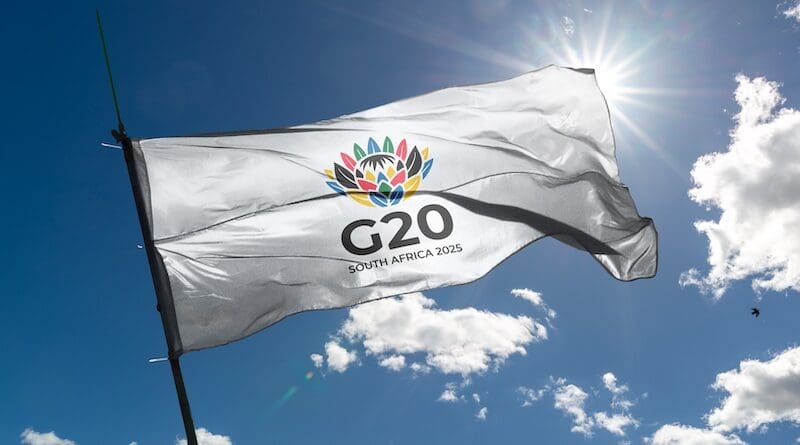
G20 Summit In South Africa: A Historic First – OpEd
“Overshadowed by US Absence”
The 2025 G20 Summit, held in Johannesburg, South Africa on November 22–23, marked a milestone as the first G20 leaders’ gathering ever hosted on African soil. South Africa had hoped the event would spotlight Africa’s rising geopolitical relevance and amplify developing countries’ priorities. Instead, the summit unfolded under a cloud of controversy following the complete withdrawal of the United States, ordered by President Trump.
The Trump administration pulled out all American participation—cancelling President Trump’s attendance, scrapping Vice President JD Vance’s planned visit, and instructing federal agencies not to engage a total boycott. Trump justified the decision by reviving disputed claims that white Afrikaner farmers are being murdered and deprived of their land, while also citing mistrust of Pretoria’s ties with Russia, China and Iran.
What Leaders had to say on US Boycott.
The boycott is particularly striking given that the United States is scheduled to assume the rotating G20 presidency next year—The Role that normally involves active participation during the preceding summit to ensure continuity. US allies, especially in Europe, expressed alarm. One senior European diplomat told the Financial Times, “It’s bleak… There’s really nothing we can hope to achieve without the Americans engaging.” Another sighed, “It’s one thing to be difficult, and another to completely blow it up.”
Canada’s Prime Minister Mark Carney believes the “Global economy can make progress on a range of issues, even without participation by the US, amid President Trump’s boycott of the G20 leaders’ meeting”.
South African President Cyril Ramaphosa was blunter. “If you boycott a process, you are the greatest loser because the show will go on,” he said, adding that he would still follow protocol in handing over the presidency—even “to an empty chair.”
The US absence was not the only high-profile gap. China’s President Xi Jinping, who has scaled back his international travel, did not attend, sending Premier Li Qiang instead. Russia also dispatched lower-ranking officials due to President Putin’s ICC arrest warrant, which obliges South Africa (an ICC member) to detain him if he entered the country. Argentina’s President Javier Milei, citing political alignment with Trump, also stayed away.
G20 China’s B20 Focus: Business in African
The G20 brings together 19 countries plus the European Union, with the African Union added as a permanent member in 2023. It serves as the world’s premier platform connecting major advanced economies with emerging and developing nations. Unlike the G7, it spans diverse political systems and economic models, making consensus difficult but giving the Global South an important voice.
The B20 (Business 20) Chinese Media Focused is the official business community engagement group within the G20 ecosystem. It convenes corporate executives, policy specialists, and private-sector stakeholders to develop recommendations that shape the economic agenda of the G20 presidency.
In 2025, B20 South Africa has gained an unusually high level of visibility—especially in Chinese media. Analysts in Beijing view South Africa’s presidency as a symbolic “Global South moment,” where business-driven development initiatives are as important as political negotiations. It is the first B20 Summit ever held in Africa, aligning with China’s long-term commercial strategy on the continent.
China’s strong emphasis on the B20 this year sees strategic interests in Africa as a core partner in supply chain diversification, infrastructure development, green energy, and digital markets. Many of the B20’s 2025 priorities—sustainable industrialization, inclusive finance, and digital innovation—map directly onto sectors where Chinese companies already operate extensively. The absence of top Western leaders created an opportunity for China to reinforce its long-term economic role on the continent through business diplomacy rather than political theater.
Chinese analysts have therefore highlighted the B20’s workstreams—especially their 30 formal recommendations—as central to shaping the G20’s future direction, regardless of geopolitical friction among major powers.
In an interview with Global Times, B20 South Africa Sherpa Cas Coovadia argued that the China–Africa partnership demonstrates how strategic collaboration can accelerate global transformation: “China can help shape a global order that is not only more sustainable but also more just—an order where prosperity is shared across North and South.”
South Africa’s Goals
South Africa intended to use the landmark summit to champion the concerns of developing countries, drawing on its dual role as Africa’s most industrialized economy and a representative of lower- and middle-income states. Key priorities included:
• Expanding financing for climate adaptation in vulnerable countries
• Strengthening support for green energy transitions
• Addressing debt burdens faced by developing economies
• Confronting persistent global inequality
• Promoting investment and industrialization across Africa
But the political turbulence, most visibly by the US boycott, shifted global attention away from these priorities. Trump’s newly expanded Tariffs against several G20 members injected friction into the business-focused B20 discussions, where multinational companies had hoped for predictability further complicated matters.
G20: Bitter-Sweet Moment for South Africa
Hosting the summit remains historic, but the absences of several world leaders diluted the symbolism of Africa’s debut as G20 host. Ramaphosa had hoped Johannesburg would project Africa’s growing clout; instead, headlines centered on Washington’s disengagement.
With Trump set to take over the G20 presidency next year—after calling the forum “basically the G100” and vowing to streamline. For South Africa, the legacy of the 2025 summit may ultimately lie not only in diplomatic tensions but also in the heightened business engagement—particularly through the B20—where countries like China continue to deepen their long-term interests in African development.
The direction of the G20?
For most of the post-war era, the US has been a reliable partner, an open export market, and a source of investment and development assistance. Those days appear to be over now. The US has turned dramatically inward while aggressively using strong-arm tactics to obtain the economic and strategic outcomes it desires.
The US’ President Trump unilateral rejection of the fundamental principles underpinning the rules-based trade system it created is not an implosion. Free trade principles and a belief in rules-based trade have taken a beating. US non-participation did not plunge the agenda into disarray.
The political will, economic dynamism, and cooperative networks of the Global South are expanding at remarkable speed. Against this backdrop, the G20 conceived as the premier forum bridging advanced and emerging economies must reassert itself as a platform for coordination rather than an arena for geopolitical point scoring and fragmentation.
For South Africa, the true legacy of the 2025 summit may lie less in diplomatic turbulence and more in the surge of business engagement, especially through the B20 where major players like China are deepening long-term commitments to Africa’s development trajectory. This shift underscores a broader reality.
With President Trump set to assume the G20 Presidency next year, threatening to “Streamline” the forum even as the US retreats from the very principles of openness and cooperation it once championed. The world enters a new phase of uncertainty. Whether the G20 can rise to this moment or be dragged into another cycle of unilateralism remains to be seen. For now, all eyes will be on 2026. It will be a “Wait and Watch” but the stakes are high with President Trump in command.

Like what you read?
Please consider supporting Eurasia Review. Thank you for your consideration!
