
Descendants Of Nazis Convert To Judaism – OpEd
Some 6 million European Jews were killed by the Nazis during the Holocaust — the mass murder of Jews, Gypsies and other groups before and during World War II. Soviet Army troops liberated the Auschwitz-Birkenau Death Camp on January 27, 1945, and the day has become known as International Holocaust Remembrance Day. An estimated 1.1 million people, mostly Jews, were killed in the Auschwitz-Birkenau death camp.
A small reproduction of the Amsterdam annex where Anne Frank hid with her family opens to the public at the Center for Jewish History on January 27, International Holocaust Remembrance Day.
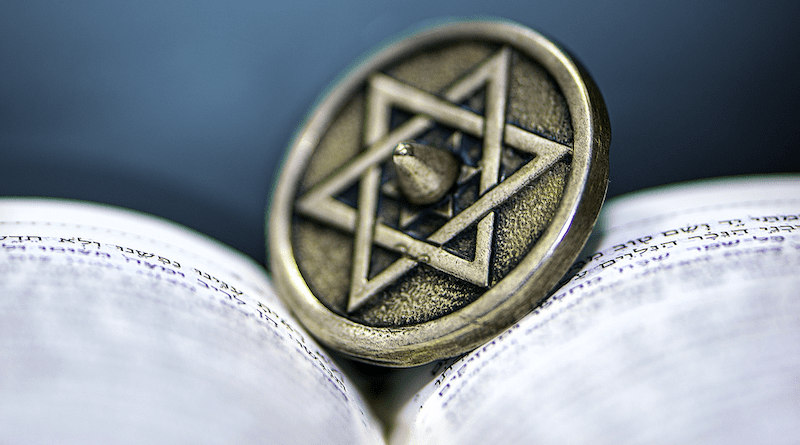
Matthias Goering, a 59-year-old physiotherapist, and a descendant of Hermann Goering, Adolf Hitler’s right-hand man, is wearing a Jewish skullcap, with a Star of David pendant round his neck. After being brought up to despise Jews, he has embraced their faith. And Goering keeps kosher dietary rules, celebrates shabbat and is learning Hebrew.
Actually Matthias isn’t a “descendant” of Hermann. “His great-grandfather and Hermann’s grandfather were brothers”, which makes him a second cousin once removed. After the war, his family’s anti-Semitic tradition persisted through his military doctor father’s imprisonment in and return from a Soviet prison camp. When times were hard, Matthias says: “Our parents would say to us, ‘You can’t have that, because all our money’s gone to the Jews.'”
Things did not go well for Matthias. By 2000 his Swiss physiotherapy practice was bankrupt and his wife had left, taking their son. Broke and lonely, he was close to suicide, and says he prayed for the first time in his life. The same day a physiotherapy practice near Zurich offered him a job.
Mr Goering started attending Christian churches, but two years later began his journey towards Judaism. He says God told him “to guard the gates of Jerusalem”, despite his name and his family history. “I knew then,” he says, “I had to go to Israel.”
Other descendants of Nazis have trodden this path. Katrin Himmler, who published a book in 2005 about the war crimes of her great-uncle, the SS commander Heinrich Himmler, married an Israeli. “It was as if we were predestined to meet,” she says.
Then there is Monika Goeth whose father was Amon Goeth, the camp commandant in Schindler’s List, who shot Jewish prisoners from the balcony of his villa. She has spent years seeking rapprochement with camp survivors. “I am completely drawn to Judaism,” she says. “Jews were the real heroes.”
If you think that these people are ‘undesirable or unstable nuts’ who should be pushed away; read the opening statement on conversion by Eliezer Melamed in his book on conversion; published as one of a popular Israeli Orthodox Judaism series “Pininei Halacha”.
“If a German or an Arab seeks to join the Jewish people, even if he is the son of a fierce anti-Semite, we should accept him and love him like any other Jew. Moreover, we should love him even more than other Jews, in keeping with the commandment to “love the convert, for you too were strangers in the land of Egypt (Deuteronomy 10:19).”
What if a convert is prepared in principle to accept Torah’s Duties and its commandments, but believes that from time to time he will have to transgress some of the commandments? Strictly speaking, it is clear that there is no dispensation for desecrating the Sabbath, even occasionally; neither is it permissible even in difficult conditions to eat forbidden foods.
Nonetheless, the imminent Rabbi Chaim Ozer Grodinski, holds that it is possible to convert such a person because he relates to the acceptance of Divine commandments in principle. In principle, the convert has agreed to take upon himself observance of the commandments, and it is only on occasion that he believes he will transgress. (After all, no human, Jew or non-Jew, is perfect, and as Solomon advises us, ” Do not be overly righteous, and do not make yourself to be excessively wise.” (Kohellet 7:16)
Finally, every rabbi who deals with converts and conversion should be guided by the general principle of Jeremiah’s description of the God of Israel:”Behold, I am a God who brings near’ says the Lord, “and not a God who pushes away”. (Jeremiah 23:23)

Like what you read?
Please consider supporting Eurasia Review. Thank you for your consideration!
