
When India’s Gen Z Broke The Myth Of Political Invincibility – OpEd
Key Takeaways:
- NEET Crisis Evolved into Accountability Debate: Allegations of paper leaks and administrative failures in India’s National Eligibility cum Entrance Test (NEET) expanded beyond education into a national conversation about institutional trust, fairness, and executive accountability, culminating in the reported resignation of Education Minister Dharmendra Pradhan.
- Gen Z Digital Mobilization Style: Young Indians organized primarily through decentralized online networks using satire, memes, humour (e.g., the “Cockroach Janta Party”), and short-form content, combining digital activism with offline participation in ways that challenged traditional political structures.
- Broader Implications for Democratic Legitimacy: The episode highlighted a generation less bound by conventional party identities and more focused on defending institutional integrity; it signals potential shifts in how public pressure can influence even strong majoritarian governments and raises global questions about engaging digitally fluent youth in democratic accountability.
How a satirical student movement transformed an examination crisis into a national debate about accountability, democracy, and the limits of executive power
Governments often survive economic downturns, corruption allegations, and electoral setbacks. They rarely expect an entrance examination to become a defining political moment. Yet India’s prolonged NEET controversy has evolved into something far larger than an administrative dispute. Allegations surrounding examination integrity, the public response, and the ensuing political fallout have exposed a deeper crisis of institutional trust. The reported resignation of Union Education Minister Dharmendra Pradhan has become a focal point in that debate, even as analysts continue to differ over the precise political forces that led to it. What is beyond dispute is that India’s youngest generation has demonstrated an extraordinary capacity to organize, communicate, and sustain public attention. This episode deserves to be understood not simply as an education story but as a window into how democratic politics is changing in the world’s largest democracy.
The Generation That Refused to Look Away
Governments rarely lose political ground because of an examination. Ministers rarely become symbols of a wider democratic reckoning because of students. Yet that is precisely the trajectory India’s NEET controversy appeared to follow.
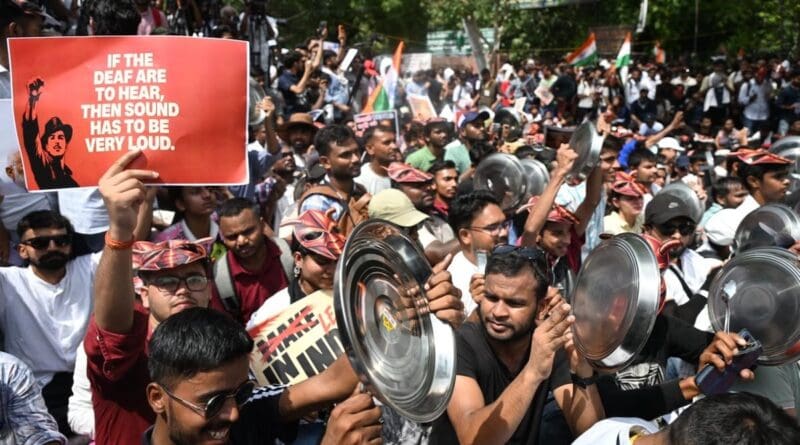
What began as widespread anger over allegations of paper leaks, administrative failures, and declining confidence in one of India’s most consequential competitive examinations gradually evolved into a broader public debate about accountability itself. Student networks, parents, educators, civil society groups, and digital communities transformed an education crisis into a national conversation about institutional credibility.
The reported resignation of Education Minister Dharmendra Pradhan has therefore come to symbolize more than an individual political departure. Whether it resulted primarily from sustained public pressure, internal political calculations, or a combination of both remains open to interpretation. But its symbolism is unmistakable. For many young Indians, the episode demonstrated that collective civic action can still influence national politics. More importantly, it revealed the arrival of a generation that speaks a political language fundamentally different from its predecessors.
The First Crack in Modi’s Fortress
For more than a decade, Prime Minister Narendra Modi’s government cultivated an image of exceptional political discipline. Policy reversals were uncommon. Cabinet ministers projected unity. Electoral success reinforced the perception that centralized authority had become the defining feature of contemporary Indian politics. Against that backdrop, the NEET controversy acquired significance beyond education policy.
For millions of families, competitive examinations represent one of the few institutions that promise social mobility through merit. Confidence in that promise is central to India’s democratic compact. When allegations emerge that the system has failed, the consequences extend far beyond admission lists. They raise difficult questions about fairness, transparency, and equal opportunity.
Public frustration intensified because many students viewed years of preparation as being placed at risk by circumstances beyond their control. That sense of betrayal proved politically potent. It united urban and rural families, crossed linguistic boundaries, and resonated among citizens who otherwise occupied very different political spaces. The controversy became less about an examination than about whether public institutions remained worthy of public trust.
When Merit Became a Political Question
Education has always occupied a special place in India’s national imagination. For generations, examinations have been viewed as ladders of opportunity capable of overcoming class, geography, and inherited disadvantage. That belief explains why controversies surrounding examination governance generate unusually intense public reactions.
The debate surrounding the National Testing Agency was therefore not simply administrative. It quickly evolved into a discussion about institutional design, regulatory independence, technological safeguards, and governmental accountability. Supporters of the government argued that reforms were already under way and that isolated failures should not overshadow broader educational achievements. Critics contended that repeated controversies pointed to deeper structural weaknesses requiring independent scrutiny.
These competing interpretations are unlikely to disappear with any single administrative decision. Restoring confidence requires more than replacing officials. It requires rebuilding public faith that the institutions responsible for evaluating merit operate transparently, consistently, and beyond political influence.
How Satire Challenged Political Power
Perhaps the most remarkable feature of this movement was not its size but its style. Unlike many earlier student agitations organized through traditional political structures, this mobilisation flourished through decentralized digital networks. Humour, satire, short-form videos, memes, and online communities became instruments of political communication.
Groups such as the self-described “Cockroach Janta Party” demonstrated how symbols once intended as insults could be reclaimed as expressions of resilience. Whether viewed as political theatre or serious activism, such tactics reflected a generation comfortable transforming internet culture into civic participation.
This matters because governments are generally accustomed to negotiating with organized political parties and identifiable leaders. They are less prepared to engage movements whose leadership is diffuse, whose messaging evolves in real time, and whose influence depends as much on digital participation as physical protest.
In that sense, the movement revealed not merely dissatisfaction with educational governance but a broader transformation in how political legitimacy is contested in the digital age.
The End of Political Impunity?
Whether this episode marks a lasting shift in Indian politics remains uncertain. Democratic systems frequently absorb moments of intense public anger before returning to familiar patterns. Yet dismissing the movement as a temporary outburst would overlook its broader implications.
The controversy demonstrated that even governments with commanding parliamentary majorities remain vulnerable when institutional credibility becomes the central political issue. Citizens may disagree over ideology, economic policy, or electoral choices, but confidence in fair public institutions occupies a different moral category. It speaks directly to the relationship between the state and the individual.
The reported resignation of the Education Minister has therefore acquired significance beyond questions of cabinet management. To supporters of the government, it may represent administrative accountability and political responsiveness. To critics, it illustrates the effectiveness of sustained public pressure. Both interpretations underscore an important democratic reality: institutions derive authority not only from law but also from public confidence.
The episode also renewed discussion about the role of executive accountability. Opposition leaders demanded broader explanations for the handling of the crisis, while government representatives emphasized corrective measures and institutional reforms. That debate reflects a healthy democratic tension rather than a settled verdict.
Why India’s Gen Z Matters to the World
Youth-led movements have reshaped politics across continents—from climate campaigns in Europe to democracy movements in Asia and Latin America. India’s experience now adds another chapter to that global story.
What distinguishes India’s Generation Z is its ability to combine digital fluency with civic organization. These young citizens move effortlessly between online mobilisation and offline participation. They consume information differently, distrust institutional messaging more readily, and expect immediate public accountability. They are also less constrained by traditional political identities.
For many participants, the movement was not primarily about supporting or opposing a political party. It was about defending the integrity of institutions that shape their futures. That distinction matters. Democracies remain strongest when public participation extends beyond electoral competition to include sustained engagement with governance itself.
International observers should therefore resist interpreting this episode solely through the lens of Indian partisan politics. It reflects broader global questions confronting democratic societies: How can governments preserve public trust in critical institutions? How should states respond to digitally coordinated civic movements? What forms of leadership resonate with younger generations whose political habits differ fundamentally from those of their parents? These questions extend far beyond India’s borders.
Democracy’s Youngest Revolution
Every generation inherits its defining political challenge.
For India’s Generation Z, that challenge appears to be restoring confidence in institutions that promise fairness, opportunity, and accountability. The NEET controversy became the vehicle through which those concerns found national expression, but the underlying issues reach much further. They touch education, governance, transparency, and the evolving relationship between citizens and the state.
Whether the reported resignation of a cabinet minister ultimately proves to be a turning point or a temporary political adjustment will become clear only with time. History rarely announces its decisive moments as they occur. What is already evident, however, is that India’s political conversation has changed.
A digitally connected generation has shown that humour can coexist with seriousness, that decentralized organisation can rival conventional political machinery, and that public institutions remain subject to scrutiny from citizens who refuse to accept opacity as the price of governance.
Democracy is sustained not by the absence of conflict but by the capacity of citizens to insist that institutions remain answerable to the public they serve.
India’s young protesters have reminded their country—and perhaps the wider world—that democratic legitimacy is never a permanent possession. It must be renewed continuously through trust, transparency, and accountability. That may prove to be the most enduring lesson of this extraordinary political moment.

Like what you read?
Please consider supporting Eurasia Review. Thank you for your consideration!
