Manila Takes A Bold Stance On The South China Sea – Analysis
By Edcel John A Ibarra
The Philippines’ new ‘unyielding’ foreign policy on the South China Sea seems to be unsettling ASEAN. Philippine President Ferdinand Marcos Jr has launched a transparency initiative that exposes China’s illegal aggression in the South China Sea. The Philippines has also strengthened its defence cooperation with the United States and allied countries and has begun exploring military agreements with new partners. Altogether, these moves are viewed as undermining ASEAN neutrality and non-alignment.
While similar criticisms may be levelled against other ASEAN members, ASEAN remains neutral and non-aligned despite the Philippines’ policy shift. ASEAN is known for not choosing sides among the great powers, but this is not because each member adheres strictly to neutrality and non-alignment. Some members are known to have chosen sides because of geographic, historical or economic factors.
These diverse national-level stances contribute to ASEAN’s overarching neutrality and non-alignment. If ASEAN imposed neutrality and non-alignment to all members, it would contravene its core norm of non-interference and cause internal disagreements.
Given that no ASEAN member has been strictly neutral and non-aligned, the terms are also nebulous. On the South China Sea issue, ASEAN countries are binding themselves to strict interpretations. Legal and historical definitions of neutrality and non-alignment do not prevent ASEAN from speaking out against China’s maritime assertiveness.
Under the Law of Neutrality, states do not lose their neutral status when they verbally condemn a belligerent state, as long as they do not materially assist the other side. Similarly, under the Bandung Principles of the Non-Aligned Movement, states are justified in calling out aggression against their territorial integrity. Neutrality and non-alignment are compatible with taking a principled stance, but ASEAN still often settles for watered-down language or silence.
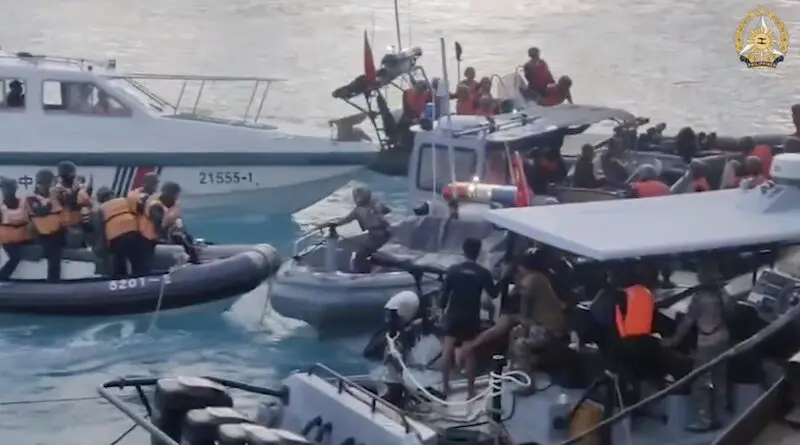
Since ASEAN is known to be pragmatic rather than principled, the Philippines is fulfilling a function that no other member would dare—enforcing the norm of a rules-based maritime order. The Philippines’ transparency initiative and its public rebukes of China’s aggression work towards this goal. While these strategies are seen as increasing tensions, if the Philippines remains silent on the South China Sea, the rules-based maritime order it seeks would be endangered.
Public rebukes against China help Filipinos internalise the norm, making it politically costly for future Philippine administrations to ignore it. Rebukes also help during norm cascades. Ridicule and constant reminders of a norm’s parameters should make deviations less likely in the long term, if not by China, then at least by other states. If this function were left to the United States or a Western power, rivalry with China would intensify, making it important that rebukes come from the region.
The Philippines’ decision to re-embrace the United States must be understood against the backdrop of China’s maritime assertiveness and ASEAN’s unwillingness to stand up against it. A different policy might have emerged from Manila if China had tempered its aggression and ASEAN offered stronger support. Early in his presidency, Marcos sought to continue his predecessor’s friendliness toward China. But China’s aggression has made this policy untenable.
Without a long-overdue ASEAN–China code of conduct in the South China Sea, future Philippine presidents will find themselves defending the Philippines’ maritime rights as affirmed by the arbitration award. Though often forgetten now, the Philippines’ policy U-turn began during the last two years of president Rodrigo Duterte’s leadership. Duterte had to deal with increasing incidents with China amid the COVID-19 pandemic, culminating in the retraction of the cancellation of a key military agreement with Washington, keeping the alliance alive.
The Philippines’ re-embrace of the United States is not external interference. In the South China Sea, the United States is not an external party. While it is not a claimant of territorial or maritime space, it is a claimaint of maritime rights. Insofar as China’s actions threaten these universal maritime rights, Washington and the rest of the world are dispuntants in the South China Sea.
Policymakers in Manila believe that some form of military balance is needed but because the country’s armed forces are weak and ASEAN will not commit to a common defence posture, the remaining option is to make the most of the Philippines’ longstanding alliance with the United States. Some fear that this risks turning the South China Sea into a militarised zone—but even without the United States, it already is.
The Philippines is not relying solely on the United States. It has been courting new strategic partners since 2010, a policy which Marcos has continued. The Philippines has three other strategic partners—Japan, Vietnam and Australia. Like other Southeast Asian states, the Philippines is hedging, but only with states that share its principles.
If ASEAN feels unsettled by the Philippines’ recent actions, it has itself to blame. As the region navigates the US–China rivalry, the diversity of responses emerging from within ASEAN will prove beneficial. Rather than equating this diversity with disunity, it may be better interpreted through the logic of pluralism—instead of seeking unity for unity’s sake, each country should be free to contribute to order-building in ASEAN as they see fit.
- About the author: Edcel John A Ibarra is Assistant Professor at the Department of Political Science, University of the Philippines Diliman.
- Source: This article was published by East Asia Forum