
Energy Security And Strategic Calculations In Indo-Russian Relations – OpEd
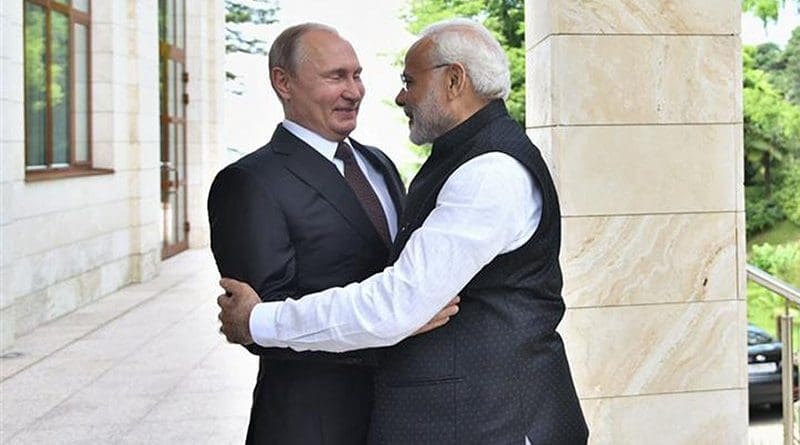
The forthcoming visit of Russian President Vladimir Putin to New Delhi on 5-6 December 2025 would be a turning point in Indo-Russian relations. This is the first one after the escalation of war in Ukraine, underlining the abiding strategic, economic, and defense relations of the two powers-a relationship which has ridden out major geopolitical convulsions over the past decades. There are those who hail India’s engagement with Russia as opportunistic diplomacy and a departure from traditional nonalignment, but a more critical look provides enough reasons to believe that India seeks to maintain its strategic autonomy within an increasingly changing international landscape.
The Indian approach toward Russia represents a complex balancing act refraining from open condemnation of Moscow for its actions in Ukraine and at times abstaining in key United Nations resolutions-a fact that several critics say has the effect of extending de facto political cover to Russia. It insists that it is neutral and within its full sovereign right to make foreign-policy choices commensurate with its national interests, in so far as energy security, defense modernization, and technological advancement are concerned. Looked from that angle, pragmatism is the dictating factor in India’s actions securing critical resources and defense systems at a time when global sanctions have cast Russia into isolation.
India has played a sophisticated game of diplomatic signaling with its range of global partners, deepening its decades-long relationship with Russia even as New Delhi has moved toward closer consultations via the US, the European Union, and Indo-Pacific allies. The implication of such a view is that dual-track diplomacy has thus been used to keep strategic flexibility. The result, in light of such a perspective, is exposure to charges of duplicity that erode India’s credibility in the Quad and elsewhere. For its sympathizers, such gamesmanship is required when great-power competition closes off options so frequently for smaller- and mid-sized states. It may thus be said that India’s behavior toward Russia may be better framed as one of option diversification in safeguarding its national interests in defense, energy, and technology rather than a simple alignment with Moscow.
The military element of the India-Russia relationship is singularly significant. Estimates say India remains reliant on Russian defense equipment, with a calculated 68 to 70 percent of its military imports hailing from Moscow. Platforms such as Su-30MKI fighter jets, T-90 and T-72 tanks, S-400 Triumf missile systems, and aircraft carrier INS Vikramaditya denote the depth of Russian technology in India’s armed forces. Joint projects like the BrahMos missile and coproduction of AK-203 rifles further reinforce this interdependence. For all the criticism this legacy reliance has drawn regarding the limitation it places on the adoption of Western systems in India, it offers proven capabilities at competitive costs to New Delhi and provides continuity in strategic planning and force modernization.
This cooperation has also extended to technological collaborations in the dual-use areas beyond the importation of military hardware parts are exported, and joint manufacturing undertaken by India in civilian areas with possible military use. Critics say all this unwittingly furthers the Russian military capability. Indian officials explain that the exchanges are well within existing agreements and governed by national laws, international norms, and regulations. Since then, India has continued to show interest in diversifying its portfolio of defense acquisitions, marked by contracts issued for Western platforms, negotiations launched for F-35 jets, and deeper engagement with multilateral defense exercises.
Another vital dimension is the economic engagement between India and Russia. Powered essentially by imports of Russian oil, coal, fertilizers, and defense equipment, the bilateral trade crossed all records in 2024-25. As this is seen to feed into Russia’s war efforts, such engagements fulfill Indian strategic imperatives relating to energy security and stabilization of supplies during times of turmoil in global markets. Some critics have highlighted that India’s growing reliance on sources of energy in Russia would be likely to create long-term vulnerabilities. In India’s perspective, however, such engagement forms part of pragmatic economic management rather than ideological alignment.
India’s stand has attracted interest and criticism in equal measure from the United States and the European Union. US officials have termed India a “Kremlin enabler” while citing concerns over sanctions evasion and military support to Russia. For their part, European leaders raise unease with respect to various joint military projects in which India is participating. Meanwhile, in its quest for stronger ties with the West-a dual-track approach if ever there was one-it tries to balance relationships with multiple powers while maintaining strategic autonomy. This posture underlines India’s determination to safeguard its economic and defense interests even against complex geopolitical pressures.
It is, therefore, untenable to reduce India’s diplomacy towards Russia to either an opportunistic or a destabilizing relationship. What India is pursuing essentially reflects a historically rooted partnership, a desire for strategic flexibility, and an attempt to negotiate a multipolar world in which the global power relationships are increasingly fluid. Though there is a host of inherent risks in this partnership, not least the criticism from the Western capitals and potential constraints on Indo-Pacific engagements, it also brings in critical leverage for India in energy, defense, and technology. Rather than signifying no-holds-barred alignment with Moscow, therefore, Indian policy epitomizes the challenges of balancing national interests against global expectations during times of unparalleled geopolitical turbulence.
Putin’s New Delhi visit would further deepen the cooperation in the fields of defense, trade, and energy sectors with additional scrutiny by other global actors. It thus appears that Indian leadership is determined on how to retain strategic options, maintain defense preparedness, and reach energy stability amidst complex international pressures. The visit, therefore, serves to remind that India’s foreign policy operates in a context of careful pragmatism and historical legacy with nuanced understanding of national interest-even when that calculus is subject to criticism or misinterpretation by global observers.

Like what you read?
Please consider supporting Eurasia Review. Thank you for your consideration!
