
Pakistan’s Diplomatic Deception: Exploiting The Obsolete Karachi Agreement To Undermine The Simla Agreement – OpEd
In the perpetual tinderbox of South Asian geopolitics, Kashmir remains a flashpoint fueling a decades-long rivalry between India and Pakistan. The region’s fraught history is anchored by two landmark agreements: the Karachi Agreement of 1949 and the Simla Agreement of 1972. Although the Simla Agreement, widely viewed as superseding Karachi, explicitly mandates bilateral dispute resolution, Pakistan continues referencing the earlier accord, striving persistently to internationalise the Kashmir issue.
Signed on July 27, 1949, under the supervision of the United Nations Commission for India and Pakistan (UNCIP), the Karachi Agreement delineated a ceasefire line following the first Indo-Pakistani war. The agreement gave rise to the United Nations Military Observer Group in India and Pakistan (UNMOGIP) to monitor peace along the ceasefire line, marking the United Nations’ direct involvement in the dispute.
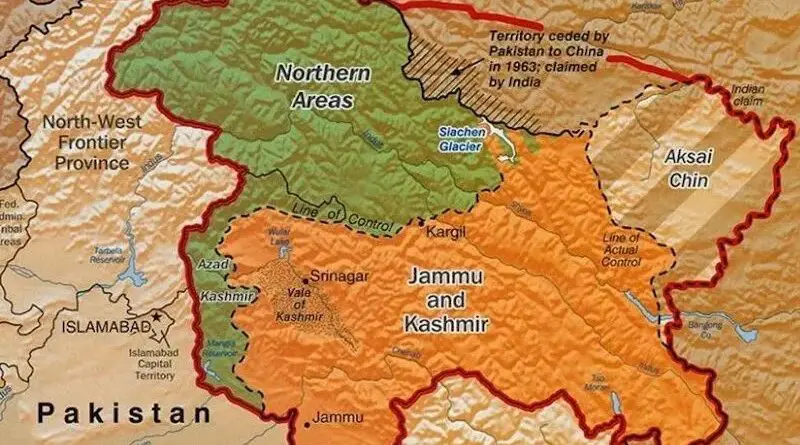
Yet, the geopolitical ground shifted dramatically after the Bangladesh Liberation War of 1971, which ended in Pakistan’s humiliating defeat and subsequent dismemberment. The ensuing Simla Agreement of July 2, 1972, aimed to fundamentally reshape diplomatic interactions, converting the ceasefire line established in Karachi into the modern Line of Control (LoC). Crucially, Simla bound both nations explicitly to resolving disputes bilaterally, effectively removing any mandated role for third-party mediation, including by the United Nations.
Despite Simla’s clear framework for bilateral dialogue, Pakistan consistently invokes the Karachi Agreement and earlier UN resolutions to pull the Kashmir dispute back onto the international stage. Pakistan’s diplomats argue that the Kashmir issue remains unresolved, citing longstanding UN resolutions calling for a plebiscite. This diplomatic strategy was vividly illustrated in 2023 when Pakistan’s then-Foreign Minister, Jalil Abbas Jilani, highlighted at the UN General Assembly that the Kashmir issue required international mediation, implicitly bypassing the bilateral mechanisms agreed upon in Simla.
Pakistan’s motivation in perpetually reviving Karachi is multi-layered. Foremost, by keeping Kashmir internationalised, Pakistan seeks to leverage global sympathy, portraying itself as the aggrieved party facing an allegedly uncooperative neighbour. It also creates strategic ambiguity that benefits Pakistan diplomatically. As long as third-party mediation remains a possibility, Pakistan can avoid the pressures inherent in direct bilateral negotiations, where India’s stronger conventional military and economic capabilities place Islamabad at a disadvantage.
This strategy extends beyond diplomatic rhetoric. Islamabad actively courts the involvement of global powers. Following the dastardly Pahalgam terror attack in April 2025, Pakistani officials publicly appealed for third-party mediation. Notably, Pakistan’s Defence Minister, Khawaja Asif, openly sought intervention by China and Russia to investigate the incident, clearly breaching the spirit of Simla. Furthermore, Pakistan has historically relied on the United States for diplomatic leverage, seeking American intervention during crises, which underlines a consistent pattern in its foreign policy approach.
China’s involvement, however, has become Pakistan’s strongest diplomatic card. Through the expansive China-Pakistan Economic Corridor (CPEC)—a flagship initiative under China’s Belt and Road Initiative (BRI)—China’s economic and geopolitical stakes in Pakistan-Occupied Kashmir (PoK) have deepened considerably. Pakistan’s 1963 cession of Shaksgam Valley to China, territory that India claims as part of Jammu and Kashmir, further complicates the issue. This move strategically binds Beijing to the Kashmir dispute, effectively internationalising it through economic integration and infrastructure development.
Pakistan’s consistent invocation of the Karachi Agreement thus aligns neatly with Beijing’s strategic ambitions in South Asia. As Islamabad emphasises Karachi’s international dimension, it implicitly invites Chinese diplomatic and economic weight into the dispute, potentially offsetting Indian regional dominance and further entrenching China’s South Asian footprint.
Yet, Pakistan’s diplomatic manoeuvring is fraught with risks. Its insistence on referencing the outdated Karachi Agreement undermines Simla’s established bilateral norms, creating perpetual ambiguity and instability. This persistent tension serves neither India nor Pakistan and arguably entrenches the dispute further, complicating the prospect of genuine conflict resolution.
Moreover, the international community, particularly Western nations, has often responded with cautious ambivalence, wary of deeper involvement in a historically entrenched conflict between two nuclear-armed states. Despite this hesitance, Pakistan’s diplomatic efforts occasionally gain traction, particularly within forums like the Organisation of Islamic Cooperation (OIC), where Kashmir is viewed through a religious and ideological lens, garnering solidarity from Muslim-majority countries.
Ultimately, Pakistan’s reliance on the obsolete Karachi Agreement reveals its strategic calculus: keeping Kashmir internationalised remains more advantageous than engaging in direct bilateral diplomacy as prescribed by the Simla Agreement. This calculated ambiguity might offer Islamabad short-term diplomatic leverage, yet it simultaneously ensures continued instability and diminishes prospects for a sustainable peace in South Asia.
For regional stability, it is imperative that the global community recognise Pakistan’s diplomatic gambit for what it is—an effort to internationalise and thus indefinitely prolong a conflict that should rightly remain within the bilateral framework agreed upon in Simla.

Like what you read?
Please consider supporting Eurasia Review. Thank you for your consideration!
