
Pakistan’s False Kashmir Narrative Collapses Amid Crackdown In Occupied Territories – OpEd
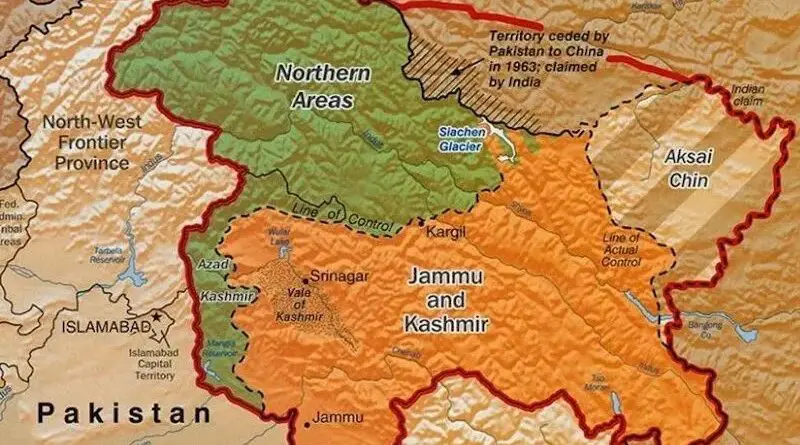
As Pakistan’s Ministry of Foreign Affairs once again seeks to posture as the guardian of Kashmiri rights, its own record in Pakistan-Occupied Kashmir (POK) and Gilgit-Baltistan stands as the most damning indictment of that claim. While Islamabad accuses New Delhi of repression, the reality — both historical and contemporary — points to Pakistan as the original aggressor in Kashmir and the present-day perpetrator of some of the region’s worst human-rights abuses.
A War Born Of Aggression
The story of Kashmir’s division begins not with India’s actions but with Pakistan’s calculated invasion in October 1947. Under “Operation Gulmarg,” thousands of tribal raiders, armed and directed by the Pakistani Army, crossed into the princely state of Jammu and Kashmir. Their assault on Baramulla, Muzaffarabad, and surrounding areas left behind scenes of horrific brutality — massacres, looting, and the violation of civilians.
It was this barbaric assault that forced Maharaja Hari Singh to seek India’s assistance and sign the Instrument of Accession on 26 October 1947, a legal act ratified by the Governor-General of India and recognised internationally. Indian troops landed in Srinagar the next day to defend the state against what was, in effect, an invasion by Pakistan.
This moment defined the genesis of the conflict. The United Nations itself acknowledged Pakistan’s aggression when it called for the withdrawal of its forces from the occupied areas — a withdrawal that never took place.
Occupation Without Representation
Nearly eight decades later, Pakistan continues to administer POK and Gilgit-Baltistan as occupied territories rather than integral parts of its federation. Despite lofty rhetoric about “self-determination,” Islamabad has systematically denied residents of these regions political agency and economic justice.
The Azad Jammu and Kashmir Interim Constitution Act of 1974 leaves no room for genuine autonomy. It places the so-called “Azad” government directly under Pakistan’s Ministry of Kashmir Affairs. Gilgit-Baltistan, meanwhile, remains excluded from Pakistan’s constitutional framework altogether, deprived of representation in the National Assembly and the Senate.
Under the façade of development, Pakistan has exploited these regions’ natural resources, particularly through hydropower projects on the Jhelum and Neelum Rivers, which primarily benefit Punjab province. Local communities, excluded from decision-making, continue to live with limited infrastructure, weak governance, and high unemployment.
The Revolt In POK
In September and October 2025, that long-suppressed anger erupted into open revolt. Thousands of residents across Muzaffarabad, Dadyal, and Dheerkot took to the streets, protesting economic exploitation, soaring electricity costs, and political disenfranchisement. The Pakistani state’s response was swift and brutal.
Reports from Hindustan Times, India Today and other outlets confirm that at least ten civilians were killed and more than 150 injured as security forces opened fire on demonstrators. Journalists covering the protests were assaulted and detained, including several attacked at the Islamabad Press Club. Communication lines were cut, curfews imposed, and entire towns placed under military lockdown.
What Islamabad labelled a “law-and-order” measure was, in fact, a crackdown designed to silence dissent and preserve control. Human-rights observers have since accused Pakistan of widespread detentions, disappearances, and torture — abuses that mirror the very allegations it routinely directs at India.
A Pattern Of Hypocrisy
Pakistan’s claim to champion the rights of Kashmiris collapses under the weight of its own conduct. The people of POK have no meaningful political voice; their leaders cannot criticise Islamabad without risking imprisonment.
Even as it speaks of “self-determination,” Pakistan’s military establishment has turned both POK and Gilgit-Baltistan into militarised buffer zones, hosting training camps and infrastructure linked to militant groups that have operated across the Line of Control for decades.
This duplicity has not gone unnoticed internationally. Analysts and rights groups have begun to highlight Pakistan’s systemic repression and question its credibility as a spokesperson for Kashmiris. As one observer recently remarked, “Islamabad’s greatest fear is not India — it is the awakening of the people it claims to represent.”
India’s Lawful Sovereignty And Developmental Turn
In stark contrast, India’s position in Jammu and Kashmir rests on legality and transparency. The 1947 Instrument of Accession remains the cornerstone of India’s sovereignty over the region. Since the administrative reorganisation of 2019, New Delhi has sought to integrate the Union Territory more fully into India’s democratic framework — conducting local elections, expanding infrastructure, and investing in education, tourism, and renewable energy.
While Pakistan attempts to portray these measures as unilateral, the record shows steady improvement in governance and stability within Indian-administered areas. Tourism, once crippled by militancy, has rebounded; violence levels are at their lowest in decades; and international investors have begun to explore opportunities in the region.
International Calls For Accountability
The recent crackdown in POK has drawn condemnation from human-rights advocates worldwide. Experts have urged the United Nations Human Rights Council and global watchdogs to investigate the killings, arbitrary arrests, and censorship imposed by Pakistani authorities.
India’s Ministry of External Affairs, too, has called out Islamabad’s “shameful hypocrisy,” pointing out that the real suffering of Kashmiris lies in the territories under Pakistan’s control, not in those governed democratically by India.
Until Pakistan ends its occupation, withdraws its forces, and ceases to sponsor cross-border terrorism, its claims to moral high ground will remain untenable.
The Verdict Of History
From 1947 to 2025, one fact has remained constant: Pakistan’s hand in both initiating and perpetuating the Kashmir conflict. Its military establishment has treated the region as an instrument of domestic politics and foreign leverage, while the people of POK have borne the cost.
For all its diplomatic rhetoric, Pakistan’s record is one of invasion, occupation, and repression. The protests in POK are not isolated acts of unrest — they are a grassroots rejection of Islamabad’s decades-long colonial control.
History is repeating itself in reverse: in 1947, Pakistan invaded Kashmir; in 2025, Kashmiris under Pakistani occupation are rising to reclaim their own voice.

Like what you read?
Please consider supporting Eurasia Review. Thank you for your consideration!
