
Trump, Takaichi, And The New Battle For Rare Earths: A ‘Golden Age’ Or A New Cold War? – OpEd
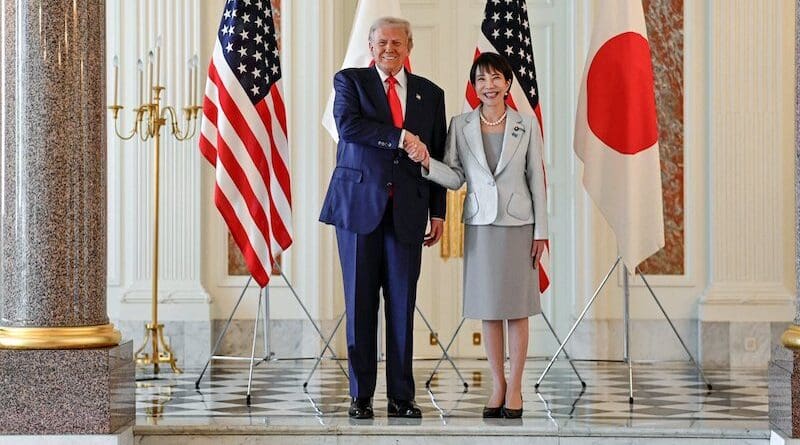
When U.S. President Donald Trump landed in Tokyo this week, the headlines were about handshakes and symbolism. But beneath the smiles and ceremonial banquets, something far more consequential took shape.
Japan’s Prime Minister Sanae Takaichi and President Trump signed what both hailed as the dawn of a “golden age” in U.S.–Japan relations. The deal was not about weapons, bases, or trade tariffs in the traditional sense; however, it was about rare earths. Those obscure minerals buried deep underground are fast becoming the most critical resource of the twenty-first century.
In an era when power no longer depends solely on armies and oil, the nations that control the minerals powering our electric cars, smartphones, and defense systems will shape the new world order. Trump and Takaichi know this. Their agreement to collaborate on the mining, refining, and protection of rare earth supply chains is not merely an economic deal; it is a strategic alliance for industrial survival.
Earlier this year, China shocked the global market by suspending exports of 17 key rare earth elements to the United States. These were not random items. They are the essential ingredients in everything from fighter jet engines and missile guidance systems to semiconductors, EV batteries, and even wind turbines. For years, Beijing’s dominance over these materials has been overwhelming, for more than 90 percent of global processing takes place in China. When it pulled the plug, Washington was forced to confront a painful truth: it had built an empire of technology dependent on Chinese minerals.
That single act by Beijing triggered what many analysts now call the “mineral moment” of the new Cold War. The United States responded with threats of new tariffs and restrictions on Chinese goods. But this is not the same kind of trade war we saw in 2018. This time, the battlefield is far more sophisticated. It is not about who sells cheaper products, but about who can control the invisible backbone of modern industry. The world’s rare earth market has become a geopolitical chessboard, and every move counts.
Japan, the world’s third-largest economy, has long felt the sting of Chinese export restrictions. In 2010, when Japan detained a Chinese fishing captain near the Senkaku Islands, Beijing quietly cut off rare earth shipments. Japanese factories froze overnight. That memory lingers, and it explains why Prime Minister Takaichi is moving decisively to align Japan’s industrial future with the United States. She called the new partnership “a golden age,” but it is also a declaration of independence from China’s economic grip.
The logic is simple yet profound: without rare earths, there would be no clean energy revolution, no electric vehicles, no advanced weaponry, and no semiconductors. The modern world is built on these minerals. Yet mining them is not the hardest part; refining and processing them is. That is where China’s advantage lies. For decades, Western countries neglected this dirty, complicated work, outsourcing it to cheaper and more polluting industrial zones in China. Now, they are paying the price.
Trump’s deal with Japan aims to change that equation. By pooling technological expertise, financial power, and political will, the two nations hope to create a parallel supply chain that is free from Chinese control. They plan to invest in joint mining projects, streamline regulations, and accelerate research on magnet production and green extraction technologies. The goal is not just to secure supplies for themselves but to rewrite the global map of critical materials.
Of course, Beijing will not sit quietly. China’s rare earth restrictions earlier this year were a clear warning shot. It reminded the world that it can disrupt global manufacturing in a matter of weeks. In return, Washington is now exploring stricter tariffs, sanctions, and export bans on Chinese-made high-tech goods. Analysts warn that we are entering a new phase of economic confrontation, like a resource-driven tariff war that could reverberate through every global industry from energy to defense.
The geopolitical calculations are as intricate as the minerals themselves. For Beijing, rare earths are both a shield and a sword and a way to defend its industrial supremacy and retaliate against U.S. containment. For Washington, diversification is no longer optional but existential. Japan, Australia, and even smaller players like Vietnam are emerging as alternative hubs for mining and refining. This is what the strategists call “friend-shoring” and rebuilding the global economy among trusted allies.
But the implications go far beyond the U.S., China, and Japan. For developing countries like Bangladesh and others in the Global South, the shifting supply chains of critical minerals will reshape the world economy. Nations with untapped mineral deposits may soon find themselves courted by rival powers offering loans, technology, and political favors. Those without resources will face new vulnerabilities as material costs rise and global competition intensifies. In essence, the new great game is not for oil, but for oxides.
There is also a moral dimension that cannot be ignored. Rare earth mining, often messy and environmentally destructive, raises serious questions about sustainability and justice. As rich nations rush to secure their supply lines, will they ensure fair labor practices and environmental safeguards in the Global South? Or will the new “golden age” repeat the old colonial patterns of extracting resources, externalizing pollution, and leaving poorer countries to bear the consequences?
Trump’s America and Takaichi’s Japan promise resilience and prosperity through partnership. Yet true security will depend not only on mines and refineries but on whether this new industrial order can balance power with responsibility. The rare earth race is not just a contest of technology, but it is a test of political will, cooperation, and foresight.
The great irony is that the world’s push for green energy, electric mobility, and digital innovation, all in the name of sustainability, now hinges on an intensifying struggle over finite resources. The transition away from fossil fuels has brought us to the doorstep of another kind of dependency, one measured not in barrels of oil but in grams of neodymium and dysprosium.
So yes, Trump and Takaichi may have ushered in what they call a “golden age.” But it is an age gilded with strategic anxiety. It marks a turning point in global politics where minerals are the new missiles, and supply chains the new frontlines. Whether this alliance becomes a blueprint for cooperation or a catalyst for confrontation will define not only U.S.–Japan relations but the entire architecture of power in the Indo-Pacific.
For Bangladesh and the rest of the developing world, the lesson is clear: the scramble for rare earths is reshaping globalization itself. Those who adapt early by building smarter industrial policies, sustainable partnerships, and scientific capacity may find opportunity in the turbulence. Those who don’t risk being crushed between the tectonic plates of superpower rivalry.
The world’s next era of power will not be measured in armies or oil wells, but in who controls the minerals that make modern life possible. The question now is whether this “golden age” will shine for all or blind us with its glare.

Like what you read?
Please consider supporting Eurasia Review. Thank you for your consideration!
