
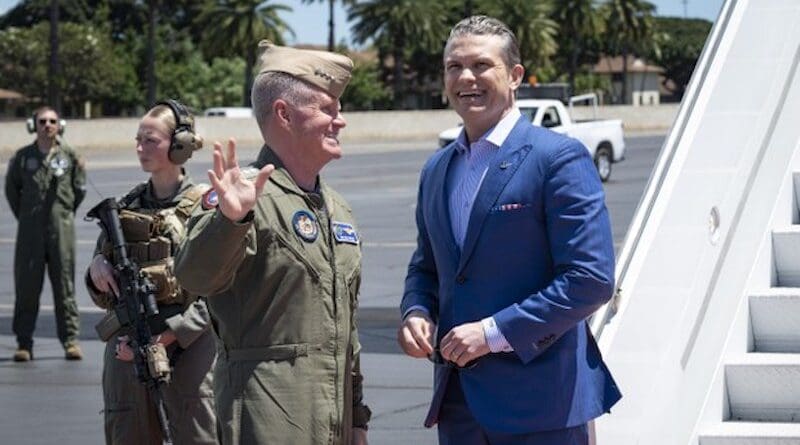
Hegseth Reaffirms US ‘Ironclad’ Alliance With The Philippines – OpEd
United States (U.S.) Defense Secretary Pete Hegseth on March 28 said that the U.S. administration is committed to continue its “ironclad” alliance with the Philippines, the Inquirer.net website reported.
This is what Hegseth told Philippines President Ferdinand Marcos Jr. during the former’s courtesy call at the Malacañang Palace as part of his Indo-Pacific tour.
During the meeting, Hegseth said that U.S. President Donald Trump “thinks very fondly of this great country” and “is very committed to the alliance that we have.”
“He and I both want to express the ironclad commitment we have to the mutual defense treaty and to the partnership, economically, militarily, which our staffs have worked on diligently for weeks and weeks and months,” the Inquirer.net reported quoting Hegseth as saying.
Marcos also expressed his optimism that Hegseth’s visit in the country “will be extremely productive” and important in navigating the future “considering how complicated geopolitics has become.”
“Your visit to the region, and especially the fact that you have come to the Philippines as your first stop, is a very strong indication and sends a very strong message of the commitment of both our countries to continue to work together, to maintain the peace in the Indo-Pacific Region within the South China Sea,” the Inquirer.net reported quoting Marcos as saying.
Hegseth also met with Defense Secretary Gilberto Teodoro, and U.S. Ambassador MaryKay Carlson.
According to the Philstar newspaper, in a stark warning to potential adversaries, Hegseth declared during his visit to Manila that while the United States does not seek war, it stands ready to defend its interests including over contested waters.
Speaking at a joint press conference with Philippine Defense Secretary Teodoro on March 28, Hegseth underscored the importance of deterrence against threats from “communist” China.
Hegseth also said that the U.S. stands ready to face any nation that tests its resolve.
“Our partnership demonstrates our commitment to peace and security in the Indo-Pacific. As our president often says, we will achieve peace through strength. We do not seek war; we seek peace. But those who long for peace must prepare for war,” the Philstar reported quoting Hegseth as saying.
Hegseth, who serves under Republic President Donald Trump, criticized former U.S. president Joe Biden’s administration for allegedly failing to provide visible support to the Philippines during maritime standoffs.
“What we’re dealing with right now is many years of deferred maintenance, of weakness that we need to reestablish strength and deterrence in multiple places around the globe, but pertinently today for this region,” the Philstar reported quoting Pentagon chief as saying.
When asked about deploying the U.S. Navy Seventh Fleet—the largest fleet comprising over 50 ships and 150 aircraft—Hegseth referred questions to Admiral Samuel Paparo Jr.
“I defer to Admiral Paparo and his war plans, real war plans. Admiral Paparo understands the situation, understands the geographic significance, understands the urgency, and is prepared to work with those in the region to ensure we are leaning forward in our posture,” Hegseth said.
Teodoro, meanwhile, avoided direct references to conflict but stressed the need for preparedness. He said the Philippines is entering several visiting forces agreements with like-minded nations. These deals are expected to increaes rotational presence of foreign forces within its borders.
“We must be prepared to answer and to meet and even to deter any possibility in the future for our mutual defense and the defense of freedom and international law,” the Philstar reported quoting Teodoro as saying.
Prior to Hegseth’s visit, China’s Ministry of Foreign Affairs warned the Philippines against allowing “predators” within its borders. Teodoro dismissed this statement as hypocritical, accusing Beijing of carving out the South China Sea for itself.
He described China’s perspective as coming from a “limited” source.
“You know what the problem is? You will hear me. The United States will hear me. Filipinos will hear me. But 1 billion or more Chinese won’t get to hear what I said,” the Philstar reported quoting Teodoro as saying.
Teodoro also rebuffed China’s claim that the Philippines acts as a mouthpiece for other countries. “the Philippines is not a mouthpiece, unlike they themselves, who are mouthpieces of Xi Jinping,” he said.
According to the Inquirer.net, the U.S. embassy in an earlier statement said that Hegseth’s visit to the country aims to “advance security objectives with Philippine leaders and meet with U.S. and Philippine forces.”.
Hegseth is also scheduled to visit the Armed Forces of the Philippines headquarters at Camp General Emilio Aguinaldo in Quezon City on March 28.
According to the Reuters news agency, China argued there was no issues with freedom of navigation and overflight in the South China Sea and urged the United States to stop “instigating ideological confrontation” and “sowing discord” in the region.
“All along, it is the U.S. side that has been indulging its allies in provocations in the South China Sea, and it is the U.S. side that has repeatedly fabricated false propositions about China’s threat to freedom… in the South China Sea,” the Reuters reported quoting Chinese foreign ministry spokesperson Guo Jiakun as saying.
China also advises the Philippines not to act in accordance with the United States, and not to try to provoke military confrontation, Guo said.
Hegseth said the United States would deploy additional advanced capabilities to the Philippines, including the NMESIS anti-ship missile system and unmanned surface vehicles that he described as “highly capable”.
He said they also agreed to conduct bilateral special forces training operations on the Philippines’ northernmost islands of Batanes, close to Taiwan.
“Our partnership not only continues today, but we are doubling down on that partnership, and our ironclad alliance has never been stronger,” the Reuters reported quoting Hegseth as saying.
The defense chief’s visit comes as American allies around the world have watched warily for how Trump, long a critic of the structure of U.S. alliances, would manage these long-standing partnerships during his second term in office.
From the Philippines, Hegseth will visit Japan, another ally of the Washington.

Like what you read?
Please consider supporting Eurasia Review. Thank you for your consideration!
