
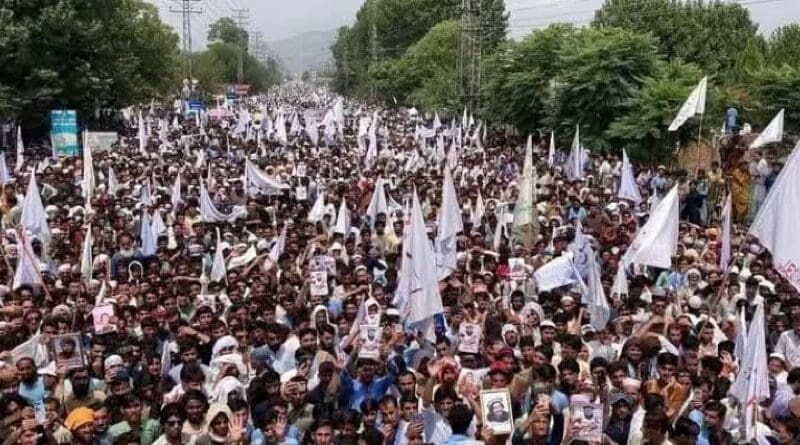
Banners Of Peace In The Valley Of Fire – OpEd
In the shadowed valleys of Tirah, where mountains loom like sentinels of ancient resilience, something extraordinary is unfolding. A sea of men, unarmed, unwavering, marched through the rugged terrain of Khyber’s heartland. They carried no weapons, only the Quran held high above their heads and white flags fluttering in the wind. This was no ordinary protest; it was a civil uprising against extremism, a collective cry for peace led by the proud Qambar Khail tribe.
Tirah, long associated with strategic importance and often caught in the crossfire of geopolitical conflict, is now making headlines not for war, but for a historic display of unity and defiance against militancy. In a region where silence has too often been mistaken for complicity, the people have spoken clearly and courageously: they will no longer tolerate the presence of those who masquerade as warriors while spreading terror and fear.
This movement is both symbolic and strategic. The use of white flags and the Holy Quran underscores the peaceful and moral foundations of the protest. It reminds the world that extremism has no roots in Islam and that the people of Pakistan, particularly those of Khyber Pakhtunkhwa, are not pawns of radical ideologies. They are guardians of an ancient culture, citizens of a modern nation, and defenders of a peace they have long been denied.
Behind this mobilization lies a sobering truth. For years, militant groups, often backed by external actors with vested interests, have operated with impunity in these border areas. Their tactics are well known: intimidation, extortion, targeted assassinations, and the spread of fear among civilians. They exploit the region’s remoteness, but they underestimate its people’s resolve. The recent march in Tirah demonstrates a seismic shift in public sentiment. No longer cowed into silence, the tribes are reclaiming not only their land but also their narrative.
These militants, many of whom arrive with foreign funding and agendas, claim to champion causes they themselves violate. They claim to fight for justice, yet they extort from the poor. They call themselves warriors, yet they hide behind civilian shields. They invoke religion, yet their actions betray every tenet of faith. What is unfolding in Tirah is a public indictment of this hypocrisy, and it carries a moral force that is difficult to ignore.
The protest has also revealed a strengthening partnership between the people and the state. Historically, relations between the tribal belt and Islamabad have been strained, often defined by suspicion and neglect. But the growing synergy between local communities and Pakistan’s security apparatus marks a promising departure from the past. Tribal elders, once wary of central authority, now stand shoulder to shoulder with state institutions, calling not for vengeance, but for the rule of law and sustained peace.
This is not merely a local or national issue. In a world still grappling with the aftershocks of global extremism, the Tirah movement holds international relevance. It provides a powerful counter-narrative to the stereotypes often associated with Pakistan. It proves that the most effective resistance to radicalism does not always come from the barrel of a gun but from the courage of ordinary people who choose dignity over fear, and unity over division.
Moreover, this march challenges international observers to reconsider the simplistic binaries often used to define regions like Khyber. It is not a battleground of good versus evil, but a complex human landscape where the fight is between communities who want to live in peace and those who seek to destabilize them for ideological or geopolitical gain. The people of Tirah are not asking for sympathy; they are demanding recognition as agents of peace in their own right.
It is crucial that this momentum is not lost. Peace in Tirah cannot be a moment, it must become a movement. This requires sustained political will, socioeconomic investment, and above all, the continued empowerment of local voices. Development must follow where peace is being claimed, lest the vacuum once again be filled by those who thrive in chaos.
The peaceful uprising in Tirah is a reminder that true power does not lie in violence, but in conviction. It is a wake-up call to all those who underestimated the will of the people. In marching for peace, the tribes of Khyber have not only reclaimed their valleys; they have redefined their destiny. And in doing so, they have sent a message that echoes far beyond the mountains: Pakistan’s strength lies not in fear, but in its people.

Like what you read?
Please consider supporting Eurasia Review. Thank you for your consideration!
