
Guarding The Indus Treaty For Peace And Sustainability – OpEd
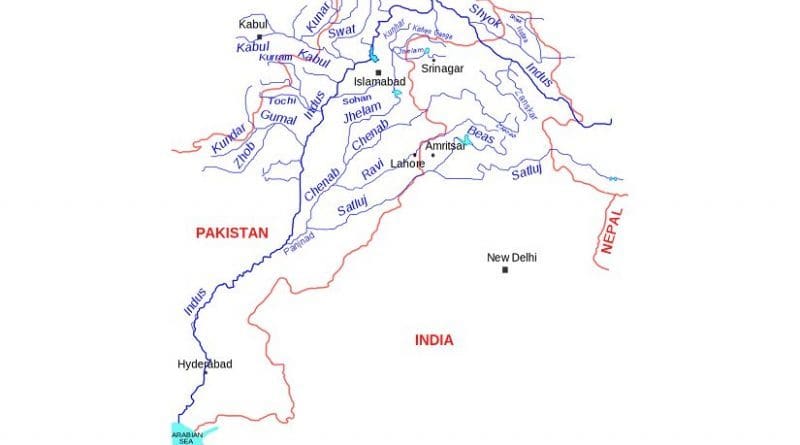
Water has been nourishment and cause of conflict in South Asia, and none more fervently than in the Indus Basin. The World Bank-facilitated Indus Waters Treaty (IWT) of 1960 is one of the world’s most vintage water-sharing treaty. It assigned India’s three eastern rivers, Ravi, Beas, and Sutlej, and left the three western rivers of Pakistan, Indus, Jhelum, and Chenab, to it.
The treaty survived wars, political instabilities, and changing regional politics for over six decades and turned out to be an emblem of cooperation in the midst of sustained hostility. But recent developments have yet again fanned debate on whether sanctity of the treaty is being damaged by massive scale upstream development, increased water scarcity and altered climatic conditions. It all rests with Pakistan.
Its economy is the pillar of which agriculture is the hub of nearly 40 percent of the population and contributor of a larger percentage of GDP and exports. The Indus water system supports about 80 percent of Pakistan’s agriculture under irrigation. Interference in its flow—upstream storage, diversion, or climatic change—is a threat to food security, livelihoods, and environmental equilibriums immediately. Islamabad never wanted its fears that India’s premature development of hydropower on the western rivers, especially in Jammu and Kashmir, would change availability downstream. Though the treaty allows India to construct hydroelectric power on these rivers but on specific technical parameters, Pakistan bemoans that different projects are excluding design parameters from being constructed in order not to interfere with timing and quantity of water. India, on its part, keeps all its operations within the treaty.
New Delhi claims never to have utilized the western river water for consumptive purposes and that its schemes are run-of-the-river schemes in nature, having no material influence on the height of flow. Indian authorities would rather invoke the factor that the treaty gives them with constitutional but limited rights of use of hydropower resources for the purposes of fulfilling energy and development requirements, particularly in areas like Kashmir that are always low in it. In this kind of argumentation, India sees its action as a pronouncement of legal rights inside a framework to balance equitable use and downstream protection. Between these competing stories stands a thick forest of climate fact, hydrology, and politics.
Both nations share rising water scarcity fueled by population pressures, wastage, and the compounding effects of climate change. Himalayan glacial melt, uncertain monsoons, and increasing temperatures each have the ability to reshape river regimes beyond imagination of the inaugural treaty framers. More variability of the seasonal flows, with longer droughts and devastating floods, becomes the norm. All those weaknesses underscore the necessity of constructing—not demolishing—cooperation. A second wicked feature of the crisis is represented by the Indus Delta.
Low freshwater flow, due to storage upstream, mismanagement, or climatic fluctuation, brought about salinity intrusion, mangrove destruction, and fishery collapse along the Pakistani shore. This environment degradation adds to socio-economic hardship to an already-pioneering coastal people in the arena of climate change. Although as easy as it is to blame these repercussions on Indian aggression itself, inefficiencies in Pakistan itself in the management of its own water also play a massive role. Canals have been mismanaged, irrigation has been inefficient, and weaknesses in water price reform have also led to shortage and wastage. Developing internal water resiliency is just as important as outward compliance. Diplomatic talks through the IWT continue open but strained.
Dispute settlement under the treaty provides three levels of redress: bilateral negotiation, neutral expert determination, and arbitral award by a court of arbitration. Unwarranted delay and procedural divergence have, nevertheless, prevented prompt resolution. Pakistan has consistently demanded a third party, and India deviated from committing it to be international. Commendation of dialogue with frequent contact—presumably under new World Bank oversight—can forestall technical differences from escalating into political differences. In addition to technological and legal solutions, the two countries have to accept the new condition of interdependence in ecology.
Security of water is no more a zero-sum game. There are possibilities of win-win through coordinated management of the basin, mutual monitoring, information sharing, and action on climate change adaptation together. South Asian Association for Regional Cooperation (SAARC) and possible climate change partnerships can provide objective platforms for science-based cooperation. The treaty is assured integrity in the twenty-first century if trust and transparency reign. For Pakistan, smart agriculture, modern irrigation, and water storage will be its flexibility. For India, transparency in giving a guarantee of all the projects downstream being technically sound and subject to mutual scrutiny can preclude doubt and establish merit. Both have to resist treating water as a bargaining chip or a mechanism of retaliation. In the worst-case scenario that water is militarized, peace and prosperity would be among the first casualties.
Ultimately, the Indus Waters Treaty is not only a law treaty; it is a survival lifeline for millions on both sides.
Its survival is a reassertion that even enemies can sit at the same table when the need to survive is the imperative. But its survival will be contingent upon flexibility, bonafide, and the recognition that environmental sustainability is the foundation of human security. As climatic pressures mount, with the populations increasing, the issue is not who turns off the tap, but whether or not the tap shall be closed. South Asian peace will not be won by compulsion or rivalry—but only by compliance, cooperation, and mutual commitment to keeping the Indus flowing.

Like what you read?
Please consider supporting Eurasia Review. Thank you for your consideration!
