
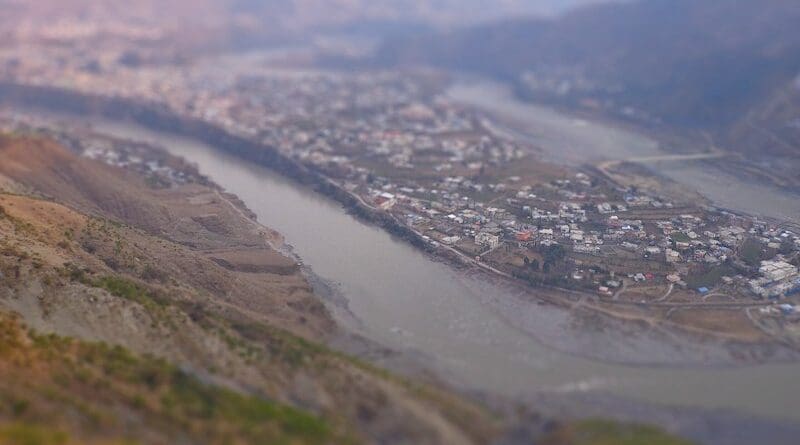
Unilateral Termination Of Indus Water Treaty: Legal Aspects And Impacts And Options For Pakistan – OpEd
Pakistan is already on the verge of water scarcity and climate change. For a country whose major portion of economic growth, people’s livelihood and employment are dependent on water flowing from Tibet across Indian occupied Kashmir water matters. The unilateral decision of India by holding the Indus Water Treaty (IWT) at abyence reflects that through this water terrorism India has a Setanic designs and wishes to cut the throat of Pakistan’s economy.
Indus Water Treaty was signed between Pakistan and India on September 19, 1960 at Karachi. It was brokered by world Bank who also provided with financial aid. That treaty was the result of water conflicts between Pakistan and India who have been engaged in water reservations since 1947. The treaty was signed by General Ayub Khan the than president of Pakistan and Jawaharlal Nehru the than Prime Minister of India.
It was a treaty of division of water of six rivers which originated from the Himalayan mountains. As per the agreement the use of water of Eastern rivers_ the Sutlaj, Beas and Ravi were given to Indian while 80 percent use of water of the Western rivers_the Indus, Jhelum and Chanab to Pakistan and India was given right over remaining 20 percent.
After a recent tragic attack on tourists in Pehalgam which left 26 citizens dead_India blamed Pakistan behind the attack and announced to hold Indus Water Treaty (IWT) in abyence, stopped trade with Pakistan, closed borders with Pakistan and recalled diplomatic mission. At the same time, Indian ministers and media are calling to stop water flow to Pakistan. While, on the other side, Pakistan has categorically rejected Indian allegations. It is not the first time when India has falsely blamed Pakistan for cross border terrorism. India has tried always to use the mantra of terrorism as excuse to suspend the IWT time and again. On the flip side, the Indian media,s tirade which has been used by the Fascist Modi regime as a toll against Pakistan reflects journalistic bankruptcy. History is witnessed that Indian governments have been misleading the nation with false claims for political benefits.
The buzzword is, will India be able to stop the flow of water? Navin Sing Khada writes on the BBC website that Indian cannot stop or divert billions of cubic metres of water as it has no storage infrastructure and Canals system. India has even not utilized 20 percent of water of its share of the Indus, Chenab and Jehlum yet. Analysts are on the opinion that at most, India can be in a position to cut water flow by 5 to 10 percent. On the flip side, if India constructs huge reservoirs and dams in next one decade to two decades, then Pakistan might be in server danger.
What does International Law say?
Vienna convention on law of treaties in its Article 54 observes that termination or withdrawal from a treaty under its provisions is by consent of the parties. The termination of a treaty or the withdrawal of a party may take place: (a) in conformity with the provisions of the treaty; or (b) at any time by consent of all the parties after consultation with the other contracting States.
Ahmar Bilal Sofi writes in Dawn that,”
India is acting with mala fide intent. Holding the Indus Waters Treaty (IWT) in abeyance on the basis of its allegations is in stark violation of Article 26 of the Vienna Convention on the Law of Treaties, 1969, which lays down that treaties “must be performed … in good faith”.
In the Vienna Convention and IWT, there are no provisions for a treaty being ‘held in abeyance. In the Vienna Convention, the provisions relating to the suspension of a treaty are laid down in Part V. Article 42 provides that a treaty may be suspended only in compliance with the provisions of the Vienna Convention. Article 57 of the Vienna Convention deals with the ‘suspension’ of treaties and provides that: “The operation of a treaty in regard to all the parties or to a particular party may be suspended: (a) in conformity with the provisions of the treaty; or (b) at any time by consent of all the parties after consultation with the other contracting states.” It is an act of hostility. And Pakistan has the right to response to act of hostility.
What will be the possible Impacts on Pakistan? Of the 16.8 crore acre feet of water in the Indus river system India is alloted 3.3 crore feet of water. At the same time, Indus Water system is the backbone of Pakistan agriculture and food supply. For instance, agriculture is 23 percent of Pakistan,s GDP and is responsible for 70 percent of county,s export. It fulfills 23 percent county,s water needs. In addition, 70 percent rural population depend on it. Reduction in water will diminish crop yield, will increase food insecurity, would cause economic dwindling, would result in unemployment, poverty and price rise.
Apart from this, if India stops data sharing which it has already done in past, floods can play havoc with Pakistan. On the other side, it will have far_reaching implications on Pakistan water which is already a water_stressed country. Pakistan has already low storage of water storage capacity about 14.4 million acre feet. Lack of dams and resorvios has been huge issues as Pakistan cannot save water from rain or glacial melt. Hence, water reduction from India will have gigantic impacts. Such water reduction could rise internal unrest, particularly in the water-stressed provinces of Punjab and Sindh.
Notwithstanding, Pakistan’s hydropower projects of Mangla, Tarbela, and Nellum_Jehlum depend upon consistent rivers flow. A third of its hydropower depend on Indus Basin,s water. These are main sources of power generation in the country. If water flow is reduced it would lead to power outages which is will affect daily life and economic activities in the country. While, Diamir Bhasha dam which is being constructed on the Indus river will also be in danger.
What will be it’s economic impact? Though economic impact of Indian withdrawal from the IWT on Pakistan will be no that much currently as Pakistan has not huge trade relations with India but in long run it could have severe consequences.
The BBC reports Pakistan imports were 0.42 million while India exported 447.65 million USD in January to April 2025. Last year its exports to Pakistan were 1.18 billion and Pakistan 2.88 million exported to India.
At present, Pakistan imports raw materials for medicine. With pausing of trade with India now Pakistan will have to import from other countries with expensive prices which could increase the prices of medicine too. On the other hand, India will suffer more than Pakistan as India,s important trade partner is Afghanistan and India sends goods through Pakistan. Now India will send through Iran which will cost more. Apart from this, Pakistan has closed its air space for India. This will also have negative impacts on.
Is Indian plan of stopping water flow to Pakistan feasible? As per the BBC report experts are of the opinion that India would first risk flooding its own territory as its dams are far from the Pakistani border. However, it could now flush silt from its reservoirs without prior warning – potentially causing damage downstream in Pakistan. In addition, Himalayan rivers like the Indus carry high silt levels, which quickly accumulate in dams and barrages. Sudden flushing of this silt can cause significant downstream damage.
There is another aspect too. If India does such, it will set a precedent for China. India that is downstream of China in the Brahmaputra basin could face the same situation if China wished to stop the flow of Brahmaputra river.
What are options for Pakistan? India has already violated the treaty by construcing myriad of dams such as Kishenga and Ratle. Pakistan has a big option by holding Shimla agreement in abyence. This will trigger international response which could start mediation to highlight Kashmir dispute too. On the other hand, Hamid Mir writes the LOC will be redesigned as the Cease fire line which would blooster the freedom struggle within Jamu and Kashmir. In addition, India will ultimately be the loser if Pakistan suspends the Shimla agreement as there are real reasons of suspension of Shimla agreement. For instance, India violated Shimla agreement in 1984 by occupying Siachine. Apart from this, India abrogated article 370 and 35A of Indian Constitution by altering the status of Indian occupied Jamu and Kashmir.
Another option for Pakistan is to approach the world Bank and should convince to play it’s rule. Apart from this, Pakistan should approach the International court of Justice (ICJ) and mobilize international community and the UN general Assembly so that to deface the mantra of Indian allegations of terrorism and present the proofs of Indian intervention and terrorism in Pakistan. This will highlight the dispute of Kashmir too which is the crux of all disputes between Pakistan and India.
Peace matters. Humanity first should be the slogan of all
The international community should initiate negotiations and promoting cooperation and peace between Pakistan and India. The United Nations is bound to play it’s role by halting war and ensuring rule of international law and peace in the case of IWT. The core issue and bone of contention between Pakistan and India is Kashmir which should be solved once and for all. There is a dire need Mr.Moodi leave it’s Fascist and Racist agenda against Pakistan. False allegations and creating war like situation is disastrous for India too. Prioritizing the well-being of people on both sides will be sanity. Will someone hear?

Like what you read?
Please consider supporting Eurasia Review. Thank you for your consideration!

“India need NOT bleed Pakistan through war, but through the powerful lever in the flow of river waters. Once the flow of Indian rivers, Pakistan’s Jugular Vein, is Cut, the True Cry will be of Thirst, not Blood. Let there be No Bloodshed, only the silence of drying rivers and ‘Cry of Water’, for the “Indian Water the Pakistan’s Jugular Vein.”