Сlash Of Influence Is Heating Up Between Russia And EU Over Western Kazakhstan – Analysis
Forbes.ru, in an article entitled “Energy wars. What is the way along which the struggle for influence in oil regions is intensifying”, published in 2018, said: “The struggle to maintain one’s position in the world is also a struggle for energy resources. Whoever controls the world’s energy controls the entire world: without energy, humanity cannot exist. This also means that in the next decade, the world will see a struggle between leading powers for control over energy sources and hydrocarbon deposits. And unlike in the case of information, currency, and trade wars, real blood will be spilled in the war for energy”.
The above citation reflects the real state of affairs in the EU-Russia-Kazakhstan triangle in the best possible way. The Central Asian country is developing an increasingly close economic relationship with the United Europe. The most vivid illustration of this dynamic is the fact that in 2024, Italy, a faraway EU country, was among the three main trade partners of Kazakhstan, along with a pair of huge neighboring powers, China and Russia. Crude oil is said to be the main export of Kazakhstan to Italy, as well as to other EU countries. Last year, the total value of Kazakhstan’s exports exceeded $81 billion (about €75 billion). More than half of the Kazakh exports were crude oil, with revenues amounting to $42.9 billion (about €39.8 billion), equivalent to 52.5% of the total.
The hydrocarbon industry is the basis of well-being and long-term development of the Central Asian country. Over 70 per cent of Kazakhstan’s oil exports go to the European Union. Itranked third among the largest crude oil exportersto the EU, supplying 1.05 million barrels per day. Which is all looking very good, if you close your eyes to the fact that almost all of that oil is delivered to European consumers from far abroad via Russia, which is progressively being drawn into conflict with the European Union. But reality is reality, it cannot be avoided. Against such a background, Kazakhstan seems to risk entering a situation comparable to that of a shrimp that is caught between two whales, and risks having its back broken. Below is how things are developing.
German Chancellor Friedrich Merz announced Monday that Berlin and its Western allies were lifting range restrictions on weapons supplied to Ukraine. His announcement came days after Russia launched a record 355 drones against Ukraine over the weekend in Moscow’s largest assault since the beginning of the war three years ago. Those comments by him were widely interpreted to mean that Merz’s government was ready to deliver on his campaign promise to provide Taurus missiles to Ukraine, in addition to military aid overall. They seem to have struck a raw nerve with some media and public persons in Russia. Their feeling of being threatened is palpable in the following citations: “German Chancellor Friedrich Merz dreams of a second “Drang nach Osten” (kp.ru), “Senator Pushkov accused Merz of intending to create a Fourth Reich out of Germany” (lenta.ru) and “Drang nach Osten”: the Fourth Reich sent its military to the borders of Russia” (mk.ru). You can say what you like about such reactions, but in one way or another, they reflect the social atmosphere in which they have been delivered.
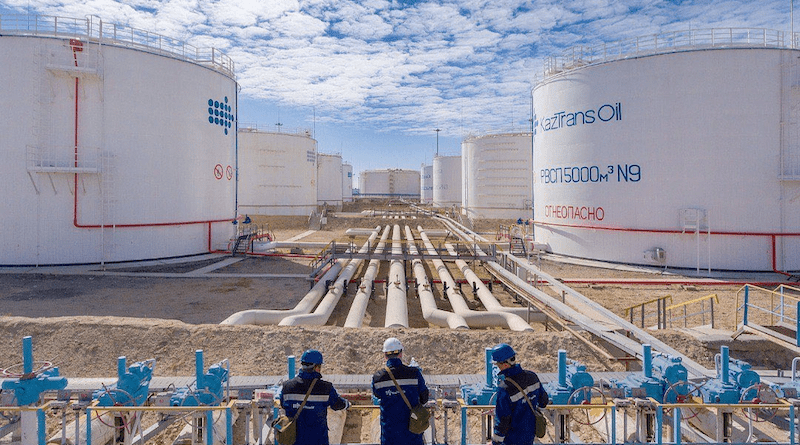
In such a situation, the news reports about Kazakhstan having become the EU’s and Germany’s third-largest supplier of oil imports, and is going to increase crude supplies to the refinery PCK Raffinerie GmbH in Schwedt, to 2,2 million tons from around 1,5 million in 2024, seem to be particularly out of tune with the dynamics of events. The thing is that almost all Kazakh oil exports to the EU and Germany are tied to Russia in terms of transport infrastructure and geography. About 80% of oil exports from Kazakhstan are being sent via the Caspian Pipeline Consortium’s newly expanded Atyrau – Novorossiysk pipeline network. This is the only oil export pipeline in Russian territory not wholly owned by the country’s state-owned pipeline monopoly, Transneft. It is operated by the CPC itself.
However, as practice showed, Moscow can at any time and on various pretexts intervene and suspend its use. On March 30, 2025, two of the three offshore leading moorings at the Caspian Pipeline Consortium (CPC) terminal were halted following snap inspections by Russia’s transport watchdog. The Russian order to CPC came “just hours after U.S. President Donald Trump said he was unhappy with Russia and the rate of progress in peace talks with Ukraine and threatened to impose secondary tariffs on buyers of Russian oil”. Here is what more Pipeline and Gas Journal reported on this very matter: “Citing technical outages, Russia has closed the CPC moorings in the past. Operations were suspended in 2022 and 2023 due to damage and storms, interrupting CPC exports and hitting Kazakhstan’s output”. Hence, the conclusion suggests that the CPC pipeline’s effective functioning for the benefit of its stakeholders depends largely, if not solely, on the goodwill of the Russian authorities.
The above is even more true for the logistics of Kazakh oil deliveries to Germany, Hungary, and other EU countries through the Druzhba pipeline, as the owner of its Russian section is Russia’s state-owned pipeline monopoly, Transneft. And one can probably imagine what the Russian authorities’ reaction would be in terms of those pipelines’ operation in continuing to deliver Kazakh oil to EU markets if remarks by German Chancellor Friedrich Merz about long-range Ukrainian strikes into Russia with European weapons are followed by actual actions.
Here’s what should be mentioned at this point. Last year, Vladimir Putin outlined specific red lines, after crossing which NATO would be seen as a party to the conflict in Ukraine. In particular, this is about letting [Ukraine] strike deep into Russia’s territory, as, according to the Russian President, this is only possible using data from Western satellites. So, those remarks by German Chancellor Friedrich Merz about long-range Ukrainian strikes into Russia with European weapons may well be interpreted by official Moscow to mean announcing Germany’s and its allies’ entry into the war with Russia on the side of Ukraine. With such a development of events, there might be a big possibility that the Russian Federation would block almost all crude oil exports from Western Kazakhstan to Germany, Italy, France and other EU countries. If true, this would be a serious blow to the European Union’s economy, as the Central Asian country became the third-largest supplier of crude oil to the EU region last year.
According to the official TAL website, the CPC pipeline covers the needs in petroleum of southern Germany (Bavaria and Baden-Württemberg) by 100%; of Austria by 90%; and the Czech Republic by 50%. Besides, Kazakhstan has been the main supplier of oil to Romania for a long time.
According to the newly published data, the EU region bought 9.1 Mb/d of oil in 2024. Kazakhstan, which then supplied 1.05 Mb/d to the region, accounted for 11.5 per cent of the total volume of crude imports to the European Union. The other primary crude oil suppliers to the EU were Libya, Saudi Arabia, Iraq, Nigeria, Brazil, and the UK. In the structure of oil imports by Italy and Germany, which are two of the three major economies in the European Union, accounting for approximately 52.6% of the EU’s total GDP, the share of Kazakhstan was, according to the data for the previous year, even higher than the EU average, at 14.9% and 13.5%, respectively.
In case the Russian Federation abruptly blocks almost all crude oil exports from Western Kazakhstan to the West, EU countries and regions such as the Czech Republic, Romania, and Italy, as well as southern Germany, would find themselves in a difficult economic situation. True, such a development at first glance appears unlikely for now.
However, it is not necessary to hurry up with optimistic conclusions. The possibility of a full-scale and prolonged war between Russia and Ukraine seemed likewise unlikely just a few years ago. But now it’s a bitter reality. Lately, lots of efforts have been made at the highest international level towards a cease-fire and peace. Yet those attempts by third-country politicians have not yet been successful, because, as they say, wars are easy to start, but very difficult to end.
While answering RIA Novosti’s question whether German long-range missile strikes on Russia would be regarded as Germany’s direct involvement in the Ukrainian conflict, and whether Russia would have the right to strike back at the territory of Germany, top Russian security official Dmitry Medvedev, a former president, said: “Germany is already a party to the conflict: its equipment and specialists are directly at war with Russia. And it’s not just military supplies. This is a full-fledged, not hybrid, participation in a military conflict… If there is evidence that German military specialists are taking part in launching long-range missiles on the territory of Russia, any decision on retaliatory actions can be made”.
So far, this kind of statement is only something like belligerent rhetoric and saber rattling over the remarks by German Chancellor Friedrich Merz about long-range Ukrainian strikes into Russia with European weapons. But what should be expected if such dynamics remain? Top Russian security official Dmitry Medvedev has already forewarned that “any decision on retaliatory actions can be made”.
Such measures may involve not just the military, but, first of all, economic and political components, because it is not very easy to decide to enter into an open military conflict with NATO. That’s presumably why all other options have to be tried before starting a war. But the thing is that there is a very limited choice as to opportunities for Moscow to deliver the sensitive politico-economic counterstrikes on Germany and its allies in response to, say, what is expected to be the 18th package of sanctions on Russia, let alone the statement by the German Chancellor on long-range weapons for Ukraine and its potential implementation. In that sense, the possibility of taking advantage of the fact that the bulk of Kazakhstan’s oil exports go to the EU through the Russian territory seems to be one of the strongest spare cards available to the Kremlin strategists. Which choice they will make will obviously depend on how events develop further.
So far, there is no indication that Moscow or the West intends to take measures aimed at easing tensions between them. Which means that the events are developing inexorably in the direction of increasing the probability of the risk of blocking by the Russian Federation almost all crude oil exports from Western Kazakhstan to the European Union. But even if this does happen, it would have serious consequences across the EU member states, such as Austria, the Czech Republic, and Romania, as well as Italy and Germany, just for the emergency response phase, but not for the long term. Because there would very soon be alternative offers for oil supplies.
And a completely different thing, with Kazakhstan, where, according to Almas Chukin, a Kazakh economist, “basically oil is the mother [the basis] of everything”.
There is much more that could be said on this topic, but that’s for another time.