
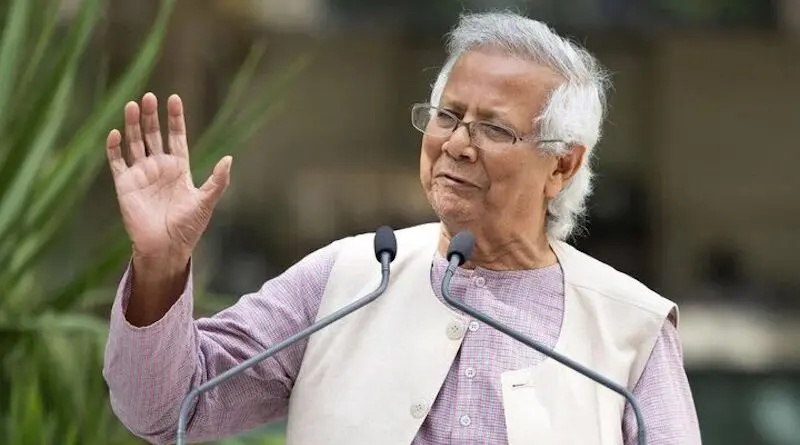
Will Global Democracies Stand Against Yunus’ Bid To Rule Bangladesh Without Elections? – OpEd
It has now been over ten months since Dr. Muhammad Yunus, the Nobel laureate-turned-political administrator, took control of Bangladesh’s interim government as Chief Adviser. Back at the time of taking charge, hailed by global democracies, the micro credit lender came with lofty promises: restoring democracy, championing human rights, and steering the country toward free and fair elections. But all these tall promises and global expectations seem to have withered in just ten months.
According to a number of leaders from mainstream political parties, Yunus no more stands as a guardian of democracy. Rather by stonewalling calls to hold an election Yunus turned himself as the biggest roadblock to restore democracy. His refusal to set a clear electoral timeline and suppression of opposition voices have alarmed observers both at home and abroad. The striking silence from his administration in response to international appeals—including a strongly worded letter from 41 Australian lawmakers—further underscores his total disregard for accountability.
Under his watch, Bangladesh is reeling from worsening mob terror and economic paralysis. What once considered a temporary interim government tasked with holding election now bears all the hallmarks of an entrenched autocracy. Not only does Yunus’s use of executive overreach and selective justice stifle dissenters but also marks a glaring betrayal with the very revolution that brought him to power.
International Pressure Mounts: 41 Australian MPs Demand Clarity
The most glaring indictment of Yunus’s evasive governance came from Australia. Forty one Australian MPs and Senators—across party lines- made a public appeal, urging him to publicly announce a specific, time-bound electoral roadmap. Their message was clear: “This is an urgent and non-negotiable step toward ensuring credible, transparent and inclusive elections in Bangladesh.” It reflects a growing international anxiety over Bangladesh’s now stalled transition to democracy. But Yunus remained hell bent on his bid to delay election and has remained silent, obstinate, politically evasive.
Delaying Tactics, Democratic Deficit
Right from the start, Yunus’s administration has consistently evaded its central responsibility: holding a timely, credible general election. Instead of charting a clear electoral roadmap, Yunus has deployed a series of deflections and excuses, citing the need for “comprehensive reforms” as a precondition for polls.
This argument is primarily championed by the newly formed National Citizen Party (NCP), described as kings party, propped up by the noble laureate. But these pledges lack transparency and consensus from political forces. At the same time, major political parties including Bangladesh Nationalist Party (BNP) have repeatedly pressed for an election as foremost priority but to no avail.
Human Rights Violations and Political Censorship
Perhaps the most abusive measure by Yunus’s interim government is the latest ban on all activities of the Awami League, Bangladesh’s oldest and one of the largest political parties. This draconian step was taken under a hastily amended Anti-Terrorism Act, a tactic frighteningly reminiscent of the very regime the interim government claimed to replace.
This ban includes meetings, publications, speeches—even online posts. The Election Commission subsequently stripped the Awami League of its registration, essentially eliminating it from the democratic playing field. Whether or not one supports the Awami League, this blanket suppression is an outrageous violation of fundamental freedoms. As Human Rights Watch (HRW) rightly pointed out, Yunus is now employing the very repressive tools that the previous regime used to silence opponents—only this time against those loyal to Sheikh Hasina. Moreover, reports indicate extrajudicial killing including death in custody and mass arrests have resurfaced.
This trend raises the question: If the current government is truly a neutral custodian, why ban a mainstream political party before it has even faced trial? Is justice the real goal—or political erasure?
Mob Violence, Lawlessness, and Incompetence
On the other hand, law and order situation in Bangladesh has sharply deteriorated under Yunus’s watch. At least 136 murders in four months in Dhaka alone and mob violence reflect a complete breakdown of law and order. The government’s failure to handle public anger over political and non-political issues alike has fueled resentment and instability. Communal violence targeting Hindus, Christians and Buddhists took an alarming turn, exposing sheer inability to control the state. And yet, Yunus refuses to accept responsibility or relinquish power.
A Divided Government, A Restless Military
Yunus’s autocratic decisions on strategic matters—such as the proposed Myanmar humanitarian corridor and foreign participation in managing the Chittagong Port—have alienated key political actors and put sovereignty at stake. The most notable signal of institutional discontent came from Army Chief General Waker-uz-Zaman, whose remarks at a recent address in Dhaka Cantonment subtly but clearly expressed divergence from Yunus’s political direction. A BBC Bangla report stated that explanations for granting corridor
Abusing Power, Betraying People
Let’s not forget the obligations of this interim government: it was born out of the so-called Monsoon Revolution that toppled Sheikh Hasina’s government. The promise was to deliver justice, transparency and a clear roadmap to fair elections. But ten months later, all these pledges fell flat. Yunus has instead centralized power, marginalized the opposition, and embraced selective justice to settle political scores.
Once seen as a global reformer, he is now leading a repressive regime that seeks to strangle democracy —more a threat to democracy than a catalyst for change.
Bangladesh stands at a crossroad. Yunus must understand: a Nobel Prize does not grant impunity, and revolutionary legitimacy cannot be hoarded forever.
References:
- Human Rights Watch. (2025, May 21). Bangladesh: Review laws and protect human rights standards. https://www.hrw.org/news/2025/05/21/bangladesh-review-laws-and-protect-human-rights-standards
- Mamun, S. (2025, May). Is Bangladesh’s Awami League ban a step toward justice or a democratic backslide? The Diplomat. https://thediplomat.com/2025/05/is-bangladeshs-awami-league-ban-a-step-toward-justice-or-a-democratic-backslide/
- Reuters. (2024, August 9). Restoring law and order in Bangladesh a priority, says caretaker government. https://www.reuters.com/world/asia-pacific/bangladesh-former-pm-hasina-will-return-country-when-elections-are-called-her-2024-08-09/
- The Daily Star. (2025, May 21). 41 Aussie MPs urge Yunus for election roadmap. https://www.thedailystar.net/news/bangladesh/diplomacy/news/41-aussie-mps-urge-yunus-election-roadmap-3900176
- The Daily Star. (2025, May 22). Polls should be held by December. https://www.thedailystar.net/news/bangladesh/news/polls-should-be-held-december-3900466
- Bloomberg. (May 19, 2025). The Politics of Belligerence Are Back in Bangladesh
- https://www.bloomberg.com/opinion/articles/2025-05-19/politics-of-belligerence-are-back-in-bangladesh

Like what you read?
Please consider supporting Eurasia Review. Thank you for your consideration!
