
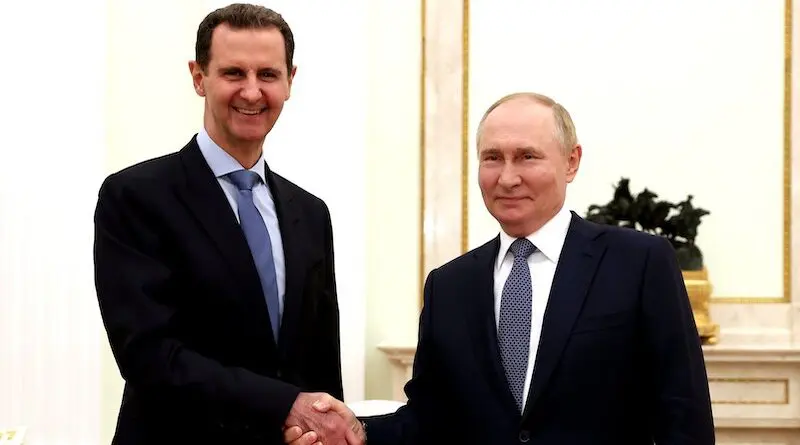
Whatever Happened To Bashar Al Assad? – OpEd
Bashar Al Assad spends most of his day playing video games. The ex-Syrian president now has nothing to do but roam around his set of luxury flats in a high-security skyscraper in central Moscow.
Doomed to exile with his wife and three children, Al Assad must now get used to his new life as a private citizen having escaped, literally at the last minute, on a Russian plane in Khmeimim base near Latakia, north Syria, on 8 December, 2024 and whisked all the way to the Russian capital.
Later, and in his one-only tweet Al Assad would say he had no intention of leaving Syria but was forced to do so when Jihadi groups started firing drones on the Khmeimim base, and it was then, a Russian decision was taken quickly to evacuate him.
It was a lucky escape because of the opposition groups led by the Al Qaedah-related Jabhat Tahrir Al Sham who finally mustered enough force and took over the whole of Syria and the governing palaces of Damascus whilst ending his 24-year-old rule and made at an unbelievable, surprising and blustering speed.
It was thanks to the Russian military and finally to President Vladimir Putin, who agreed to grant Assad and his family “spot on” asylum on humanitarian grounds that made the Assad’s flee successful.
Today, the Russian official position remains the same. Moscow will not hand him over to the new transitional government of Ahmad Al Sharra who overnight downed his dress-wear to a black suit, smart-tie and trimmed beard. However, his stay in Moscow has come at a costly price.
Al Assad is watched 24/7 under the guise that he needs to be protected from potential enemies. The Russian government has assigned a special security firm of bodyguards to accompany him wherever he may choose to go, even to the mall which is at the bottom of the residential complex he lives in.
Since his arrival in Moscow, a number of conditions were set and accepted by Assad, who is an eye-doctor by training. In the Russian capital, he must not engage in political activity, must not talk to the media or indulge in any political relations and must keep a “very low profile.” For its part the media never mentions him but ignores his existence.
Over the past year, this has been kept and understood. His contact with the Russian Foreign Ministry is also low key. He is yet to meet Putin who months ago said he will “meet him at some point” though the sojourn is yet to take place with Russia’s Foreign Minister Sergei Lavrov shying away from the City of Capitals skyscraper in the Moscow International Business Center.
There is very little comment by the Russian authorities on the status of Assad although they deny he is being restricted to his place of residence and can move freely about in Moscow as he pleases, but with the protection of the body guards, and has even a villa “dacha” residence he can go to and relax in and meet friends and other family members possibly likely his brother Maher Al Assad, an ex-commander of the 4th Elite Division and past head of the Republican Guard in Syria and now staying at the Moscow Four Seasons Hotel.
This is where he is thought to have spent his time last September after he was hospitalized for poisoning. While the authorities tried to keep a lid on this, his poisoning episode, described as “serious”, was picked up by many of the world news agencies with a tirade of speculations that later followed.
Many believed his poisoning was deliberately made by opposition factions in Syria and designed to embarrass the Russian government over her refusal to hand over the ex-Damascus president who is wanted for alleged war crimes. However, the poisoning episode has since proved Moscow was right to provide him with a band of bodyguards that accompany Assad everywhere he goes.
With agreeing to his asylum, Moscow is walking a tightrope it seeks to carefully manage. Russia has long maintained a strategic relationship with Syria and was very close to his father, former president Hafez Al Assad who maintained a tight grip on the country for 29 years since 1971 and became a president through a coup.
Russian Leverage
It doesn’t want to lose its military presence in Syria built through its Khmeimim airbase and Tartus naval logistics center which are seen as an important counterweight to American and western hegemony in the region. It has built economic assets through Russian companies and management of the commercial port of Tartus. And above all, it doesn’t want to lose its geopolitical influence in the country.
This is mainly why Putin has forced Assad into a discreet, almost secluded wall of silence which seems to be working this time, and emphasised by the visit of the new Syrian president Al Sharaa to Moscow last October, where he was received by Putin with pomp despite his calling for the extradition of the former president.
On the face of it, it would appear that political realities and pragmatism is the overriding factor now, and the former Syrian dictator who only followed in his father’s footsteps when his brother Bassel Al Assad was car-crash killed in 1994 and was groomed to be the next president, will stay in Moscow for quite some time yet, and may even find something meaningful for him to do.
Meanwhile, the only role assigned to him will be to play more videogames and visit the mall downstairs in his residential complex, and just maybe, travel incognito in the Russian capital as he tries to watch over his wife Asma whose cancer has recurred and his three other sons: Zain, Kareem and the older Hafez who has now a Phd in Mathematics from the Moscow State University and is looking for an academic career.
But with their claimed billions of dollars, the Assads don’t need to work but it’s early days to look into the future.

Like what you read?
Please consider supporting Eurasia Review. Thank you for your consideration!
