
Shock And Delight: Bosnia Divided Over End To US Sanctions On Dodik – Analysis
Decision to lift sanctions on Bosnian Serb leader sparks mixed reactions – from celebrations among his allies, to accusations of murky political bargaining among others.
By Enes Hodzic and Irvin Pekmez
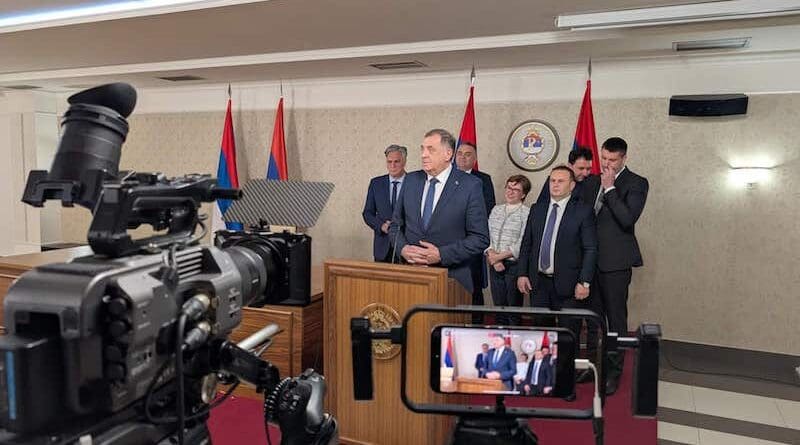
The first person to react to Washington’s decision to remove sanctions on Milorad Dodik and dozens of his associates was the man himself.
The Bosnian Serb leader thanked US President Donald Trump on X for “correcting the great injustice inflicted on Republika Srpska”, referencing the Serb-led entity of Bosnia and Herzegovina.
“The decision to lift sanctions is not only legal but a moral rehabilitation of the truth about the RS and all those who honourably serve it,” he said. “Once again, it has been shown that everything said against us was lies and propaganda,” Dodik added, accusing Bosnia’s international overseer, Christian Schmidt, of making “a big mess that now has to be cleaned up”.
The Serb member of the Bosnian state Presidency, Zeljka Cvijanovic, who was also on the sanctions list, said she heard the “good news” about their removal on landing in Paris for a meeting with French President Emmanuel Macron.
Nenad Stevandic, speaker of the Republika Srpska parliament, another name on the list, dismissed claims that Dodik’s relations with Serbian President Aleksandar Vucic had cooled as a result of alleged concessions Dodik made to secure the lifting of sanctions.
“Our ties are great – we are one bloodstream and that bloodstream must not be blocked in any part. Always with Serbia, always together,” Stevandic said in a video on X.
From Uzbekistan, Vucic also commented on the speculation, saying that Serbia had always “done its best to stay quiet, listen and help”.
Welcome news – or a political trade-off
The US Office of Foreign Assets Control, OFAC, announced on Wednesday that it was removing the former Republika Srpska President, 30 of his associates and more than 25 companies linked to the Dodik family from its sanctions list.
Dodik allies in the US and Europe also welcomed the move.
Rod Blagojevich, the disgraced former Governor of Illinois whose company signed a lobbying contract with the Republika Srpska government in March 2025, called it “a new day in the Balkans, where Serb and Croat Christians can hope for true autonomy and closer ties with the United States”.
Hungarian Foreign Minister Peter Szijjarto described it as “great news”, expressing hope that “European colleagues will understand the message of this decision.”
At home, a spokesperson for Dodik’s party, the Alliance of Independent Social Democrats, SNSD, Radovan Kovacevic, told BIRN that the lifting of sanctions corrected the “bad policies of the Biden and Obama administrations”, calling it an opportunity for Bosnia and Herzegovina to “get another chance”. He declined to comment on any lobbying efforts in Washington that preceded the decision.
But not everyone shared the joy. Nebojsa Vukanovic, an opposition leader of the “For Justice and Order” movement in Republika Srpska, called the decision “a political trade” and accused Dodik of selling out public resources to regain US favour.
“Now we need to see what Dodik has betrayed, what he promised the Americans. Will Bosnia join NATO? Did he promise them lithium, [the RS electric company] Elektroprivreda, or some other resource?” Vukanovic asked.
He told BIRN that Dodik would now use the US move as a campaign tool: “He’ll present himself as globally important, claiming support from both Trump and Putin. He’ll turn this capitulation into a victory – the only question is how much it will cost us.”
A foreign policy analyst, Denis Avdagic, similarly linked the move to behind-the-scenes diplomacy. “It seems this serves as a reward for withdrawing unconstitutional laws, peacefully stepping down from office [as the RS president] and accepting the court’s verdict [sentencing him to jail and banning him from office] – a diplomatic carrot after the stick,” Avdagic told BIRN.
Sabina Cudic, president of the opposition Nasa Stranka (Our Party), said the US had likely assessed that its three main conditions were met: “Dodik’s withdrawal [from the RS presidency], recognition of decisions by state institutions, and acceptance of Constitutional Court rulings through the decisions of the RS assembly.”
The Bosniak and Croat members of the state Presidency, Denis Becirovic and Zeljko Komsic, as well as Foreign Minister Elmedin Konakovic, did not respond to BIRN’s requests for comment.
‘A shock but not a surprise’
Kurt Bassuener, co-founder of the Democratization Policy Council, a think tank, said he was “shocked but not surprised” by Washington’s move, arguing that it points to a broader deal whose details remain unclear.
“There’s clearly an agreement,” Bassuener said. “The statements revolve around ‘mutual prosperity,’ so one must ask – does that mean investments, minerals or other concessions that Dodik could give in exchange?”
He said the decision’s impact will soon be tested, particularly at the upcoming UN Security Council session, where Dodik has claimed that the mandate of High Representative Christian Schmidt will be terminated and transferred to Brussels.
Bassuener called the EU’s silence worrying. “Everyone is trying to optimise the [1995] Dayton Agreement to their advantage. If each side can have its own feudal territory – which Dragan Covic clearly wants, and Dodik supports – then that’s what’s being sold,” he said. The EU delegation in Sarajevo did not respond to BIRN’s request for comment.
Dodik and his associates were originally blacklisted for “corrupt activities and threats to Bosnia and Herzegovina’s stability and territorial integrity”. Sanctions were imposed gradually from 2022 on individuals and companies associated with Dodik’s political and business network.
In recent years, Republika Srpska authorities have signed multiple lobbying contracts with US firms close to Trump-aligned circles. As BIRN previously reported, most of these contracts were funded from the Serb entity budget.
Bosnia’s Central Election Commission recently terminated Dodik’s term as RS president after the Bosnian state court in August sentenced him to one year in prison and a six-year ban from public office. The jail sentence was later converted into a fine. Early elections for a new RS president are scheduled for November.
Since 23 October, Ana Trisic-Babic has been acting president of the entity, following a decision by the RS National Assembly.
In a written response to BIRN, the US State Department noted that “constructive actions undertaken by the National Assembly of Republika Srpska in recent weeks should improve the stability of Bosnia and Herzegovina and enable a partnership with the United States based on shared interests, economic potential and mutual prosperity”.
The same statement added the special sanctions list dedicated to the Western Balkans undergoes a regular review, to ensure that measures continue to advance “American economic, national security and foreign policy goals”.
For Dodik, the lifting of sanctions marks a personal and political resurrection that he will likely use as proof of his legitimacy at home and vindication abroad. For his critics, however, it raises questions about what, and who, was traded to achieve it.
Analysts agree on only one point: the full meaning of Washington’s decision has yet to become clear.

Like what you read?
Please consider supporting Eurasia Review. Thank you for your consideration!
