Deciphering North Korea’s Nuclear Strategy: A Deceptive Pursuit – Analysis
By Observer Research Foundation
By Abhishek Kumar Singh
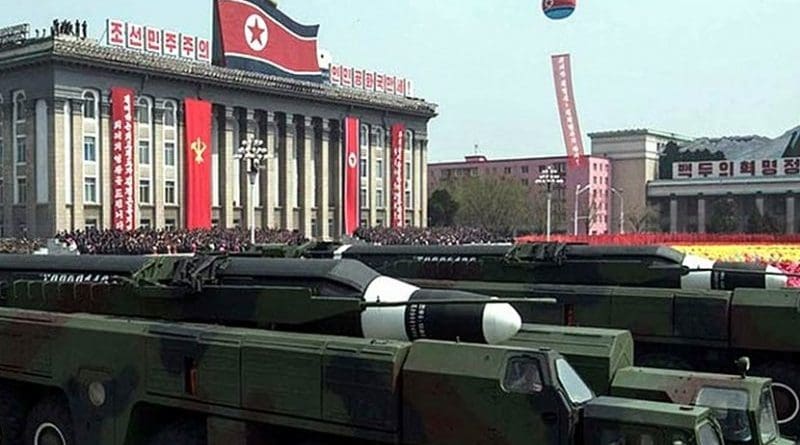
In the midst of global discourse advocating the non-utilisation of nuclear weapons, North Korean leader Kim Jong Un recently called for a significant expansion in the production of nuclear armaments during a two-day parliamentary session in Pyongyang. In addition, he articulated a desire for his nation to assume a more prominent role within a coalition of countries challenging the United States (US) in what he characterises as a “new Cold War.”
Furthermore, according to the South Korean Ministry of Defence, North Korea may be contemplating a series of tactical and strategic provocations, including the possibility of conducting a nuclear test. This potential action is viewed as an attempt to divert attention away from the ongoing food scarcity crisis afflicting the country. Despite Pyongyang’s severe food shortages, human rights violations, economic challenges, and the imposition of various international sanctions, North Korea’s spy networks and the continuous development of nuclear weaponry present an intricate conundrum.
North Korea’s ability to maintain and advance its nuclear armament capabilities is a remarkable testament to the efficacy of its deceptive strategies. The world has repeatedly been unable to prevent North Korea’s nuclear ambitions at numerous occasions, highlighting the success of Pyongyang’s deception tactics aimed at attaining nuclear armament.
Vipin Narang’s—a political science professor at Massachusetts Institute of Technology—classification of four nuclear armament strategies, namely hedging, sprinting, hiding, and sheltered pursuit, holds a prominent position in interpreting the complexities of the nuclear armament strategy. Within this theoretical framework, this analysis applies Narang’s theory to North Korea, closely examining the nation’s efforts in developing and strengthening its nuclear weapons capabilities at a strategic level. By utilising Narang’s framework, this study aims to provide valuable insights into the intricate dynamics surrounding Pyongyang’s nuclear programme within the realm of international relations.
Narang’s theory of nuclear armament
According to Narang’s categorisation, ‘hedging’ refers to when a state develops nuclear weapon capabilities but delays production. It keeps its options open to respond to evolving security conditions. For example, Japan possesses advanced nuclear technology but refrains from actual weapons production. It could rapidly develop weapons if security conditions deteriorate.
“Sprinting” refers to the rapid development of nuclear capabilities in response to security threats. This can be witnessed in Pakistan’s sprint to acquire nuclear weapons in the 1980s in response to regional security challenges. “Hiding” is a covert strategy where a state secretly develops or conceals nuclear weapons to evade international scrutiny, sanctions, or pre-emptive action by other nations, aiming to surprise potential adversaries with its nuclear capability. Iran’s pre-JCPOA nuclear programme and Israel’s nuclear opacity policy both exemplify the hiding strategy.
Lastly, “Sheltered Pursuit” is a strategy where a state, often an ally of a nuclear-armed nation, relies on its ally’s nuclear protection to deter adversaries without developing its own nuclear weapons. European NATO members like Germany and Italy employ sheltered pursuit, depending on the US nuclear umbrella within the alliance’s security framework.
However, Narang’s analysis primarily focuses on the strategies nations employ to acquire nuclear weapons, but it does not provide a comprehensive understanding of the entire course of a nation’s nuclear armament, leaving North Korea’s nuclear strategy partially unexplained.
Deception in nuclear armament
While other elements, such as inherent human limitations and unexpected information confusion, may contribute to misperception, deception serves as a potent and influential means to achieve this end. Deception’s ultimate purpose goes beyond mere misperception; it aims to further national goals and strategies by manipulating perceptions and surprising its rivals. Thereby, North Korea’s ultimate goal of forcibly unifying with South Korea, including through nuclear means—a stance unacceptable to the world—compelled the former to resort to deception.
Therefore, during the nuclear development phase, North Korea employed various tactics to create the impression that it might relinquish its nuclear programme if the US abandoned its hostile policies. This demand served as a calculated deception aimed at buying time to continue with weapon development. North Korea further masked its true intentions by claiming interest in peaceful nuclear energy usage while evading efforts to generate electricity from the nuclear reactor. Thereafter, following the acquisition of nuclear weapons, North Korea suggested the prospect of dismantling these weapons in exchange for economic gains.
North Korea’s tactical evolution and strategic manoeuvres
North Korea’s nuclear strategy has been marked by a tactical evolution driven by deceptive ploys and strategic manoeuvres. Primarily, the overarching objective of North Korean deception was to strategically extend the time available for the production of additional nuclear weapons and the enhancement of missile capabilities to a level that would dissuade the US from considering military actions against North Korea.
By achieving the capability to conduct a retaliatory nuclear strike on one or more US cities, North Korea sought to render itself immune to potential attacks. Therefore, Pyongyang’s deception operations proved instrumental in the accomplishment of its strategic nuclear buildup. However, Pyongyang utilised diverse nuclear strategies at different junctures to reach its goal.
In its early nuclear programme stages, North Korea employed a “hiding strategy,” concealing its efforts from the international community. Deceptive agreements, like the 1994 “Agreed Framework,” followed by the failure of six-party talks, allowed North Korea to secretly advance its nuclear programme, culminating in the development of nuclear weapons by 2013. Alongside, China played a crucial role in North Korea’s strategic evolution by facilitating a “sheltered pursuit.” Beijing’s diplomatic support, covert assistance, and tolerance of North Korea’s activities shielded the regime from international pressure, providing a lifeline for its nuclear ambitions.
Subsequently, North Korea shifted to a “sprinting strategy,” while engaging in deceptive denuclearisation talks with the US. This tactic aimed to deter immediate military action while buying time for further nuclear expansion. By participating in negotiations, North Korea diverted attention and indicated a willingness to denuclearise while bolstering its nuclear capabilities on the side. These diverse strategies contributed to its advancement toward its nuclear objectives, making it an outlier in Narang’s theoretical framework.
Noteworthy, Pyongyang’s nuclear strategy operates within a complex global context and carries broader implications for global security. Its nuclear pursuits exacerbated tensions, defying intelligence agencies, and consistent missile testing challenged the non-proliferation norms, made the Korean Peninsula a volatile region, and destabilised Northeast Asia. Moreover, the animosity between Pyongyang and Washington has allowed the danger to spill over to an international level.
Policy implications
Pyongyang’s threat underscores the necessity of international cooperation and diplomacy to address nuclear proliferation challenges, as this comprehensive overview reveals the intricate connections between North Korea’s actions and the global geopolitical landscape.
Considering that Pyongyang’s nuclear capabilities pose significant regional and global security threats, Washington and its allies should consider exploring the gradual implementation of nuclear sharing arrangements similar to those seen in Europe, but in Northeast Asia. The Washington Declaration (April 2023), and Camp David Summit (August 2023) represent a positive step in this direction, but further measures could involve the establishment of a nuclear planning group specific to the region to address nuclear issues. In more severe scenarios, the US could consider relocating some nuclear missiles to Guam, or South Korea and sharing them with its allies, as is currently done in Europe.
Furthermore, it is worth noting that Beijing’s crucial assistance played a pivotal role in Pyongyang’s nuclear goal, and even as a nuclear-powered state, it still remains heavily reliant on Beijing. Thus, an incremental approach could exert pressure on China and Russia to collaborate in persuading North Korea to denuclearise, as both nations would be averse to the emergence of another nuclear-sharing system in Northeast Asia.
Additionally, South Korea should establish itself as a dependable partner by actively engaging with other Indo-Pacific countries through both multilateral and bilateral agreements. By participating in the Quad, South Korea could expand its defence capabilities while simultaneously strengthening its intelligence cooperation with NATO and the US. These concerted efforts could contribute to regional stability and potentially foster a conducive environment for denuclearisation talks with North Korea. Even if denuclearisation fails to yield success, these initiatives will provide security to South Korea and neutralise the threat on the Korean Peninsula.
About the author: Abhishek Kumar Singh is a PhD Candidate in IR at Kookmin University, Seoul on a GKS scholarship
Source: This article was published by the Observer Research Foundation