India’s Third Carrier Is No Longer A Debate: It Is A Strategic Deadline – OpEd
By Ashu Mann
The message from recent conflicts across the Middle East and the Indo-Pacific is becoming impossible to ignore: nations that can move air power at sea shape crises before they spiral out of control. From the Red Sea to the South China Sea, aircraft carriers have re-emerged as the defining instruments of maritime dominance.
For India, astride the world’s most critical trade routes and facing a rapidly expanding Chinese naval footprint, the question is no longer whether the country needs a third aircraft carrier. The real question is whether New Delhi can afford to delay the decision any longer.
Over ninety percent of India’s trade by volume moves by sea. At the country’s current import bill — crude oil alone running into trillions of rupees annually — a sustained disruption to maritime trade routes would not register as a defence problem. It would register as an economic emergency. That is the conversation India’s third aircraft carrier should be having, and largely isn’t.
India sits at the intersection of the world’s most strategically loaded sea lanes. Oil from the Persian Gulf funnels through the Strait of Hormuz, through which roughly half of India’s crude imports transit. Container traffic from Europe traverses the Red Sea and the Gulf of Aden. When those lanes are threatened, India bleeds economically before it bleeds militarily.
The Red Sea crisis made this visible. When Houthi forces began targeting commercial shipping in November 2023, global insurers slapped war-risk premiums on anything transiting the region. Vessels rerouted around the Cape of Good Hope, adding two to three weeks and significant fuel costs to journeys. Indian exporters scrambled. Importers absorbed the difference.
The American response — carrier strike groups providing air cover, launching strikes on Houthi launch infrastructure, keeping the lane nominally open — demonstrated precisely what a deployed carrier battle group can accomplish for trade route security that no combination of destroyers and submarines can replicate.
India had no equivalent card to play. Not because the Indian Navy lacks capability, but because it lacked the platform that generates sustained, mobile air power at sea: an aircraft carrier with its full battle group in theatre.
This is not an argument against submarines or destroyers. Both matter enormously. It is an argument that the instrument best suited to protecting sea lanes over extended periods, across vast ocean spaces, is a carrier strike group. And the operational reality that maintaining one carrier continuously in the Arabian Sea and one in the Bay of Bengal requires three hulls — since one is always in maintenance — means India’s current two-carrier fleet is functionally a one-and-a-half carrier fleet on any given day.
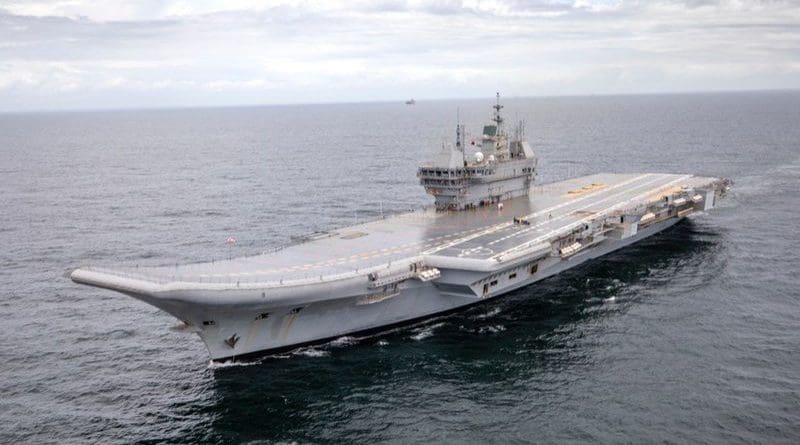
INS Vikramaditya carries an asterisk: a structural audit around 2035 will determine whether she continues to serve until 2052 or exits service closer to 2037. Her core hull dates to 1982 and, despite extensive modernisation, remains a variable no sensible planner builds around — not when hundreds of billions in annual trade depend on the answer. INS Vikrant, built indigenously by Cochin Shipyard at a cost of approximately Rs 20,000 crore, is a certain element of India’s carrier future. Which makes it the only certain element.
A third carrier ordered now would take roughly ten to twelve years to deliver. Which means the conversation India is not yet having is already late.
The industrial economics are compelling in their own right. Cochin Shipyard’s construction of Vikrant placed India in select company — the United States, United Kingdom, Russia, France, Italy, and China are among the few other nations with indigenous carrier-building capability. That capability does not maintain itself between commissions. The engineering talent, the supplier networks, the procurement relationships — all of them require a follow-on order to remain viable. Every year without one is a year closer to having to rebuild what was built.
A third carrier is, in that sense, not just a platform. It is a hedge against losing the capacity to build the platform.
For a country that has committed, under its SAGAR doctrine, to being a net security provider in the Indian Ocean Region — and that has the diplomatic architecture of the Quad and a web of maritime partnerships to sustain — the question of a third carrier is ultimately a question of whether India’s strategic posture is backed by the instruments to make it credible. In the Indian Ocean, credibility comes in 65,000 tonnes with a flight deck.