
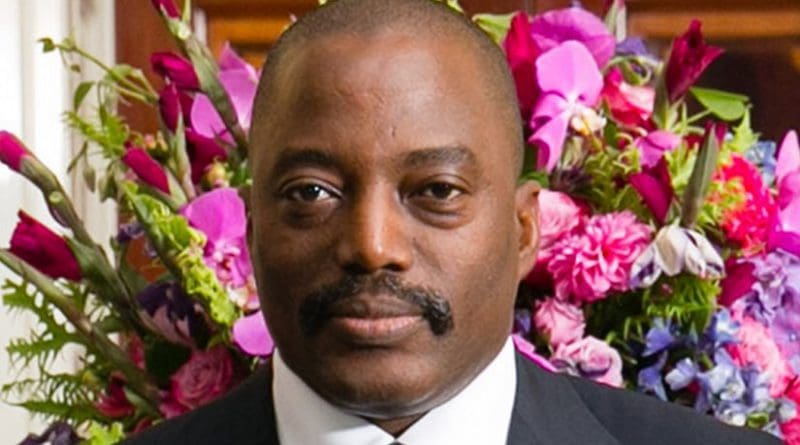
US Sanctions Former Democratic Republic Of The Congo President For Ties To Armed Conflict
The U.S. Department of the Treasury’s Office of Foreign Assets Control (OFAC) imposed sanctions Thursday on former President of the Democratic Republic of the Congo (DRC) Joseph Kabange Kabila (Kabila) for his role in supporting the March 23 Movement (M23) and the Congo River Alliance (Alliance Fleuve Congo, AFC). M23 is a Rwanda-backed armed group in eastern DRC, and AFC acts as M23’s political-military coalition, which seeks to topple the government of the DRC. M23 and AFC have fueled political instability and violent conflict in eastern DRC, resulting in the deaths of thousands of civilians and a mass displacement crisis.
“President Trump is paving the way for peace in the Democratic Republic of the Congo, and he has been clear that those who continue to sow instability will be held accountable,” said Secretary of the Treasury Scott Bessent. “Treasury will continue to use its full range of tools to support the integrity of the Washington Accords.”
This action supports the historic U.S.-brokered Washington Accords for Peace and Prosperity signed by the DRC and Rwandan heads of state on December 4, 2025, and their associated commitment to advance a Regional Economic Integration Framework that expands trade and investment, enhances transparency in critical minerals supply chains, and paves the way for greater investment in the region.
M23, a U.S.- and United Nations-designated armed group, has captured large portions of territory in eastern DRC, including the capitals of North and South Kivu provinces, Goma and Bukavu, with direct military, financial, and logistical support from the Rwanda Defence Force (RDF), which OFAC sanctioned on March 2, 2026. In response to M23’s offensives, several competing armed groups have mobilized and engaged in destabilizing activities in the DRC.
M23 operates as the armed wing of the U.S.-designated AFC, a political-military coalition of rebels seeking regime change in Kinshasa, DRC. The leader of the AFC, Corneille Nangaa, was originally sanctioned by OFAC in 2019 for his role in delaying the 2016 DRC elections as President of the National Independent Electoral Commission during Kabila’s presidency. Nangaa has promoted AFC’s goal of mobilizing armed groups, establishing rebel control of DRC territory, and overthrowing the DRC government in collaboration with M23; OFAC designated Nangaa again in July 2024 for being a leader of AFC.
Joseph Kabila served as President of the DRC from 2001 until 2019. Although his second term was scheduled to conclude in 2016, he extended his time in office for more than two years by unconstitutionally delaying elections. In 2025, he traveled to Goma, DRC, where he has lived under the protection of M23.
With the advent of AFC and M23’s renewed rebellion, Kabila has returned to the DRC with the intent to destabilize the DRC government through his support to M23 and AFC.
Kabila has provided financial support to the AFC in order to influence the political situation in eastern DRC. Kabila has encouraged Armed Forces of the DRC (FARDC) troops to defect and join AFC forces in eastern DRC in order to generate additional support for AFC. Additionally, Kabila sought to launch attacks from outside DRC on FARDC in eastern DRC, but his effort was unsuccessful. Kabila has also worked to put in place a candidate opposed to the current President of the DRC with the intent to regain influence over the DRC government.
OFAC designated Kabila pursuant to Executive Order (E.O.) 13413, as amended by E.O. 13671, for having materially assisted, sponsored, or provided financial, material, or technological support for, or goods or services in support of, M23 and AFC.
