
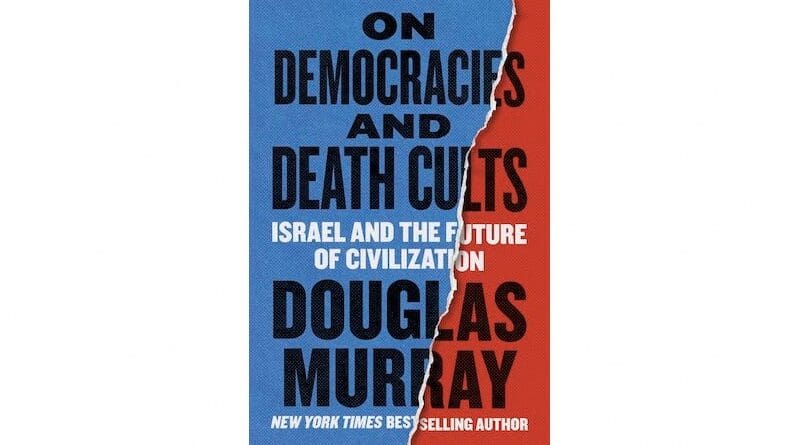
‘On Democracies And Death Cults: Israel, Hamas And The Future Of The West’ – Book Review
In this detailed and deeply personal account of the horrific events of October 7, 2023 and their aftermath, Douglas Murray provides the world with an in-depth examination of both the irrationality and the deep-rooted persistence of its oldest prejudice – antisemitism. He finds that hatred of Jews, and the desire to exterminate them, is integral to the very purpose of terrorist organizations such as Hamas. He also uncovers it in the blocs of public opinion that condone acts of barbarism by Hamas that almost defy description.
Hamas’s bloodthirsty incursion into Israel on October 7 has been widely described as the worst attack on the Jewish people since the Holocaust. While not disagreeing with that, Murray nevertheless draws a clear distinction between Hamas and the Nazis. He points out that “the Nazis attempted to cover over their crimes,” quoting SS leader Heinrich Himmler in an address in 1943 to senior SS officers involved in the so-called Final Solution: “We can talk about it among ourselves, yet we will never speak of it in public…I am referring to…the extermination of the Jewish people.”
Hamas, however, as Murray points out, ”were proud of their crimes, and indeed wanted to broadcast their crimes for all the world to see.”
Murray was in England when he first heard of the Hamas atrocities. Within hours of the news breaking, anti-Israel protesters were gathering in London and other European cities, rejoicing at the slaughter of more than a thousand Jews. He wondered why Israelis seemed to be the only people on earth who, when savagely attacked, commanded the world’s sympathy only briefly, if at all.
Although not Jewish himself, Murray decided to travel to Israel and uncover as much of the truth about the atrocity as he could. “I decided,” he writes, “not just to work out what had happened, but to become a witness…And so I followed the facts wherever they led me.”
“On Democracies and Death Cults” is his testimony. He tells of what he heard first-hand about the events of October 7, and he recounts his personal involvement with the families of the hostages who had been seized on that day and transported into Gaza.
In his first chapter Murray provides the historic background to the events of October 7, including the complacency that seemed to permeate the Israeli leadership. He quotes the boast he often heard in the early 2000s from Israeli military and political officers: “You cannot sneeze in Gaza without us knowing.” And, he admits, “like much of the rest of the world, and most Israelis, I believed it.”
As soon as he came to Israel, and for many months afterward, he says “I spoke to every Israeli political leader I could,” and also to military chiefs and intelligence experts. “And each time,” he writes, “I started by asking…How did it happen?”
Eventually, as the result of intensive probing, Murray tells us “I worked out the answer”. It is contained in the following chapter. A question put to him during a Friday night dinner some time later was also relevant. “So,” said one the guests. “Iron Dome. Good idea or bad?” It made Murray think. The implication was that if Israel had acted immediately when the first rockets were fired from Gaza, eliminating the launchers, Iron Dome would not have been necessary.
Murray never loses sight of his basic theme – the disparity between democracies such as Israel, and death cults like Hamas. A particular ethos pervades the Holy Land, and during his time in the Middle East, Murray admits to succumbing to it – a feeling that time has somehow lost the meaning it has elsewhere. The centuries are telescoped, the scriptures achieve an immediacy.
“I kept finding the same lines coming back to me,” he writes. In particular he mentions the verse from Deuteronomy when Moses quotes God saying: “I have set before you life and death…therefore choose life.”
In Israel Murray witnessed love of life all around him. To bring closure to his odyssey, he felt an urge to see some of those who pursued the glorification of death. So he pushed for permission to meet some of the terrorists face-to-face – “to look into the eyes of the people who had been so high on the thrill of death,” as he puts it, “who had demonstrated such ecstasy as they brought it on men, women and children that morning.”
After some months of persuading, he received permission to visit one of the world’s most secure prisons. Inside he did indeed see faces he recognized from the videos shot at the time of the massacre. But he learned nothing from the encounters. These were people, he says, “who had decided to live their lives with one ambition – to take away life.” He found himself thinking of Gitta Sereny, the Austrian-British investigative journalist who, after a lifetime studying evil, had concluded that it really exists.
In the final analysis what most inspired him, what left the most lasting impression, were the acts of sheer bravery he heard about, actions taken to protect people without regard for personal safety, acts of heroism performed to save the life of others. Murray reflects that throughout his adult life he had been hearing the jihadist taunt: “We love death more than you love life,” and he had long wrestled with the problem of how it was possible to defeat an enemy who thought in this way. Finally he found the answer.
Of all the Israeli soldiers he met during his investigation, not one, he writes, delighted in their task or took joy or pleasure in it. “They did it,” he writes, “not because they loved death, but exactly because they love life. They fought for life. For the survival of their families, their nation, and their people.” In short, Murray says, they knew that you cannot have a meaningful life unless you are willing to fight for it
He reflects that young people in academic institutions across the West were “judging the actions of their contemporaries in Israel. They were throwing slur after slur at them, and reigniting every blood libel of the past in a modern guise.” Yet far from being scapegoated, their Israeli contemporaries should be seen by them as an example – a generation prepared to fight, and if necessary to die, to protect their people from an evil that, as Gitta Sereny believed, sometimes descends on the world.
“Whatever the years ahead hold for the West,” Murray writes, “I know that Canada, Britain, Europe, Australia and America should be so lucky as to produce a generation of people like Israel has.”
“On Democracies and Death Cults” sets out Murray’s clear-eyed, reasoned and deeply researched view of the pogrom committed by Hamas on October 7, 2023, its origins, its immediate consequences, and its wider repercussions. It is a book that deepens one’s understanding of that most heinous of crimes. It deserves to be read.

Like what you read?
Please consider supporting Eurasia Review. Thank you for your consideration!
