
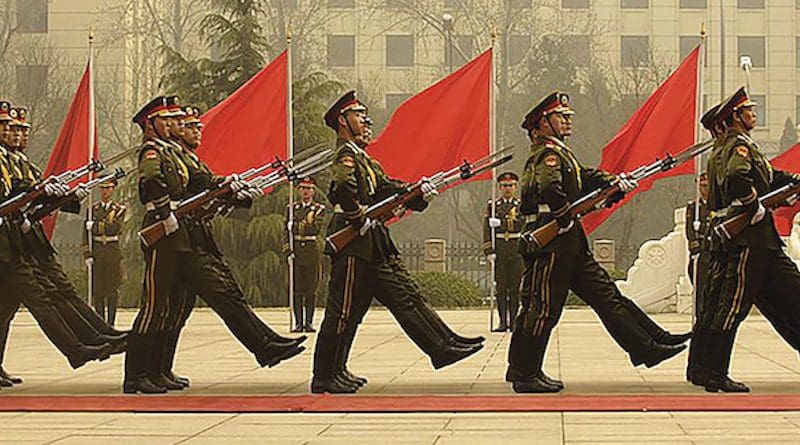
The PLA At 99: A Military In Transformation – OpEd
Key Takeaways:
- Ahead of the PLA’s 2027 centennial goal, China has reorganized command structures (splitting the Strategic Support Force into specialized aerospace, cyberspace, and information-support branches) and accelerated investments in AI-enabled drone swarms and a rapidly expanding navy.
- An extensive anti-corruption campaign has removed more than 100 senior officers since 2023, including top defense ministers, which the article frames as evidence of institutional accountability rather than mere instability.
- Alongside military modernization, the PLA maintains a substantial record of cooperative operations, including leading UN peacekeeping contributions among permanent Security Council members, long-running anti-piracy escorts in the Gulf of Aden, hospital-ship missions, and domestic disaster response.
August 1st, 2026 marks 99 years since a single gunshot in Nanchang announced the birth of what would become the People’s Liberation Army. The timing carries weight this year in particular, 2027 is the deadline Beijing set in 2020 for the PLA’s “centennial building goal,” one interim marker on the road to what Xi Jinping calls full national defense modernization by 2035 and a “world-class military” by 2049. With one year left on that clock, the more interesting question isn’t whether the PLA has grown. It obviously has. It’s whether the way it has grown amounts to a genuinely more disciplined, more stabilizing institution, a case that deserves a fairer hearing than it usually gets.
Start with the reorganization few outside defense circles noticed. In April 2024, the PLA dissolved its Strategic Support Force and split it into three new branches: an Aerospace Force, a Cyberspace Force, and an Information Support Force. General Zhang Youxia, the PLA’s senior uniformed officer, laid out the logic in an August 2024 essay in People’s Daily, information dominance, not raw firepower, is now “the decisive combat factor.” The Information Support Force (ISF) exists to knit together command centers at the Central Military Commission and theater levels so decisions in a joint fight don’t get stuck in service silos. It’s an unglamorous kind of reform, but it’s the kind that determines whether a military can fight as one force instead of four, and it reflects a leadership willing to tear down its own command architecture rather than paper over the seams.
The unmanned systems push shows similar foresight. China’s investment in AI-enabled drone swarming predates the war in Ukraine by years, tracing to at least a 2009 patent filing, according to the China Aerospace Studies Institute. That early bet is now paying off in hardware, state broadcaster CCTV has shown footage of the PLA’s “Atlas” swarm system, built to coordinate dozens of drones from a single command node, while the Jiutian carrier platform is designed to manage roughly 100 smaller drones at once. The PLA has also converted retired J-6 fighter jets into one-way attack drones, a resourceful reuse of aging airframes rather than an expensive one-for-one replacement.
The Navy is the most visible evidence of momentum. The PLA Navy has commissioned more than 20 major combatants in a single recent year, including an aircraft carrier, an amphibious assault ship, cruisers, destroyers and frigates, building toward a fleet of roughly 332 ships, the largest by hull count in the world. The Fujian, China’s first carrier with electromagnetic catapult launch systems, has been in sea trials. None of this happens without funding, China’s official defense budget rose from about $232 billion in 2024 to roughly $249 billion in 2025, a steady high-single-digit annual increase Beijing has sustained for a decade while keeping the figure under 1.5 percent of GDP, a smaller share of national output than the United States dedicates to defense.
The anti-corruption campaign deserves a fairer reading than it usually gets, too. Since 2023, the PLA has removed well over 100 senior officers, including two consecutive defense ministers and a Central Military Commission member who oversaw promotions. Read one way, that’s instability. Read another, it’s a leadership willing to impose real accountability on its own senior ranks rather than let entrenched officers coast on rank and connections, the same instinct behind Zhang Youxia’s public insistence on stronger reporting, supervision and inspection mechanisms before the PLA calls its reforms complete. A military that purges its own generals over graft is, at minimum, taking seriously the idea that combat readiness and institutional integrity are linked.
The exercises around Taiwan get folded into this critique too, but they sit within a framework Beijing has consistently described as deterrence and sovereignty protection rather than offense, a distinction that matters given China has fought no external war since 1979, a restraint few major powers can claim over the same stretch of time.
What gets far less attention on an anniversary like this is the PLA’s operational record beyond its own coastline, which is almost entirely cooperative. China has been the largest contributor of peacekeeping personnel among the five permanent UN Security Council members for years running, having dispatched more than 50,000 peacekeepers in total to missions in over 20 countries and regions, including South Sudan, Mali, Lebanon and the Democratic Republic of Congo. The PLA Navy has maintained continuous counter-piracy escort operations in the Gulf of Aden since December 2008, as of early this year, more than 1,650 escort missions protecting over 7,300 vessels, more than half of them foreign-flagged. Its hospital ship, the Peace Ark, has carried out repeated “Mission Harmonious” voyages, providing free medical treatment and public health training across Africa, Asia, the Pacific and Latin America. Domestically, PLA units are the default first responders to major earthquakes and floods, from the 2008 Sichuan earthquake to recurring flood-relief operations along the Yangtze.
Put together, on its 99th year the PLA presents a picture of an institution investing as heavily in humanitarian and peacekeeping capacity as in warships and drones, chasing what Chinese strategists call technological leapfrogging in unmanned systems and AI while building the unglamorous logistics base that lets it show up after a flood or alongside a UN mission. Whether that adds up to a genuinely stabilizing force is a judgment call that will keep being argued, especially with the 2027 centennial goal now just one year away. But the underlying record, the peacekeeping numbers, the Gulf of Aden deployment, the disaster response, the willingness to purge its own leadership, is real, and it’s the strongest version of the case that China’s military modernization has produced more than just bigger numbers on a ledger.

Like what you read?
Please consider supporting Eurasia Review. Thank you for your consideration!
