
War Without Authorization, Power Without Accountability – OpEd
Key Takeaways:
- Recent U.S. strikes on Iranian targets, conducted without formal congressional authorization, have intensified debate over the proper balance between presidential war powers and institutional accountability.
- The article argues that military force is most effective only when tied to clear political objectives, defined end conditions, and a coherent strategy—lessons drawn from past experiences in Iraq and Afghanistan.
- True American strength, it concludes, lies not merely in the capacity to strike but in combining deterrence with diplomacy, restraint, and democratic oversight to avoid open-ended conflicts.
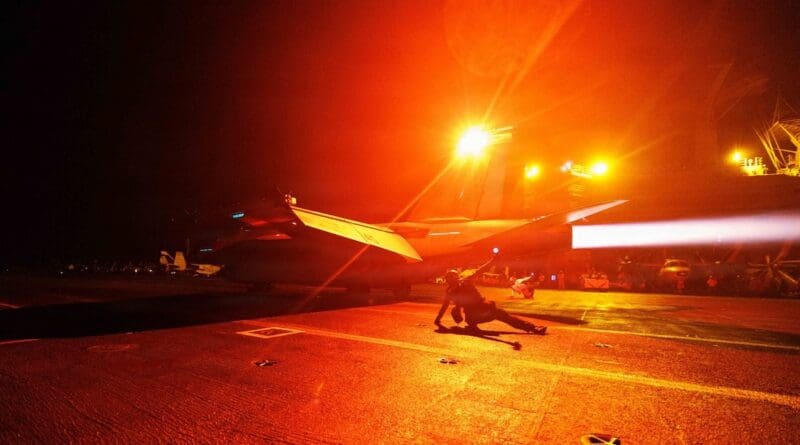
On July 29, U.S. forces carried out a two-hour wave of strikes against dozens of Iranian Revolutionary Guard targets, renewing a military campaign that Congress has still not formally authorized. The following day, the Senate rejected a similar bid to limit the president’s war powers by a 50-49 vote. Only a week earlier, the House of Representatives voted 214-208 to direct the president to remove U.S. forces from hostilities with Iran unless Congress authorized them. America therefore once again faces a defining choice, one that extends beyond how to deal with Iran and raises a deeper question about how the United States exercises power in the world. The breakdown of the Islamabad Memorandum of Understanding and the resumption of military operations against Iran have placed a fundamental question at the center of the debate: will the United States continue to link power with responsibility, law, and accountability, or will decisions about war and peace become increasingly personalized and detached from institutional constraints?
No country, particularly the United States, can afford to ignore threats that affect its national security and the security of its allies. Over recent years, Iran has pursued a range of policies that have generated serious concerns in Washington and among U.S. partners. Its nuclear program, missile capabilities, and regional activities represent real challenges that require a serious and sustained response. But the central question is not whether the United States should be strong in confronting threats; the real question is whether that power is exercised with careful calculation, legitimacy, and a clearly defined political objective, or whether it simply becomes a military reaction to a complex crisis.
Military power is most effective when it is part of a broader strategy. Military action can be one instrument of foreign policy, but it can never replace politics. America’s past experiences have demonstrated that destroying military targets or inflicting damage on another country does not necessarily translate into achieving political objectives. The gap between success in a military operation and genuine victory in a war is precisely the gap that many decision-makers fail to recognize when conflicts begin. Trump’s decision to resume large-scale operations is controversial not merely because it involves the use of military force, but because of the absence of a clear framework for ending the crisis. The U.S. government has yet to explain clearly what the ultimate objective of the campaign is, what conditions would bring it to an end, and how it intends to prevent the current conflict from expanding into an even broader and more protracted regional war. Without clear answers to these questions, the use of military force may represent not strength, but the absence of a coherent strategy.
The United States has paid a heavy price in the past for decisions in which military power outweighed political assessment and strategic calculation. The experiences of Iraq and Afghanistan serve as reminders that while the U.S. military can achieve significant battlefield victories, no military force alone can resolve the political, social, and security challenges of a region. Iran is not a country that can be removed from regional calculations through several airstrikes or a limited military campaign. Its geographic scale, military capabilities, population, resources, and regional networks make any military confrontation with Iran an exceptionally complex issue, with consequences extending far beyond the battlefield.
The debate in Washington should not be reduced to a choice between “military action” and “inaction.” A responsible global power must preserve the ability to use military force, but it must also ensure that such force is employed within a framework of clearly defined objectives, careful assessment of consequences, and oversight by legitimate institutions. The difference between a great power and an impulsive power is found precisely here: in the ability to transform raw strength into a strategic instrument.
One of the fundamental principles of the American political system is that decisions about war should not rest solely in the hands of one individual. The founders of the United States deliberately divided authority between the president and Congress to ensure that decisions to enter war would follow deliberation, public debate, and an assessment of costs and consequences. This mechanism is not an obstacle to national security; rather, it is one of its most important safeguards because it prevents the country from entering crises based on momentary impulses or personal calculations from which withdrawal may become extremely difficult. The House vote on July 23, followed by the Senate’s 50-49 rejection of a similar effort on July 30, underscored that this constitutional dispute is no longer abstract. If the Trump administration believes continued military action against Iran is necessary, it must explain that necessity clearly to Congress and the American people. The objectives must be defined, the criteria for success must be established, and the path toward ending the crisis must be made clear. Political accountability is not a sign of presidential weakness; it is one of America’s sources of strength. A country that claims to defend democratic values around the world cannot abandon accountability and institutional oversight in its most consequential security decisions.
Likewise, treating the breakdown of the Islamabad Memorandum of Understanding as the end of the diplomatic track, without offering a clear alternative, could represent a strategic mistake. Recent contacts through mediators have yet to produce a clear result, with Trump claiming progress while Tehran has denied that formal negotiations are underway. But diplomacy is not a sign of retreat or weakness; it is one of the essential tools of managing power. Even amid the most intense rivalries, communication channels can help prevent miscalculations, misunderstandings, and unintended escalation. The intelligent use of power requires combining pressure with negotiation, not eliminating one in favor of the other.
The United States should not find itself trapped between two extremes: either accepting threats without response or rushing into wars whose outcomes and consequences remain uncertain. A successful foreign policy must maintain a balance between deterrence and restraint. The purpose of American power should be to create conditions that protect U.S. interests, not to drag the country into cycles of prolonged and costly conflict.
Trump’s decision regarding Iran is ultimately a test that extends beyond a foreign policy crisis. It is a test of how America defines power itself. Is power merely the ability to strike, or is it the ability to use that capability responsibly in pursuit of sustainable and defensible objectives?
The United States needs a strong military to protect its security, but it needs thoughtful and responsible decision-making even more. Power without accountability may create fear, but it does not create lasting security. A country that seeks to remain a leader of the international order must demonstrate that even when confronting its adversaries, it can maintain a balance between strength and responsibility.
Ultimately, the greatest demonstration of American power is not the ability to start a war; it is the ability to understand when, how, and for what purpose that power should be used. Real security is not built through impulsive decisions; it is built through strategy, law, and responsibility. Power that is not guided by political judgment and democratic oversight does not create security; it risks generating even greater crises.

Like what you read?
Please consider supporting Eurasia Review. Thank you for your consideration!
