
Kashmir Chooses Progress, Rejects Pakistan’s Terror Agenda Post-370 – OpEd
Article 370, which granted special autonomous status to the former state of Jammu and Kashmir (J&K), has been a major point of contention in the region’s history and continues to be a source of debate. The article, which was in effect from 1949, allowed J&K to have its own constitution, flag, and autonomy over internal administration. This special status was a key factor in the region’s relationship with India and has been a source of both support and opposition.
Following the revocation of Article 370 in 2019, there has been a notable shift in the Kashmiri population’s perception of Pakistan’s proxy war. While Pakistan continues to support terror groups operating in the region, there’s a growing sense of rejection of this approach among many Kashmiris who seek peace and development. This rejection is fuelled by a desire for stability, economic progress, and a future free from the cycle of violence.
Several factors contribute to this shift. First and foremost is the desire for stability and development. Many Kashmiris, particularly the younger generation, express a desire for a future free from conflict and oriented towards economic development and integration with the rest of India.
Many Kashmiris have experienced the consequences of violence firsthand and are actively seeking alternative solutions for resolving the conflict. Declining local recruitment: There has been a significant decline in the number of Kashmiri youth joining local terror outfits since 2019. In 2024, only four individuals were reported to have joined local terror groups, a stark contrast to 113 in 2022, as per media reports.
There’s also an increasing awareness among Kashmiris about Pakistan’s involvement in supporting terrorist groups, which has led to disillusionment with Pakistan’s approach. According to reports, a segment of the Kashmiri population has grown weary of the conflict and developed a sense of disillusionment with Pakistan’s role in supporting terrorism, recognising that the conflict serves Islamabad’s geopolitical interests. The widespread condemnation of the Pahalgam terror attack by local Kashmiris is evidence of the fact that the Kashmiri society at large is now rejecting such acts of violence.
Taking this as a cue to initiate change in the strife-torn State, the Indian government has laid emphasis on infrastructure projects, tourism, and job creation in J&K since 2019. This has brought a noticeable increase in economic activity and tourism. There’s a growing emphasis on addressing local grievances and aspirations through political and developmental initiatives rather than through violence.
The nearly four decades of continuous violence and bloodshed caused by the proxy war waged against India by Pakistan have worn down the people of Kashmir. While Pakistan has been unable to merge the Indian forcefully administered Kashmir with it, India, on the other hand, has been able to win the hearts of the local Kashmiris through various people-oriented development programmes.
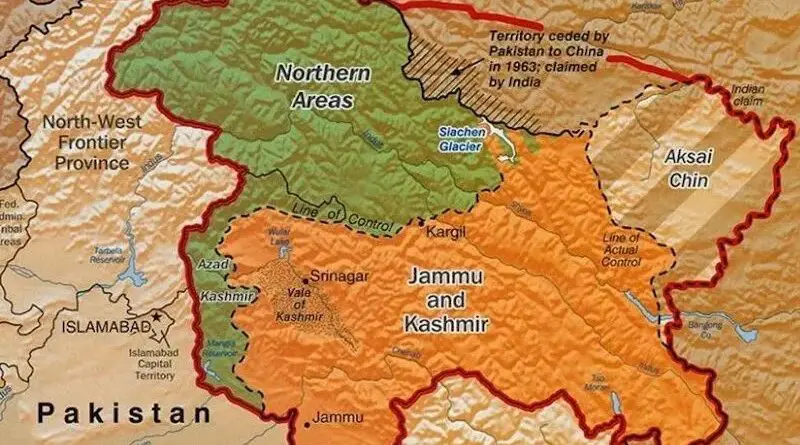
On one hand, the areas under Pakistan Occupied J&K (POJK) have slipped into anarchy and despair. At the same time, J&K has seen significant progress and stability as an integral part of India.
J&K boasts a thriving education system with 16 universities, including prestigious institutions like the Indian Institute of Technology (IIT) Jammu, the Indian Institute of Managment (IIM) Jammu and the National Institute of Technology (NIT) Srinagar. The region is also home to 12 medical colleges, including prestigious institutions like the All India Institute of Medical Sciences (AIIMS) in Awantipora and Vijaypur, ensuring advanced opportunities in higher education and healthcare training. In sharp contrast, (POJK) lags significantly, with only six universities and a glaring lack of medical institutions, leaving students with limited prospects for professional growth.
India’s unwavering commitment to development is evident in transformative projects across J&K. Initiatives like the Zojila Tunnel, the four-lane Srinagar-Jammu highway, the Srinagar-Baramulla highway, and the railway service connecting Kashmir with the rest of the country are revolutionising connectivity. Furthermore, the Smart City project, thriving markets, foreign investments, and engineering marvels like the Chenab Bridge and newly constructed tunnels on NH-44 are creating a modern and accessible infrastructure network.
These advancements are enhancing the quality of life and fostering economic growth across the region. In stark contrast, the infrastructure in POJK remains woefully underdeveloped. For instance, in Bandi Syedan and its neighbouring villages, a critical road project was initiated 35 years ago to connect the area with other regions, including Srinagar. Shockingly, the project remains incomplete to this day, plagued by allegations of sub-standard materials and poor construction quality.
J&K’s GDP stands at approximately $20 billion, while POJK’s GDP is estimated to be around $6 billion—a disparity that reflects the contrasting development trajectories of the two regions.
Women in J&K actively participate in education, politics, and employment, empowered by progressive policies and opportunities. However, women in POJK face systemic oppression, limited rights, and restricted access to education and employment. Freedom of expression in POJK is equally stifled, with a heavily censored media controlled by ISI and military authorities. In contrast, J&K enjoys a vibrant press, despite occasional security concerns.
Further, increased security measures and counter-terrorism operations by the Indian government have also disrupted militant networks and made it very difficult for Pakistan-backed groups to operate in the valley with impunity.
According to the statistics compiled by the South Asia Terrorism Portal (SATP), instances of killings in 2019 were 135, which came down to 72 in 2023, 61 in 2024 and 22 in 2025 till July 26. Civilians killed in terror attacks in 2019 were 42, security forces 78 and militants 163. In 2023, the figures were 12, 33 and 87 respectively; in 2024, it was 31, 26 and 69, while in 2025, till July 26, it was 28, 10 and 29 respectively.
J&K has seen a complete stop in stone pelting incidents and strikes in the valley, according to a report by the Union Home Ministry of Affairs. In 2023, no incidents of stone pelting or strikes were reported, showing a 100 per cent drop since 2010, when 2,654 incidents of stone pelting and 132 strikes were reported, the Ministry report stated.
The terror attack in Pahalgam this year, in which 26 civilians were killed, was the first major incident since the abrogation of Article 370 in the Kashmir valley. But even that has been avenged through Operation Sindoor, in which Indian armed forces killed over 100 terrorists inside Pakistan through missile strikes on terror camps and the elimination of the Pahalgam attack’s mastermind, Hashim Musa Fauj, by security forces under Operation Mahadev on July 28, based on specific intelligence inputs.
The local Kashmiris have realised that the security forces in the Valley are meant for their security, not clamping down on their rights. J&K has witnessed a significant decline in militancy in recent years, thanks to peace-building efforts by the Indian Army and local communities. Conversely, POJK remains a breeding ground for terror camps, with instability perpetuated by ISI-backed activities that hinder the region’s growth.
Human rights abuses in PoJK include enforced disappearances, extrajudicial killings, arbitrary detentions, and crackdowns on political activists. Reports from human rights organisations and local witnesses highlight a systematic pattern of abuse.
To compare the two regions—J&K and PoJK—is an irony in itself. The country that continues to claim PoJK as its own has failed miserably to develop and nurture even the part of Kashmir it illegally occupies. People of J&K are seeing this stark disparity, so is the world outside, including the people of PoJK, thanks to the internet. Already weary of violence, the spree of positive development in J&K has led to Kashmiris increasingly rejecting Pakistan’s proxy war policy in the Kashmir valley, viewing it as a source of violence and instability.
For the first time in Kashmir, the locals, security forces and the government are all on the same page regarding Pak-sponsored terrorism. They all want an end to this proxy war as they have realised the destructive game being played by Pakistan.

Like what you read?
Please consider supporting Eurasia Review. Thank you for your consideration!
