
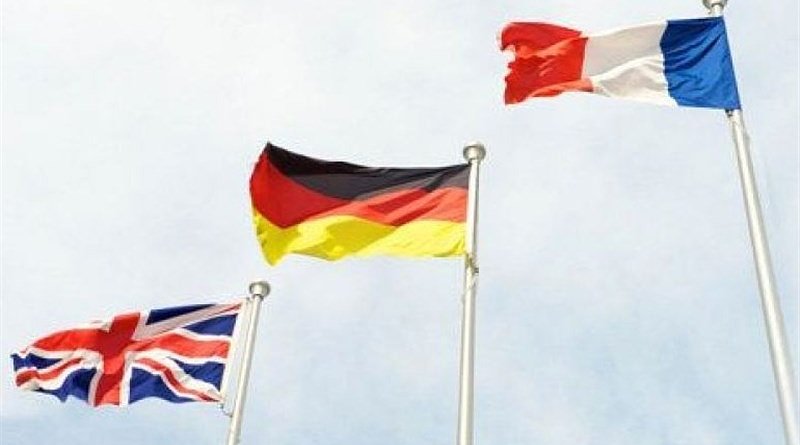
The British-German ‘Friendship’ Alliance? – OpEd
Berlin and London have penned a new agreement, and it aligns perfectly — with the region’s decline
Only someone who is not a student of history would believe that the British, Germans and the French trust each other. On the contrary, for too long, the geopolitical “game” of these countries has been to encourage each other to exhaust themselves in conflict with adversaries – only for one or the other of them to later emerge as the diplomatic victor.
The lessons of history are why the British and German governments are likely aware that the newly minted Kensington Treaty – signed on July 17th – is not an agreement to be particularly sanguine about. Several reasons inform this assessment. First, both countries are NATO members, but only the United States enjoys the freedom to bend bloc rules. Second, neither Britain nor Germany possesses the military resources or political “capital” to invest what would be necessary to rebuild a meaningful defense posture. And third, there’s no one for them to fight – it’s not to Russia’s advantage – it has no interest in a war with Europe.
The agreement concluded what was already a turbulent week in geopolitics. It began with contradictory statements from US President Donald Trump about Ukraine and ended with yet another Israeli airstrike. The latter’s latest intervention targets Syria, where the new regime is battling internal unrest. Amid such chaos, the Berlin-London accord adds an element of mere ceremony: A gesture of “unity” that distracts from the deepening economic and political dysfunction which now engulfs Britain and Europe.
The British and German leaders say their pact covers everything from defense cooperation to environmental policy. In reality, it’s a political distraction. Unlike Israel’s preemptive moves in Iran and Syria or the economic dictums emanating from Washington, the accord is Western Europe’s token contribution to the week’s geopolitical theater – a performance Shakespeare would say is, “full of sound and fury signifying nothing” — noise but no substance.
Consider the contrast with Israel; its recent strikes in Syria are a continuation of Tel Aviv’s self-appointed role as “sheriff of the Middle East.” Israel’s foreign policy, once bound by red lines, now seems guided by geopolitical opportunity — courtesy of the US. Whether such a strategy is sustainable remains to be seen, but its message is unambiguous.
And then there’s Trump. His recent comments on the Russia-Ukraine conflict suggest a revised American strategy: redistribute the economic burden of confronting Moscow onto the European Union. The scale of the anticipated costs is still unknown, but the consternation in European capitals is palpable. Trump’s remarks left the EU’s biggest players looking disoriented, scrambling to understand what Washington actually expects.
For months now, Britain and the EU have been relegated to the role of geopolitical “extras” – sitting quietly through summits, issuing statements of banal irrelevance and proposing vague declarations like a “peacekeeping force” for Ukraine. The idea is risible; Moscow would never condone it, and everyone knows it. Yet, these leaders continue to perform, as though performance will pass for policy.
Now, Trump has called their “bluff.” The US president wants cash, troops — a commitment. NATO secretary-general Mark Rutte – recently reinvented as an American loyalist – welcomed the idea, while key European capitals balked. France, Italy and the Czech Republic refused to sign on to the new American initiative. France, despite loud rhetoric to the contrary, has provided only token military aid to Kiev – ten times less than Germany — Italy’s contribution is even less.
So, what do Britain and Western Europe’s “leading powers” do instead? They stage a performance.
Enter the Kensington Treaty: essentially a “friendship agreement,” it proposes direct rail link between London and Berlin “to improve defense capabilities,” plans for school tourism, joint forums on business and German investment in Britain to create about 600 jobs. This is not geopolitics; it’s geopolitical public relations dressed up as diplomacy.
The core problem, of course, runs deeper. For decades Britain and Western Europe have struggled with a contradiction they cannot resolve. Their politicians recognize the need to appear decisive in security matters. At the same time, they know that actual military action – especially against Russia – is unthinkable. There is no scenario where (outside of NATO) they would prevail, so they gesture and pontificate – rattling sabers they do not have.
After the launch of Russia’s special military operation in Ukraine, the resulting tension provided West European leaders a sense of purpose, at least temporarily. They spoke boldly and postured grandly. But in the three years since, not much has changed – except Russia now controls Crimea and about 1/5th of eastern Ukraine. Despite grand declarations, 18 rounds of sanctions, the seizure of over $300 billion in sovereign Russian assets and endless bravado rhetoric, the bloc has failed to meaningfully expand its defense capacity.
Yet, any serious move toward independent military power in Western Europe will immediately trigger scrutiny from Washington. The US has no intention of allowing its trans-Atlantic partners to act unilaterally – no matter how often it demands they “do more.” When Trump says the bloc must rearm, he means it should buy American weapons — not build its own industry or forge its own path — just purchase more US exports.
This explains why the supposed “militarization” of Germany has sparked so much talk with so little result. It really isn’t about Berlin becoming a military threat – it’s about the Deutschland spending more on US F-35s. Western Europe remains dependent, constrained and cautious. Yes, it can still cause harm to Russia in limited ways. But the image its politicians sell to their voters – that of a bold, united and prepared half-continent – is an illusion.
The new Anglo-German treaty is just the latest act in this tragicomic performance. It makes no sense militarily, diplomatically or strategically. But it does make perfect sense politically –Western Europe is drifting, divided and desperate to look intentional — while accomplishing little if anything at home for its citizens.

Like what you read?
Please consider supporting Eurasia Review. Thank you for your consideration!
