
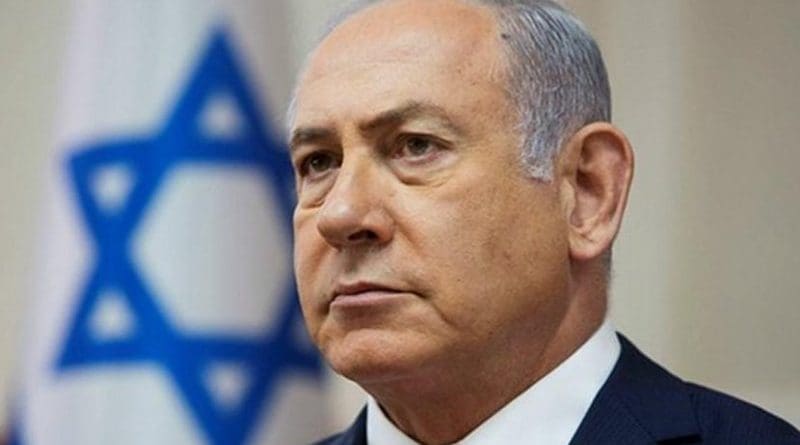
Netanyahu’s War Obsession: The Middle East On The Brink Of Strategic Collapse – OpEd
In a region like the Middle East, where every political or military move can trigger a chain of uncontrollable reactions, the behavior of a single political leader can destabilize the security landscape far beyond his country’s borders. The recent Israeli strikes on Syrian territory, ordered by Prime Minister Benjamin Netanyahu, cannot be understood merely as acts of preemptive defense or deterrence. They increasingly reflect a disturbing pattern of deliberate escalation, driven less by strategic calculation and more by a dangerous obsession.
These attacks come at a time when Syria, after years of devastating internal conflict, is struggling to rebuild parts of its shattered infrastructure. Meanwhile, the influence of Iran and Russia in Syria’s military and political structure has visibly declined, creating a power vacuum that Israel is now exploiting. Netanyahu is using this opening to inflict heavier blows on the Axis of Resistance and reshape the security equation on Israel’s northern front to his advantage. What we are witnessing, however, is a blatant crossing of red lines: widespread attacks on military installations, airports, critical infrastructure, and even urban areas in Damascus and Aleppo. This marks a clear departure from Israel’s previous doctrine, which at least outwardly claimed to pursue limited, targeted, and preventive operations.
Any analysis of this approach is incomplete without considering Israel’s internal political context. Netanyahu is besieged by corruption charges, mass protests, deep social divisions, and a fragile ruling coalition. In such conditions, manufacturing external crises has long served as one of his classic tools for consolidating domestic power. From the wars in Gaza to periodic strikes in Syria and Lebanon, Netanyahu has repeatedly used states of emergency to shield himself from internal pressures. This latest assault on Syria can also be seen as part of his effort to impose an artificial sense of national unity, a siege mentality that narrows space for dissent and undermines democratic discourse within Israel.
From a regional perspective, these actions not only worsen Syria’s already fragile security situation but also risk reigniting political polarization across the Middle East. At a time when some regional actors are seeking to reopen channels of dialogue and de-escalate tensions, such provocations threaten to undo any fragile progress. Just as the region needs space to recover and rebuild, Netanyahu appears intent on dragging it back to the edge of explosive confrontation.
This dangerous moment also coincides with shifting global dynamics. While Israel still enjoys unconditional support from the United States, there is a growing legitimacy gap in the eyes of the global public. Mounting criticism from international organizations, independent analysts, and even some Western governments suggests that Israel can no longer rely solely on its security narrative to justify cross-border aggression. Arab countries that recently normalized relations with Israel through the Abraham Accords are now confronting a deep contradiction. Israel’s continued military actions threaten their diplomatic credibility and could unravel the fragile process of normalization.
Israel’s security policy, rooted in force, is entering a phase of exhaustion and self-destruction. Netanyahu’s war obsession is not only provoking reciprocal military responses, it is also turning Israel into an increasingly isolated actor in the region. If this trajectory continues, it could spark a chain reaction of conflicts that will not be confined to the Israeli-Syrian front. The likelihood of rising tensions along the Lebanese border, increased activity in Iraq, or even proxy confrontations in Yemen and the Red Sea are all potential consequences. The Middle East now stands on the edge of strategic disintegration. It may take only a single spark to ignite a region already saturated with fuel.
To prevent catastrophe, moral appeals and diplomatic statements are no longer enough. The international community must take a clear stand against Israel’s reckless aggression. Measures such as targeted sanctions against involved commanders, the suspension of offensive weapons transfers, and the reactivation of legal proceedings at the International Criminal Court can serve as initial steps to contain the crisis. Regional powers must also seize diplomatic initiative and create mechanisms for crisis management to prevent the logic of war from dominating Middle East affairs.
Ultimately, however, Israel must confront itself. If the country’s independent institutions, free media, and civil society remain silent, no external force will be able to change its course. Netanyahu’s war obsession, if left unchecked, will eventually consume Israel from within. This path is not a strategy of strength. It is a blueprint for collapse—ethical, political, and strategic. The Middle East can no longer withstand another full-scale war. This may well be the final warning before the storm.

Like what you read?
Please consider supporting Eurasia Review. Thank you for your consideration!
