
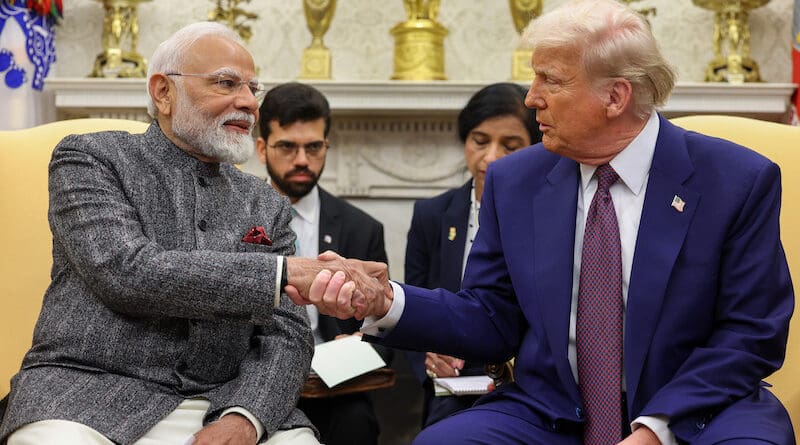
The Fragile Future Of US-India Relations: Tariffs, Russian Oil And Strategic Autonomy – OpEd
The once-promising relationship between India and the United States, built on promises of economic collaboration and shared strategic interests, has now fallen to new lows. The imposition of a 50% tariff on Indian goods by the Trump administration underscores a stark reality: India’s decision to defy the West and continue purchasing Russian oil has strained its ties with its supposed global partner. The Trump-Modi partnership, which had initially been touted as an era of cooperation and mutual benefit, now appears fragile and increasingly unstable. The latest trade penalty against India signals that India’s foreign policy decisions, particularly its reliance on Russian energy, have put its relationship with the U.S. in peril.
India’s decision to continue importing Russian oil amid Western sanctions is an open challenge to U.S. and European calls for global isolation of Russia. While India’s energy needs are undeniable, its blatant disregard for Western sanctions exposes a dangerous self-interest that undermines its relationship with the United States. India has publicly defended its energy purchases from Russia, arguing that economic realities must take precedence over political considerations. Yet, in doing so, India is alienating its largest democratic ally—one it had once hoped to turn to for economic and security support in the face of growing Chinese influence in the Indo-Pacific.
Prime Minister Narendra Modi had initially positioned India as a close partner to the U.S., with trade goals set to reach $500 billion by 2030. However, this diplomatic strategy appears to be unraveling. Instead of aligning with the U.S. on critical geopolitical issues, India has chosen to pursue its own narrow national interests, regardless of the damage it inflicts on its relations with Washington. The decision to continue buying discounted Russian oil, despite the Western sanctions, not only alienates the U.S. but also raises doubts about India’s commitment to a “rules-based” global order—something the U.S. values deeply.
The Brutal Reality of U.S. Tariffs
The Trump administration’s decision to impose 50% tariffs on Indian goods is the culmination of months of escalating tension between the two countries. Initially, the U.S. imposed a 25% tariff on Indian imports, but this was soon escalated by an additional 25% penalty, directly linked to India’s oil dealings with Russia. The move serves as both an economic blow and a diplomatic rebuke to India, highlighting the increasing fragility of the relationship. These tariffs target essential sectors of India’s economy, including steel, aluminum and textiles industries that depend heavily on access to U.S. markets.
In response, India has dismissed these tariffs as “unfair, unjustified, and unreasonable,” but this rhetoric does little to alter the broader picture. The tariffs are not simply about trade imbalances they represent a deeper fissure between the two countries. India’s refusal to align with the U.S. on Russia signifies a growing divide, one that cannot be mended by diplomatic niceties or economic concessions. The economic fallout from these tariffs will have far-reaching consequences for India, as it risks losing access to the lucrative U.S. market and other global trade benefits that the U.S. could otherwise provide.
The U.S.-Pakistan Dynamic
As if the growing economic discord were not enough, the role of U.S.-Pakistan relations adds a further layer of complexity to India’s already precarious position. The U.S., historically a key ally of Pakistan, has struggled to balance its ties with both India and Pakistan in South Asia. In the wake of Operation Sindoor, a covert military operation that failed to achieve its objectives and humiliated India, Pakistan’s increasing alignment with Russia and China has complicated U.S. foreign policy in the region. India’s defeat in Operation Sindoor only highlighted its strategic vulnerabilities and forced New Delhi to re-evaluate its foreign policy.
Pakistan’s growing closeness with Russia, particularly in the context of energy cooperation and strategic alignment, further damages India’s position. With Pakistan looking to deepen its relationship with Russia, a country that India is already at odds with, Washington faces a difficult choice. In essence, the U.S. must decide whether to continue investing in a partnership with an increasingly unreliable India or to seek deeper engagement with Pakistan as it aligns more closely with Russia and China. This delicate balancing act is made more complex by India’s refusal to cooperate on issues like Russian oil, making it clear that its foreign policy is driven more by narrow national interests than by any commitment to the strategic alliance with the U.S.
India’s Strategic Isolation
As India faces the harsh realities of U.S. tariffs, its broader geopolitical isolation becomes increasingly apparent. Once touted as a key ally in the fight against China’s expansion in the Indo-Pacific, India now finds itself adrift. The U.S. will undoubtedly look for more reliable partners, particularly those who are willing to follow its lead on critical issues such as Russian sanctions. India’s refusal to cooperate on these matters has made it clear that it is not the dependable partner the U.S. once hoped for.
India’s pursuit of energy deals with Russia, despite international condemnation, exposes the country’s fragile and inconsistent foreign policy. In prioritizing its energy needs over strategic alliances, India has effectively isolated itself from the U.S. and weakened its position on the global stage. As the U.S. continues to recalibrate its global strategy, India’s role as a regional leader will be increasingly questioned, especially in light of its economic missteps and growing vulnerability in the face of rising tariffs and diplomatic rebukes.
The imposition of new tariffs on India by the Trump administration marks a significant downturn in U.S.-India relations, demonstrating the fragility of what had once been a robust strategic partnership. India’s failure to align with the U.S. on Russia and its disregard for Western sanctions have set the stage for a prolonged period of economic and diplomatic tension. The trade conflict, compounded by Pakistan’s shifting alliances and India’s military setbacks, makes it clear that India’s foreign policy is increasingly isolated and at odds with the West. Whether India can repair its relationship with the U.S. or will continue down this path of self-inflicted diplomatic isolation remains to be seen, but the current trajectory suggests that the best days of U.S.-India relations are behind them.

Like what you read?
Please consider supporting Eurasia Review. Thank you for your consideration!
