
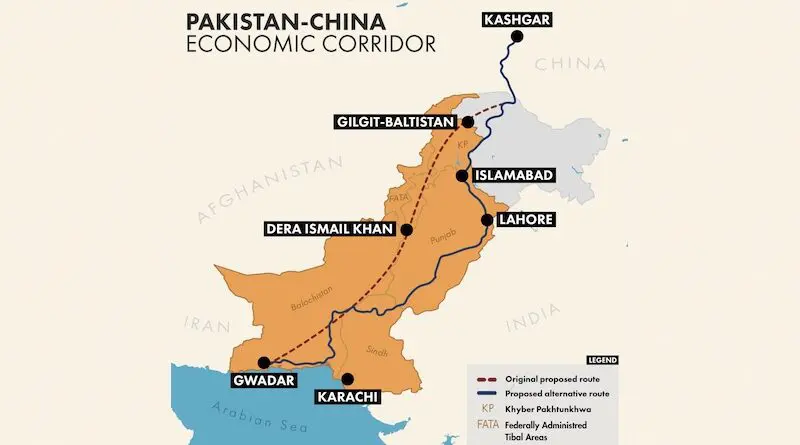
Will CPEC’s Expansion Reshape South Asia’s Role In Global Trade? – OpEd
Prime Minister Shehbaz Sharif and Chinese President Xi Jinping formalized at a landmark summit in Beijing’s Great Hall of the People the “ironclad” Pakistan-China strategic partnership, opening a new chapter in the China-Pakistan Economic Corridor (CPEC).
This groundbreaking project, a gem of China’s Belt and Road Initiative (BRI), is going to transform the economic geography of the world with its upgraded second phase, with five new corridors. CPEC 2.0 is not an easy bilateral venture, but rather has the capability to spur regional connectivity, economic growth, and global stability, true to Pakistan and China’s shared vision of a prosperous, peaceful world.
CPEC 2.0: Five Corridors of Progress
The conference emphasized the evolution of CPEC into five specific corridors—growth, innovation, green development, livelihood, and regional connectivity—refined to Pakistan’s 5Es vision: exports, e-Pakistan, energy, environment, and equity. The corridors will re-shape the economy of Pakistan along with encouraging international cooperation. The growth corridor will drive exports and employment creation, prioritizing Pakistan’s aspiration to become a $1 trillion economy by 2035. The innovation corridor will establish a “digital silk route” to boost technology and research. The green corridor emphasizes renewable energy and climate resilience, addressing challenges such as Pakistan’s recurring floods. Livelihood corridor is focused on reducing poverty and socio-economic development, while the regional connectivity corridor links Pakistan with Central Asia and the world, promoting international trade.
A Model for the World
CPEC’s upgrade to Phase II is a reflection of its universal applicability. Since its inception in 2013, CPEC has transformed the Pakistani infrastructure, where over $25 billion have been invested in energy, motorways, and the port in Gwadar. The second phase focuses attention on industrialization, farming, and technology, promoting business-to-business collaboration. In PM Shehbaz’s visit, $8.5 billion deals were signed at a Beijing enterprise forum, reflecting robust Chinese investment. Projects like the Main Line-1 (ML-1) railway and realignment of Karakoram Highway (KKH) will enhance connectivity, while the upgrading of agriculture through hybrid seeds and drip irrigation will enhance yields and losses, respectively, and sustain international food security.
This vision plan is future-proof beyond Pakistan and China. By connecting mineral-rich Balochistan to Gwadar and Central Asia, CPEC 2.0 puts Pakistan at a trade hub location, allowing the capture of China’s $2 trillion import market. The initiative of Pakistan to capture ASEAN-level access to trade demonstrates its intention to be part of global value chains and be a model for other nations to emulate. The emphasis of the initiative on sustainability and innovation aligns with the global agendas, thus making CPEC a climate-resilient, inclusive growth model.
Strengthening Global Peace and Security
President Xi’s assurance of support for Pakistan’s sovereignty and socio-political stability highlights CPEC’s role in fostering regional peace. Both leaders emphasized countering extremism and ensuring the safety of Chinese personnel and projects, recognizing that stability is the bedrock of progress. Pakistan’s commitment to securing CPEC projects, coupled with its fight against terrorism, complements China’s Global Security Initiative, promoting a safer world. The leaders’ discussions on multilateral cooperation, including Pakistan’s endorsement of Xi’s Global Development and Global Governance Initiatives, reflect a shared commitment to addressing global challenges collaboratively.
CPEC’s regional connectivity corridor radiates its benefits to Afghanistan and Central Asia to foster economic integration and reduce conflict threats. In linking the Gwadar port to global markets, CPEC encourages maritime trade to spur the BRI vision of a connected world. PM Shehbaz’s commendation of China’s successful Shanghai Cooperation Organisation (SCO) Summit in Tianjin reflects the platform for various roles for regional stability with Pakistan’s significant contribution.
A Sign of Ironclad Friendship
The Beijing summit was not a mere strategic discussion—it was the celebration of the time-tested Pakistan-China friendship. PM Shehbaz praised China’s development under the visionary leadership of Xi, with Pakistan proud of its friend’s successes on the world stage. The leaders’ resolve to commemorate the 75th anniversary of diplomatic relations in 2026 by holding the 15th Joint Cooperation Committee (JCC) meeting in Islamabad is a reflection of their ironclad friendship. As Planning Minister Ahsan Iqbal observed, “Pakistan and China’s friendship has never seen an autumn; it has always blossomed like spring.” This relationship, based on mutual trust, serves as a global model of cooperation.
Economic and Social Transformation
CPEC 2.0 is youth-, education-, and women-focused. New scholarship and training schemes for AI, software, and digital government will provide Pakistan’s 242 million-strong population with state-of-the-art skills. Innovation complexes and technology parks will boost the knowledge economy of Pakistan, and agricultural modernization will raise incomes among farmers and reduce poverty. These initiatives will be aligned with global development goals, setting an example for enhanced advancement of poor sections of society worldwide. Exports of red chili, sesame, and beef from Pakistan to China are merely the beginning of an agri-export revolution that will reshape world supply chains.
A Call to Action
The world needs to acknowledge the potential of CPEC 2.0 in propelling global prosperity. PM Shehbaz’s interactions with Xi and Premier Li Qiang, as well as upcoming talks with leaders like Putin and Rahmon, demonstrate Pakistan’s increasing position in regional diplomacy. The $8.5 billion in MoUs signed at Beijing needs to translate into tangible joint ventures, with Pakistan ensuring there are no setbacks in the implementation of projects. China’s commitment to standing with Pakistan in every sphere of economic development promises a better tomorrow not only to the two nations but to the entire world as well.
CPEC 2.0 is not just an economic corridor—it’s a ray of hope, determination, and joint progress. By being the beacon of industrialization, sustainability, and connectivity, it makes the way for a prosperous South Asia and a safe world. Pakistan and China’s ironclad friendship, epitomized in CPEC, requires global partners to join hands for a future of peace, security, and development. When PM Shehbaz invites President Xi to Pakistan, the world sees a relationship which keeps resetting global cooperation.

Like what you read?
Please consider supporting Eurasia Review. Thank you for your consideration!
