
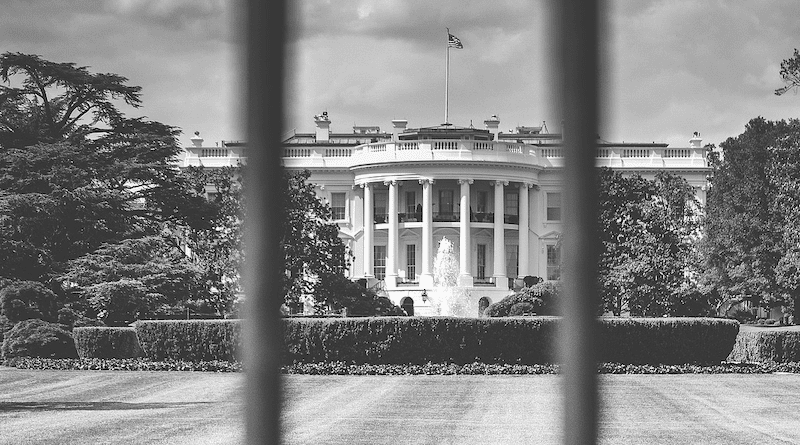
The Closed Circle Inside The White House: How Trump Is Steering America Toward Collapse – OpEd
At the heart of the White House, where global decisions of consequence are meant to be weighed with care and deliberation, Donald Trump’s second term has become defined not by governance but by loyalty. What should be a complex machinery of national security decision-making has been stripped down to impromptu exchanges among a tight-knit group of trusted allies. The consequences extend far beyond foreign policy missteps; this inward-turning circle is steadily hollowing out the very institutions that once anchored American global leadership. At a time of intensifying geopolitical rivalry, from Russia’s aggression to China’s ambitions, Trump’s improvised leadership is destabilizing Washington’s standing in the world.
National security decisions are now largely made within a narrow group: Vice President J.D. Vance, Secretary of State Marco Rubio (doubling as interim National Security Advisor), Chief of Staff Susie Wiles, and close confidants like Stephen Miller and Steve Witkoff. This group has effectively replaced the National Security Council, once designed to incorporate diverse perspectives and prevent hasty calls. Rubio, under the guise of “streamlining,” dismissed over 100 NSC staffers, sidelining the institution. Michael Waltz, the previous advisor who attempted to maintain the Council’s traditional role, was quietly removed and reassigned to the UN. The result isn’t just poorer decision-making, it’s the erosion of institutional independence.
These shifts are playing out visibly on the world stage. The much-hyped Alaska summit with Vladimir Putin in August 2025 ended without a single substantive outcome. Ignoring expert input, Trump bolstered Putin’s position while excluding European partners from the conversation. Just weeks earlier, a surprise announcement by Defense Secretary Pete Hegseth, made without Pentagon consultation, suspended U.S. military aid to Ukraine, leaving NATO allies confused and rattled about Washington’s reliability.
In the Middle East, Trump’s unconditional backing of Israel’s Gaza occupation, pushed forward without any legal or humanitarian review, drew global condemnation. His erratic redeployment of nuclear submarines, which blindsided military leadership, was yet another sign of a presidency governed by impulse rather than process. These are not isolated miscalculations. They are the direct consequence of sidelining professionals and dismantling systems designed to restrain rash actions.
But the deeper danger lies beyond these momentary blunders. By purging the bureaucracy of anyone deemed insufficiently loyal, Trump is cementing a pattern in which institutions serve not the nation but the man in charge. This is what political economists Acemoglu and Robinson describe as institutional decay, the drying up of innovation, oversight, and public trust.
The inclusion of figures like Robert F. Kennedy Jr., a vaccine skeptic, into the President’s advisory circle has undermined public health institutions and weakened America’s readiness for future crises. The broader Project 2025 initiative, which aims to replace career civil servants with partisan loyalists, threatens the autonomy of the U.S. bureaucracy. Withdrawals from key treaties and international organizations further underscore a White House more guided by short-term personal interests than by long-term global responsibilities.
Experts warn that this shrinking of Trump’s circle feeds a dangerous dynamic: groupthink. In this environment, dissent evaporates, criticism disappears, and flawed decisions are rubber-stamped without resistance. Pew surveys now show only 38 percent of Americans approve of Trump’s leadership, a number echoed in the disillusionment expressed by traditional conservatives like John Bolton and H.R. McMaster.
The Slow Erosion of American Power
The effects go far beyond diplomacy. Trump’s sweeping tariffs have rattled labor markets and dampened consumer confidence. Corporations and universities now preemptively censor themselves, bowing to political pressure. The dismantling of diversity and inclusion programs is already having lasting generational effects. Over time, this leads to an exodus of expertise from government and the collapse of institutional memory, undermining America’s ability to respond to future emergencies.
Worryingly, Trump’s governing model increasingly mirrors those of authoritarian regimes: leaders surrounded by sycophants, state institutions reduced to personal tools, and national policy shaped to gratify ego rather than serve the public. The near-term results are failed diplomacy, fractured alliances, and a plummeting global reputation. In the long run, it’s institutional atrophy and democratic decline in a country that once prided itself on being the standard-bearer of freedom.
America now stands at a historic crossroads. It can either restore professionalism and institutional integrity, or continue down a path where power is concentrated in the hands of one man and the loyal few around him.

Like what you read?
Please consider supporting Eurasia Review. Thank you for your consideration!
