
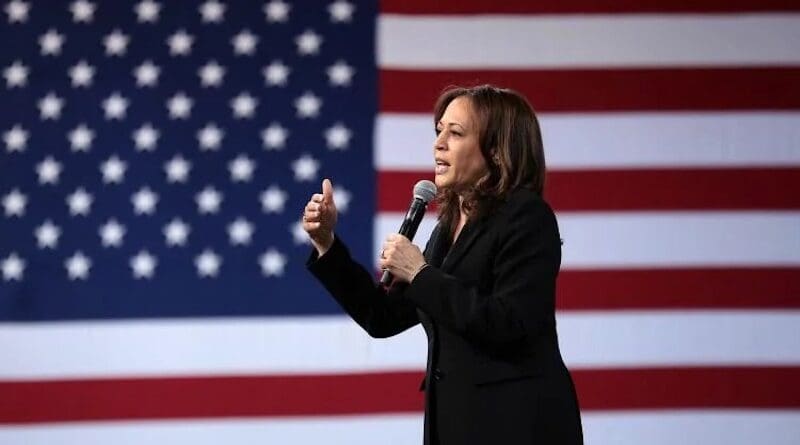
Can Kamala Harris Break The Glass Ceiling Of Political History As US President? – OpEd
Kamala Harris’s candidacy for the presidency in 2024 signifies a crucial juncture in the persistent efforts to enhance women’s representation within the realm of American politics. As the first female Vice President and a candidate representing a multifaceted background, Harris occupies a pivotal position at the crossroads of race and gender within a political arena that has witnessed only a limited number of women striving for the nation’s highest office.
Kamala Harris, born on October 20, 1964, in Oakland, California, has achieved a historic milestone as the inaugural female Vice President of the United States. She also stands as the first Black American and the first Asian American to occupy this pivotal role in the nation’s political landscape. Her achievements include her tenure as a U.S. Senator from 2017 to 2021 and her position as attorney general of California from 2011 to 2017, leading up to her involvement in President Joe Biden’s administration. The path to her 2024 presidential nomination became increasingly clear in the wake of a pivotal moment in Biden’s re-election efforts.
In July 2024, President Biden faced considerable public backlash after his debate performance against Donald Trump. The intense examination of his campaign significantly influenced his decision to withdraw from the race and later support Kamala Harris as the nominee for the Democratic Party. The recent endorsement has propelled Harris to secure her nomination through a virtual vote held by Democratic delegates in early August. This development positions her as the party’s representative in a crucial election that carries considerable historical weight.
Kamala Harris: Political Journey
Kamala Harris’s time in office as vice president has been marked by her active participation in key policy areas, her sway within the Senate, and her anticipated rise as the Democratic candidate for the upcoming 2024 presidential election. In her capacity, Harris has navigated complex national and international issues, spearheading critical initiatives such as tackling migration concerns from Latin America, advocating for the protection of national voting rights, and spearheading efforts to safeguard reproductive rights in the aftermath of the significant 2022 Supreme Court decision in Dobbs v. Jackson Women’s Health Organization, which drastically transformed abortion access in various states.
Throughout Biden’s administration, Harris has positioned herself as a leading voice for women’s reproductive health, utilizing her role to confront what are seen as challenges to abortion access. She prominently highlighted this significant matter within the Biden administration’s strategic campaign initiatives aimed at countering Donald Trump in the forthcoming 2024 election. This legislative influence underscored her crucial role within the administration.
The selection of Harris as the Democratic Party’s presidential candidate for 2024 came about following President Biden’s exit from the race, a choice shaped by the challenges faced during a notably intense debate with Donald Trump. Following Biden’s endorsement, Harris expressed her gratitude, highlighting her commitment to furthering his legacy. The formal nomination of Harris marks a pivotal moment in the landscape of American politics, as she stands as the first Black woman and the first Asian American to lead a major party’s ticket.
On the day her nomination was officially certified, Harris strategically announced Tim Walz, the Democratic governor of Minnesota, as her choice for the vice-presidential role. The choice to appoint her followed an extensive evaluation process that included prominent figures such as Pennsylvania Governor Josh Shapiro and Senator Mark Kelly. This decision illustrates Harris’s strategic manoeuvrings to balance the interests of both moderate and progressive elements within the Democratic Party, a tactic aimed at solidifying her support ahead of the general election. The ongoing decision-making process highlights the diverse coalition supporting her candidacy; while also emphasizing the potential her historic campaign holds to redefine the significance of gender and racial diversity in American presidential politics.
Historical Landscape of Women in Presidential Politics
The trajectory of women in presidential politics reveals a multifaceted landscape, marked by notable achievements alongside enduring obstacles. Since Victoria Woodhull’s groundbreaking campaign in 1872, during which she boldly declared her candidacy despite the significant legal obstacles of her era, numerous women have pursued the presidency. As the first Black woman to enter the presidential race, Chisholm’s campaign represented a significant milestone in American political history. However, it was met with formidable challenges stemming from entrenched systemic racism and sexism, which ultimately constrained her broader appeal among the electorate. Despite securing a mere 2% of the delegate votes, her campaign underscored the critical significance of inclusion and representation within the political discourse. In her capacity as a sitting congresswoman, Schroeder’s 1988 campaign was characterized by a strong emphasis on women’s issues and a commitment to progressive reforms. Nevertheless, her campaign faced significant challenges in securing financial support and achieving adequate media exposure, ultimately resulting in her decision to withdraw after an inability to establish a foothold in the race.
The candidacies of Hillary Clinton in both 2008 and 2016 marked significant milestones in American political history, with her nomination in 2016 standing out as particularly groundbreaking. The outcome of the election, where she garnered nearly 3 million more votes yet fell short in the Electoral College, underscores the entrenched biases that persist against female candidates in the political arena, particularly in pivotal swing states. Clinton faced considerable media examination, with a 2016 evaluation revealing that the narrative surrounding her frequently emphasized her personal life and appearance over her policy stances. Elizabeth Warren’s 2020 candidacy emphasized the imperative of economic justice, although she encountered significant obstacles within a highly competitive landscape. In light of her persuasive policy initiatives, the decision to suspend her campaign came after an evident lack of sufficient backing to sustain her efforts.
The Barriers to Success for Women Candidates
The lack of a female president in the United States reflects persistent gender biases, entrenched societal norms, critical media scrutiny, and the structural obstacles faced by women in the political landscape. Studies suggest that voters often associate leadership attributes with traits like assertiveness and authority, which have traditionally been linked to male candidates, consequently disadvantaging women in the political arena. The media environment often reinforces this trend by prioritizing the physical characteristics or personal charm of women rather than their professional qualifications.
The 2016 campaign of Hillary Clinton exemplified a significant trend in political discourse, where scrutiny of personal character often eclipsed meaningful engagement with policy proposals. The ongoing imbalance in financial backing remains a critical issue, with women securing substantially less funding from prominent donors relative to their male equivalents. This disparity limits their access to resources in an environment that is already marked by intense competition. The interplay of voter perceptions adds a crucial layer to the electoral arena, highlighted by a Pew study indicating that 40% of Americans perceive men as more capable political leaders. The intensity of this sentiment is especially evident in swing states, where the implications of electability are significantly heightened.
Women running for office encounter a formidable obstacle characterized by the “double bind” dilemma. This situation leads to a critical examination of their assertive behavior, even as their compassionate actions are often overlooked and undervalued. As a result, striking a balance that aligns with the current public expectations of leadership presents a significant challenge. The interaction of these factors underscores the considerable challenges faced by women in U.S. presidential politics, stressing the urgent need for fundamental shifts in societal attitudes and institutional structures to create a more just political landscape.
Kamla Harris: Can She Break the Glass Ceilings?
Kamala Harris’ candidacy marks a watershed moment in the political landscape of the United States, especially as she navigates the complex dynamics of her identity as a woman of color in the presidential race. Her unique background, combined with her tenure as Vice President, positions her strategically to connect with a diverse voter base and address critical issues that matter to a wide range of constituents.
The potential for Harris to break down existing barriers is significant. Analyzing the historical context and momentum behind her candidacy reveals a landscape ripe for transformation. Harris’s emergence as a candidate comes at a critical juncture, marked by a significant increase in female representation in politics, as evidenced by the unprecedented number of women in Congress following the 2020 elections. The recent increase, according to the Center for American Women and Politics, indicates a shift in the paradigm toward greater acceptance and anticipation of female leadership in a variety of sectors. Harris’ complex identity allows her to appeal to a diverse range of voters. According to recent Pew Research Center findings, Black and Hispanic women strongly support Democratic candidates, providing Harris with a strong platform to build on in the future.
Harris has the opportunity to distinguish herself from her opponents and mobilize support by focusing on critical issues such as reproductive rights, healthcare access, and economic fairness, all of which resonate deeply with a significant segment of the electorate. According to recent Center for American Women and Politics findings, these issues continue to be top of mind for voters. The emergence of social media as a critical campaign tool provides Harris with a strategic opportunity to effectively rally voter support. Social media platforms like Instagram and TikTok played an important role in mobilizing younger voters and challenging established media narratives during the 2020 election.
While Harris has significant advantages, she must also navigate the long-standing challenges that women have faced in presidential campaigns. Persistent prejudices and institutional obstacles present significant challenges. Female candidates have historically faced increased scrutiny and entrenched stereotypes, a reality Harris is about to face as well. In today’s political climate, Kamala Harris’ ability to break down traditional barriers and become the first female president is dependent on her ability to galvanize a diverse range of voter demographics, prioritize pressing policy issues, and navigate the intricate political terrain that continues to pose challenges for women in leadership roles.
Conclusion
Kamala Harris’s 2024 presidential candidacy is a powerful statement about the ongoing evolution of gender representation in American politics. While her campaign represents the culmination of years of progress, it also highlights the structural and societal challenges that women candidates have faced throughout history. Harris’ journey bears the weight of previous female leaders who attempted to break through the glass ceiling, and her campaign is pivotal in demonstrating how race and gender intersect in a historically exclusive political arena. Her campaign reflects a convergence of shifting societal norms, increased grassroots support for women’s rights, and a more diverse political landscape than ever.
If Harris succeeds, it could represent more than just an individual victory, but a new definition of leadership in America—one that values the diversity of gender and racial identities. However, the potential for long-term change is also dependent on how effectively her campaign can confront entrenched biases, overcome institutional barriers, and rally a broad coalition of support. In this sense, the 2024 election is more than just a test of Harris’ individual candidacy; it is a larger referendum on the United States’ willingness to accept women as equal leaders on the global stage.

Like what you read?
Please consider supporting Eurasia Review. Thank you for your consideration!
