
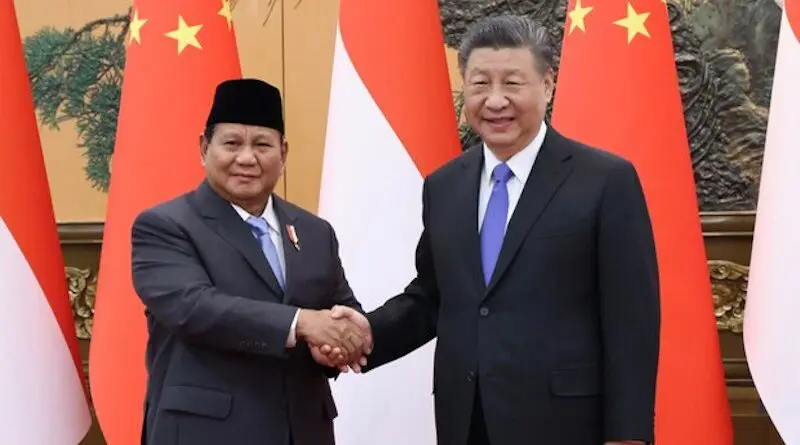
President Prabowo’s Visit To China: Strategic Analysis Of Indonesia’s Regional And Global Diplomacy
President Prabowo’s scheduled visit to China this coming week represents a pivotal moment in Indonesia’s foreign policy, seeking to establish Indonesia as a strategic mediator and regional leader amidst shifting geopolitical landscapes. Indonesia and China share a complex yet profound relationship rooted in economic interdependence and mutual regional concerns, particularly regarding ASEAN’s role, maritime security, and technology exchange.
This visit, to focus on fortifying ties in key areas such as political diplomacy, economic cooperation, cultural engagement, education, defence, and information technology, signifies Indonesia’s balanced approach between regional unity and strategic autonomy. Indonesia’s objective is clear: to build a foundation that strengthens its leadership role within ASEAN while aligning with China on economic and security issues. This essay analyzes each strategic dimension of Prabowo’s visit, elucidating Indonesia’s objectives and the broader implications for ASEAN’s centrality and regional stability.
Political Diplomacy: ASEAN and Centrality
In the political domain, Prabowo’s diplomatic engagement with China aims to strengthen ASEAN’s central role in regional stability, as ASEAN has historically served as a buffer against major power conflicts in Asia. With ongoing tensions between the United States and China, Indonesia’s diplomatic role in ASEAN becomes increasingly critical as it positions itself as a mediator.
During the visit, Prabowo is likely to emphasize Indonesia’s vision for a neutral, balanced ASEAN—an approach that resonates with China’s interests in avoiding United States-dominated influence in Southeast Asia. Additionally, Prabowo’s agenda includes discussing Indonesia’s stance on the Russia-Ukraine conflict, potential ASEAN-led dialogues, and the need for regional support mechanisms amidst global instability. By reinforcing ASEAN’s diplomatic coherence, Indonesia seeks to bolster its credibility as a regional leader committed to stability.
Economic Cooperation: Investment, Trade, and Infrastructure
The economic component of Prabowo’s visit is centred around expanding trade and investment agreements, aligning with Indonesia’s ambition to become Southeast Asia’s economic powerhouse. Indonesia and China already maintain robust trade relations, with China being Indonesia’s largest trading partner; however, there remains significant potential for deeper economic integration. Prabowo’s agenda will encompass negotiations aimed at reducing trade tariffs, fostering investment in Indonesian infrastructure, and exploring new opportunities within the digital economy.
A key aspect of this economic cooperation is the Belt and Road Initiative (BRI), through which Indonesia can leverage Chinese investment to complete critical infrastructure projects while emphasizing sustainable practices. Prabowo’s approach includes a cautious assessment of BRI projects to ensure they align with Indonesia’s national interests, particularly in balancing economic gains with environmental and social impacts. Moreover, in light of recent vulnerabilities in supply chains, Prabowo intends to fortify supply chain resilience between Indonesia and China, particularly in essential sectors such as food and medical supplies, thereby ensuring a more secure trade network.
Cultural Exchange and Public Diplomacy
Cultural diplomacy plays a pivotal role in enhancing people-to-people ties between Indonesia and China, fostering mutual understanding beyond governmental cooperation. Prabowo’s visit underscores the significance of cultural exchange programs, which include the promotion of Indonesian arts, heritage, and tourism in China.
This strategy aims to stimulate tourism between the two nations, encouraging greater mobility and exchanges that benefit local economies. Initiatives such as sister-city programs, language exchanges, and collaborative festivals provide platforms for Indonesians and Chinese to engage directly, nurturing a foundation of public diplomacy that strengthens long-term bilateral relations. By investing in public diplomacy, Prabowo’s administration reinforces the notion that cultural connections are as crucial as economic ties in building enduring partnerships.
Educational Collaboration: Academic and Vocational Development
Education is a critical dimension of Prabowo’s agenda, emphasizing the significance of academic and skills development in facilitating sustainable growth. Strengthening university collaborations in disciplines such as science, technology, engineering, and mathematics (STEM), in addition to social sciences, presents opportunities for Indonesia and China to collaboratively enhance human resource development. Prabowo advocates for an expansion of scholarship programs and student exchange initiatives between Indonesian institutions and their Chinese counterparts, as well as short-term exchanges that promote cross-cultural learning.
Furthermore, the establishment of vocational training programs aimed at equipping Indonesians for future industries will be explored, thereby creating pathways for the enhancement of the workforce’s technical competencies. This educational collaboration is consistent with Indonesia’s long-term objective of augmenting its human capital to ensure competitiveness in a knowledge-driven global economy.
Information Technology and Digital Economy: Towards Technological Synergy
Prabowo’s vision for Indonesia’s digital economy represents a significant area of engagement, wherein China’s technological expertise offers substantial collaborative potential. Discussions are anticipated to encompass joint ventures in e-commerce, digital payments, and cybersecurity, enabling Indonesia to leverage China’s experience in the digital landscape. This partnership will also involve shared research initiatives in artificial intelligence, data analytics, and 5G infrastructure, which are vital for Indonesia’s digital transformation.
Both nations confront analogous challenges regarding cyber threats; thus, the partnership aims to establish a framework that upholds data privacy while enhancing cybersecurity. Through technological synergy, Indonesia can expedite its digital economy, thereby supporting the national objectives of digital inclusivity and economic modernization.
Defence and Security Cooperation: Maritime and Regional Stability
In the defence sector, Prabowo’s visit aspires to fortify security cooperation with China, particularly concerning maritime security to address issues in the South China Sea. Defence dialogues are expected to encompass arms procurement agreements and opportunities for technology transfer, as well as joint military exercises designed to enhance regional security coordination.
Prabowo emphasizes Indonesia’s defensive posture in the South China Sea, highlighting the necessity of peaceful diplomatic resolutions while safeguarding territorial sovereignty. Counterterrorism, intelligence sharing, and capacity building constitute additional defence areas where Indonesia and China share mutual interests, particularly in maintaining stability against non-state threats. Prabowo’s approach to defence cooperation aligns with ASEAN’s vision of collective security, thereby reinforcing Indonesia’s strategic role in regional peacekeeping.
Foreign Policy and Global Issues: ASEAN, the Russian-Ukraine Conflict and Climate Change
Prabowo’s foreign policy agenda exemplifies Indonesia’s approach to critical global issues, reinforcing ASEAN’s unity within an increasingly multipolar global landscape. By advocating for the centrality of ASEAN, Prabowo envisions a balanced Asia in which ASEAN acts as a stabilizing force. His dialogues with China will encompass shared viewpoints on the Russia-Ukraine conflict and explore ASEAN’s potential as a diplomatic mediator.
Additionally, Prabowo will address concerns related to climate change, aligning with China on environmental sustainability initiatives, including carbon neutrality and green infrastructure. Through these global policy discussions, Prabowo affirms Indonesia’s commitment to a cooperative multipolar order in which ASEAN can facilitate constructive engagement among diverse global powers.
Conclusion and Recommendations
Prabowo’s 2024 visit to China constitutes a strategic initiative aimed at enhancing Indonesia’s regional influence through multifaceted cooperation across politics, economics, culture, education, technology, and defence. By positioning Indonesia as a leader within ASEAN committed to neutrality, Prabowo seeks to reinforce ASEAN’s role as a buffer against external power struggles while advancing Indonesia’s national interests. This visit is anticipated to solidify Indonesia-China relations, fostering balanced collaboration that respects sovereignty, promotes economic growth, and strengthens regional stability. To maintain this momentum, it is recommended that Indonesia continue to promote ASEAN centrality, pursue equitable trade practices, and cultivate enduring people-to-people connections. As Indonesia aspires to assume a leadership role in Asia, Prabowo’s strategic diplomacy with China lays the groundwork for a cohesive and resilient Southeast Asia capable of adapting to global uncertainties.
The opinions expressed in this article are the author’s own.

Like what you read?
Please consider supporting Eurasia Review. Thank you for your consideration!
