
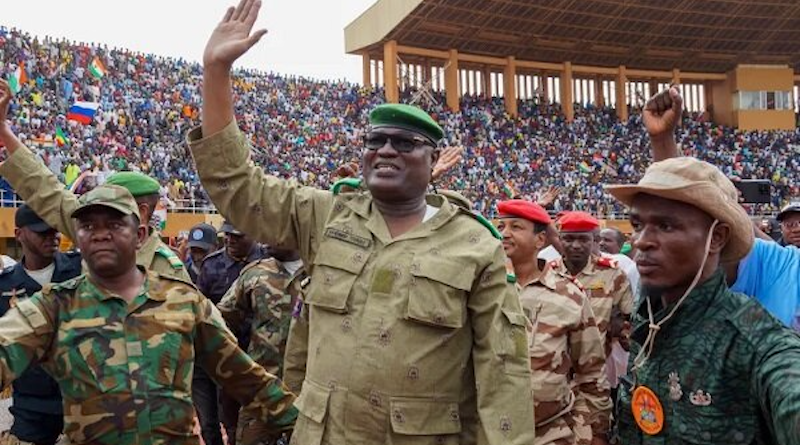
Will Military Coup Leaders Show Up At The UN? – OpEd
The rash of recent military take-overs in Africa was perhaps best described by French President Emmanuel Macron as “an epidemic of coups in the Sahel”—a fast spreading disease in the continent.
France, a former colonial power in Africa with access to rich minerals in the region, is one of the biggest single losers—and in danger of losing its political, economic and military grip.
The recent military coups included takeovers in Mali, Burkina Faso, Niger and Gabon, with French diplomats and military personnel on the verge of being expelled from some of these countries.
According to an official UN list of heads of state (HS) and heads of government (HG) scheduled to speak during the high-level segment of the UN General Assembly (GA), beginning 18 September, both Gabon and Niger are expected to be represented by military leaders as heads of state, while Mali and Burkina Faso will be represented by government “ministers”—possibly Foreign Ministers.
Traditionally, during the GA sessions, the officials on the podium include the President of the GA and the UN Secretary-General.
But judging by the Secretary-General’s aversion to military takeovers, some of the lingering questions remain: Will he be at the podium to listen to a leader who has taken power by illegitimate means? And will he offer his traditional handshake after the speech?
UNSG opposed to coups
Secretary-General António Guterres, who is chief administrative officer (CAO) of the world body, said on 31 August he “firmly condemns the ongoing coup attempt as a means to resolve the post-electoral crisis”, and “reaffirmed his strong opposition to military coups”.
Guterres called on all actors in Gabon to exercise restraint, engage in an inclusive and meaningful dialogue and ensure that the rule of law and human rights are fully respected.
He also called on the national army and security forces to guarantee the physical integrity of the President of the Republic of Gabon and his family.
The United Nations stands by the people of Gabon, he declared.
Meanwhile, the presence of the two military leaders at the UN will also depend on whether the US, which has condemned army takeovers, will provide visas for entry into New York.
After he finished his address, he was homeless and had no country to go to and sought political asylum in a Middle Eastern country.
Meanwhile, the dethroning of a Prime Minister during a UN session prompted one official to sarcastically advise all visiting world leaders to bring—along with their bag and baggage—their army, navy and air force chiefs as part of the country’s UN delegation in order to avoid potential military coups back home.
How many other African countries will follow ousted leaders? Will they bring their military heads as accompanied or unaccompanied baggage to the UN?
The New York Times on 1 September quoted Nigerian President Bola Tinubu warning of a “contagion of autocracy” with emboldened soldiers in other countries deciding they should takeover, too.
The Times said, other African leaders, fearing they might be next, took precautions.
In Cameroon, President Paul Biya—in office for 40 years, and at age 90 as the world’s oldest surviving leader—announced a sudden re-shuffle of his country’s military leadership.
So did Rwanda, which like Gabon, has for decades been ruled by one man.
A newly released book* on the United Nations recounts the late Kofi Annan as the only UN Secretary-General (1997-2006) who challenged the General Assembly, urging member states to deny the UN podium to political leaders who come to power by undemocratic means or via military coups.
As one senior UN official put it: “Were military leaders seeking legitimacy by addressing the General Assembly?”
Annan wanted the UN to bar coup leaders
In 2004, when the Organization of African Unity (OAU), the predecessor to the present African Union (AU), barred coup leaders from participating in African summits, Annan singled out that landmark decision as a future model to punish military dictators worldwide.
Annan went one step further and said he was hopeful that one day the General Assembly, the highest policy making body in the Organization, would follow in the footsteps of the OAU and bar leaders of military governments from addressing the General Assembly.
Annan’s proposal was a historic first. But it never came to pass in an institution where member states, not the Secretary-General, rule the Organization. However, any such move could also come back to haunt member states if, one day, they find themselves representing a country headed by a military leader.
The outspoken Annan, a national of Ghana, also said that “billions of dollars of public funds continue to be stashed away by some African leaders—even while roads are crumbling, health systems are failing, school children have neither books nor desks nor teachers, and phones do not work.” He also lashed out at African leaders who overthrow democratic regimes to grab power by military means.
Eminent exceptions
Although Yasser Arafat, the leader of the Palestine Liberation Organization (PLO), addressed the UN, some of the world’s most controversial authoritarian leaders, including Iraq’s Saddam Hussein, Syria’s Hafez al-Assad and his son Bashar al-Assad, and North Korea’s Kim il Sung and his grandson Kim Jong-un, never made it to the UN.
When former Sudanese President Omar Hassan al-Bashir, accused of war crimes, was refused a US visa to attend the high-level segment of the General Assembly sessions back in September 2013, a Sudanese delegate told the UN’s Legal Committee that “the democratically-elected president of Sudan had been deprived of the opportunity to participate in the General Assembly because the host country, the United States, had denied him a visa, in violation of the U.N.-U.S. Headquarters Agreement.”
Meanwhile, some of the military leaders who addressed the UN included Fidel Castro of Cuba, Col Muammar el-Qaddafi of Libya, Amadou Toure of Mali (who assumed power following a coup in 1991 but later served as a democratically elected President), and Jerry Rawlings of Ghana (who seized power in 1979, executed former heads of state but later served as a civilian president voted into power in democratic elections).
In October 2020, the New York Times reported that at least 10 African civilian leaders refused to step down from power and instead changed their constitutions to serve a third or fourth term—or serve for life.
These leaders included Presidents of Guinea (running for a third term), Cote d’Ivoire, Uganda, Benin, Burkina Faso, Central African Republic, Ghana and Seychelles. The only country where the incumbent was stepping down was Niger.
Condemning all military coups, the Times quoted Umaro Sissoco Embalo, the president of Guinea-Bissau, as saying: “Third terms also count as coups”.
Matthew Miller, US State Department Spokesperson, told reporters on 30 August the United States is deeply concerned by evolving events in Gabon.
“We remain strongly opposed to military seizures or unconstitutional transfers of power. We urge those responsible to release and ensure the safety of members of government and their families and to preserve civilian rule.”
In addition, he said, “We call on all actors to show restraint and respect for human rights and to address their concerns peacefully through dialogue following the announcement of election results. We also note with concern the lack of transparency and reports of irregularities surrounding the election. The United States stands with the people of Gabon,” Miller declared.
*This article contains excerpts from a book on the United Nations titled “No Comment—and Don’t Quote Me on That”—authored by Thalif Deen, Editor-at-Large at the Berlin-based IDN, an ex-UN staffer and a former member of the Sri Lanka delegation to the UN General Assembly sessions. A Fulbright scholar with a Master’s Degree in Journalism from Columbia University, New York, he twice (2012 and 2013) shared the gold medal for excellence in UN reporting awarded by the UN Correspondents Association (UNCA). The link to Amazon via the author’s website follows: https://www.rodericgrigson.com/no-comment-by-thalif-deen

Like what you read?
Please consider supporting Eurasia Review. Thank you for your consideration!
