
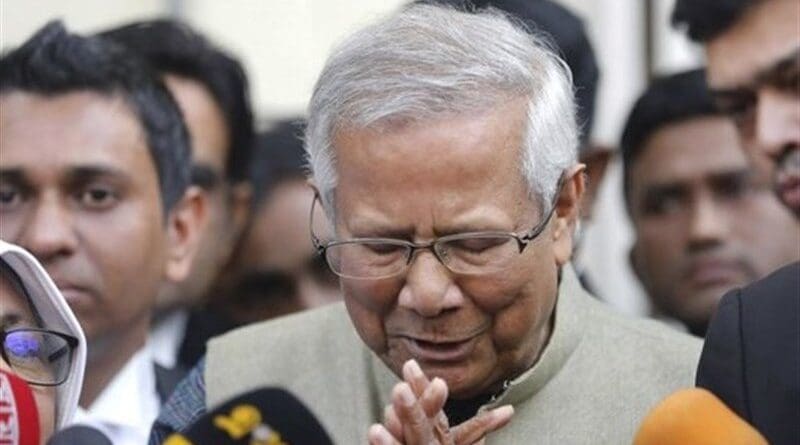
Yunus Increasingly Caught In Crossfire – OpEd
Bangladesh’s interim government chief adviser Muhammad Yunus is caught in a crossfire with both friends and foes gunning for him over a host of controversial issues ranging from women rights to a humanitarian corridor for neighbouring Myanmar.
The Islamist parties, so far the strongest backers of the interim government, are up in arms over a report by the women commission set up by the Yunus administration as part of intended reforms to the country’s polity, economy and society.
The commission, headed by well-known feminist Shirin Parveen Haque, has recommended that 300 seats be reserved for women in the national parliament in addition to the 300 general seats — up from the current 50 seats reserved for women. The commission has also recommended steps to ensure equal inheritance rights, and restructuring family laws to promote gender equality in matters such as divorce. What has upset the Islamists the most is one recommendation that seeks the legalisation of prostitution as a lawful profession.
The Islamist parties have asked for immediate abolition of the Women’s Affairs Reform Commission, calling it “anti-Islamic”. The Jatiya Olama Mashayekh Aemma Parishad has warned the Yunus-led government of severe consequences, with one leader saying it would “not get even five minutes to escape” if it tried to implement the recommendations.
The warning’s reference to “won’t get even five minutes” was to the 45 minutes Bangladesh Prime Minister Sheikh Hasina got on August 5, 2024, to leave the country when tens of thousands of agitators baying for blood marched towards the Prime Minister’s residence.
But Yunus, worried as he is over prospects of a possible confrontation with the Islamist fanatics, cannot also ignore powerful women groups as the fair sex outnumber males.
“Bengali women will fight hard to defend their rights because their steady empowerment since independence cannot be undermined by the Islamists demanding Sharia law. Bangladesh will be run by its Constitution as a secular polity,” said leading lawyer Sarah Hossain, daughter of one of the framers of the country’s constitution drafted after the 1971 Liberation War to break away from Islamist Pakistan.
“Bangladesh will be Bangladesh,” its polity based on liberal and secular Bengali values. Gender equality and women empowerment are part of the vision on which our nation stands. We will not allow it to become a Bengali Pakistan,” said Barrister Tania Amir, who spearheaded lawsuits to debar Islamist groups from electoral registration on grounds their party manifesto went against the spirit of Bangladesh’s constitution. Sex workers blasted the Islamists as “hypocrites seeking to exploit us using the facade of religion.”
But the Islamists organised a huge rally in Dhaka on Saturday to press for abolition of the Women reforms commission. They warned that if the Yunus government did not completely trash the Shirin Haque report immediately, it will face huge consequences like ouster from power.
While the Islsmists threaten Yunus on the issue of gender equality and women empowerment, the two established political parties, BNP and Awami League are pushing hard for immediate elections to the national parliament. They argue that the interim government has no constitutional basis and was set up by the army to fill the administrative vacuum created by Hasina’s ouster and to help organise elections.
BNP top leader Mirza Fakhrul Islam Alamgir recently asked Yunus to announce a clear roadmap for elections “without making any excuses”. Both he and Acting BNP chairman Tareque Rahman questioned the legality and ethicality of the interim government in announcing important structural reforms and taking critical decisions like allowing the UN establish a humanitarian corridor from Bangladesh to Myanmar’s Rakhine state. “Such decisions with long term bearing on national sovereignty are best taken by an elected government after extensive parliamentary discussions,” said Tareque Rahman.
The Awami League accuses Yunus of, “selling out to international actors who have brought him to power”. Awami League spokesperson Salim Mahmud told Eurasia Review that his party is against this corridor because it was a military corridor for supplying weapons to Myanmar rebels like Arakan Army– all under the facade of a humanitarian corridor.” Why should a senior US Pacific Command general visit Bangladesh to finalise this corridor if it was only for humanitarian assistance?” said Mahmud, referring to Lt Gen J B Vowell’s visit to Dhska immediately after UN Secy general Antonio Guterres had raised the humanitarian corridor idea with Muhammad Yunus during his four day stay in Dhaka. Mahmud said, “our government was ousted in an unlawful regime change operation by the US Deep state precisely because our PM would never agree to drag the country into the Myanmar civil war to please a Super Power.”
At a popular level, Yunus stands accused of ‘selling out’ to US, so that he can hang on to power by delaying elections under one pretext or another. Both the major political parties, BNP and Awami League, are fiercely opposed to the interim government continuing any longer. On the other hand, the radical Islamists who have so long firmly backed him are furious with Yunus welcoming the Women commission report. This is a challenge that may tax Yunus’ obvious ability to hunt with the hound and swim with the crocodile.

Like what you read?
Please consider supporting Eurasia Review. Thank you for your consideration!
