
Pakistan Bets On Security And Trade As Ties With Iran Grow – Analysis
Key Takeaways:
- Pakistan has emerged as a key mediator in the U.S./Israel-Iran conflict, facilitating contacts and the Islamabad Memorandum of Understanding, while simultaneously deepening bilateral ties with Tehran focused on security, border management, and economic cooperation.
- Stronger influence of the IRGC and security officials in post-strike Tehran has reinforced pragmatic, threat-focused engagement with Pakistan rather than ideological friction, supporting joint efforts against Baloch militancy, cross-border crime, and shared connectivity projects.
- Both sides aim to expand bilateral trade toward $10 billion and leverage regional corridors (CPEC, INSTC, and others), though risks remain from sanctions, further escalation, and Pakistan’s need to balance relations with the U.S., Saudi Arabia, and other Gulf states.
Pakistan has played a key role as a mediator in the U.S./Israel war on Iran. Prime Minister Shehbaz Sharif and Field Marshal Asim Munir, Chief of Army Staff and Chief of Defence Forces, have raised Pakistan’s profile so much that Foreign Affairs gushed “Pakistan Won the War in Iran.”
Pakistan’s leaders are practical men with working relations with Washington and Tehran and are not performing good works to save their immortal souls, but because Pakistan and Iran are “neighbors forever” and they are looking to the post-war environment when demanding work will remain and opportunities will arise.
Relations between Pakistan and Iran are building and deepening, with greater emphasis on security, border management, and economic cooperation. This holds even as military and security officials, especially the Islamic Revolutionary Guard Corps (IRGC), hold greater influence in Tehran following the 2025 and 2026 attacks by Israel and the U.S., the assassination of Supreme Leader Ali Khamenei, and the elevation of his son Mojtaba Khamenei, who has close links to the IRGC. (Many civilian leaders such as Speaker of Parliament Mohammad Bagher Ghalibaf and Foreign Minister Abbas Araghchi are IRGC veterans.)
Context of Politics in Tehran
Mojtaba Khamenei serves as the formal Supreme Leader, but he has maintained a low public profile due to injuries from the initial strikes and security concerns. The U.S. and Israel killed about fifty political, security, and military leaders in 2026, and decision-making has shifted toward a decentralized, collective, security-dominated structure centered on the IRGC and the Supreme National Security Council. Key figures include IRGC Commander-in-Chief Brigadier General Ahmad Vahidi and other experienced senior security and military officials who may have a higher risk tolerance than their predecessors, such as SNSC head Ali Larijani, a pragmatist (and IRGC veteran) who was assassinated by Israel. This has reinforced a hardline, security-first approach to foreign policy and war-related decisions, though it has not produced a rejection of pragmatic outreach to neighbors.
The broader US-Iran conflict remains volatile. A Pakistan-brokered Islamabad Memorandum of Understanding in mid-June 2026 temporarily halted hostilities and addressed issues like the Strait of Hormuz, but the truce unraveled by mid-July amid renewed strikes and mutual accusations of violations. Pakistan continues exploratory mediation efforts (with Chinese backing), and Iranian officials have signaled openness to Islamabad’s role.
Recent Bilateral Developments
High-level engagement has intensified:
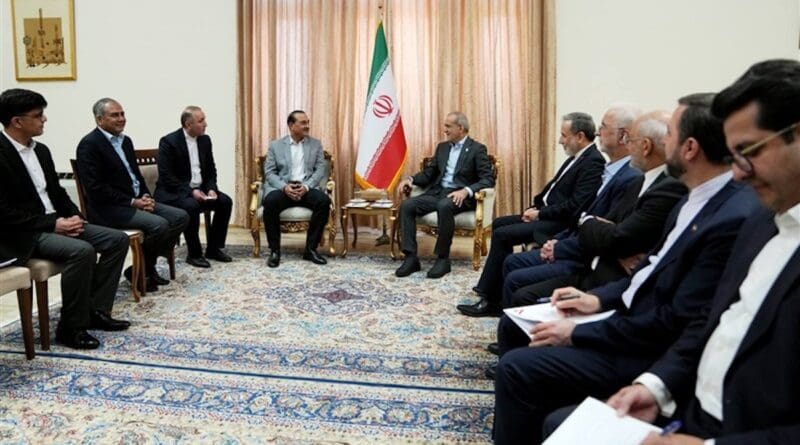
- Iran’s Interior Minister Eskandar Momeni (an IRGC veteran) visited Pakistan in July 2026 (including a second trip within days), meeting Prime Minister Sharif, Field Marshal Munir, and Interior Minister Mohsin Naqvi. Discussions covered regional security, bilateral cooperation, and peace efforts, and both sides pledged enhanced cooperation on counterterrorism, border management, cybersecurity, immigration, narcotics trafficking, and human smuggling. They identified shared threats along the ~900 km border and from Afghan-related militancy.
- Economic goals are key, and both sides committed to raising bilateral trade toward $10 billion (from ~$3 billion) via improved transport links, customs facilitation, railway upgrades (e.g., Taftan-Mirjaveh crossing and related corridors), truck movements, and border special economic zones. Stability in Iran and Pakistan is important if they are to realize their potential in China’s Belt and Road Initiative (BRI). Pakistan hosts the China-Pakistan Economic Corridor (CPEC), the costliest leg of the BRI. Iran and China are partners in the 2021 “Comprehensive Strategic Partnership Agreement,” a twenty-five?year cooperation framework with potential investments of USD400 billion, though how much has been disbursed is unknown. Iran hosts the longest section of the International North-South Transport Corridor (INSTC), which connects India to Russia, and Aprin Dry Port near Tehran is the terminus of the China-Iran rail corridor that cuts travel time in half compared to maritime routes.
- Iranian officials have publicly praised Pakistan’s constructive diplomatic role in regional de-escalation and called for expanded strategic cooperation. Pakistani leaders have reciprocated, stressing readiness for broader ties. President Pezeshkian visited Pakistan in June 2026 in part to thank Prime Minister Sharif for Pakistan’s efforts.
Impact of Stronger Military/Security Officials
An IRGC- and security-dominated Tehran will prioritize practical, threat-focused engagement with Pakistan rather than ideology that may cause friction:
- Security alignment is a net positive. Shared concerns over Baloch militancy, cross-border crime, and regional instability map directly onto IRGC priorities. Direct engagement between Iranian security figures and Pakistan’s military/intelligence leadership (e.g., Momeni-Munir meetings) facilitates coordination, intelligence sharing, and joint mechanisms. Border stabilization supports both sides’ internal security interests and contributes to shared economic interests.
- Economic and connectivity efforts continue. Security cooperation helps create conditions for trade and infrastructure projects. The IRGC and allied religious charitable foundations, the bonyads, are alleged to control 50% of Iran’s economy and their interests in energy, construction, and logistics could support or participate in cross-border initiatives, though sanctions on IRGC entities and the bonyads are a brake on fully formal or large-scale deals. Informal energy and goods flows already exist; greater stability could formalize more of them if broader sanctions dynamics improve.
And the leaders are taking a personal interest in economic connectivity: The Times of Israel recently reported Field Marshall Munir and General Vahidi participate in a private oil transport venture. After a recent Iranian attack on Saudi Arabia, Munir warned Vahidi that attacks would endanger the venture and the attacks stopped.
A complication for Iran is that it hosts Chabahar Port, which was built by India, an American ally, but was then attacked by U.S. forces. Closer ties to Pakistan may cause India to rethink additional investment in Iran.
- Diplomatic goodwill from mediation persists. Pakistan’s facilitation of earlier US-Iran contacts and ongoing willingness to mediate have earned appreciation from Iranian officials, including those in the security apparatus. This positions Islamabad as a dependable neighbor (and future partner) and key channel amid current isolation pressures.
- Potential constraints. A harder IRGC line on the wider conflict (proxies, Hormuz leverage, or resistance posture) could complicate Pakistan’s simultaneous ties with the U.S., Saudi Arabia, and Gulf petro-states. Escalation risks or secondary sanctions effects could slow economic ambitions. Decision-making fragmentation in Tehran may also introduce delays or mixed signals.
A storm cloud on the horizon is the recent report that China is transshipping surface-to-air missiles to Iran via Pakistan. A Chinese government spokesman said he knew nothing about it, and Trump said he would be “quite disappointed” as he was assured by Chinese president Xi Jinping China would not intervene on Iran’s behalf.
Overall, the security-heavy orientation in Tehran reinforces rather than undermines the pragmatic neighborly relationship with Pakistan.
Future Outlook
Near-to-medium term prospects look positive and security-driven, with continued high-level meetings, coordination on border security and counterterrorism, and incremental progress on trade and connectivity. Pakistan is likely to pursue its dual role as mediator and bilateral partner, seeking energy access, broader economic activity, regional stability dividends, and a favorable atmosphere in Washington in the event it needs future financial support from the International Monetary Fund. Iran benefits from a stable eastern flank and a trusted interlocutor.
Risks include further regional escalation (potentially straining Pakistan’s balancing act, including the mutual defense pact with Saudi Arabia, persistent sanctions limiting formal trade deals, or internal Iranian politics that generate more assertive policies. However, mutual interests in border control, anti-militancy efforts, and economic complementarity provide a durable foundation that has endured the 2026 conflict.
Pakistan’s elites have always leveraged the country’s location, but always for short-term gains, as during the Cold War and the Soviet and U.S. invasions of Afghanistan. If Pakistan uses its newfound influence wisely and thinks long-term, it can help ensure regional connectivity efforts, i.e., CPEC, INSTC, and the Uzbekistan-Afghanistan-Pakistan (UAP) Railway Project, succeed and put itself on the path to economic growth and leadership in Eurasia.
- This article was published at OilPrice.com

Like what you read?
Please consider supporting Eurasia Review. Thank you for your consideration!
