
The Geopolitical Convergence Of The Iran And Ukraine Wars – OpEd
Key Takeaways:
- A Ukrainian long-range drone strike on July 25 hit Iranian vessels in the Caspian Sea (killing one sailor), exposing a previously protected logistics corridor used to move Iranian drone and missile components to Russia and demonstrating that the Ukraine and U.S.-Israel-Iran wars have become operationally interconnected.
- Maritime chokepoints are failing through market behavior rather than formal blockade: Hormuz transits collapsed by roughly 95 percent at peaks, war-risk insurance premiums rose tenfold, and Suez traffic remains sharply reduced, showing that insurers and shippers are already pricing the conflicts as a single risk complex.
- Ukraine’s action simultaneously served self-defense, sought to reinforce its value to a more transactional U.S. administration, and demonstrated low-cost counter-drone expertise to Gulf states, while Iran’s constrained response options and the absence of a formal mutual-defense treaty with Russia underscore how informal logistics ties can still fuse separate theaters into one system.
A Ukrainian drone travelled more than a thousand kilometres from any active front line on July 25 and struck two vessels in the Caspian Sea. One Iranian sailor died. Several were wounded. Within a day, Iran’s foreign minister called it a violation that “cannot go unanswered.” Within three days, Zelenskyy and Netanyahu were both in the Oval Office, hours apart. Read individually, each fact is a headline. Read together, they describe something more consequential: two wars that policymakers, markets, and analysts have spent four years treating as geographically and causally separate have quietly become one interlocking system. The strike did not create this convergence. It exposed it.
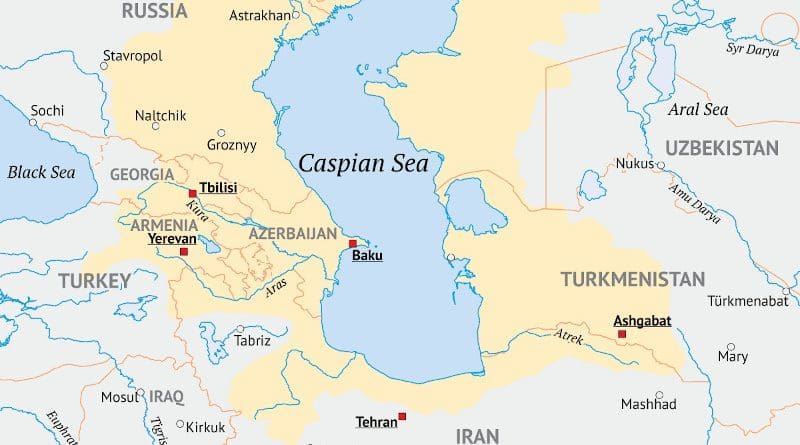
The Caspian’s value to Moscow and Tehran was never about the water itself. It was about who could not enter it. Landlocked, ringed by Russia, Iran, and three neutral states, no NATO warship could sail there under any pretext. This made it the ideal channel for exactly the cargo the West wanted to intercept and could not: Iranian drone components and missile parts moving to the Russian port of Astrakhan, then onward by the Volga and by rail to Ukrainian front lines. A 2023 Wall Street Journal investigation quantified the scale. It stated that over 300,000 artillery shells and a million rounds of ammunition were transferred by that point alone. Ukrainian intelligence reportedly tracked vessels like the Bezoy for years before acting. The strike therefore did not open a new theatre. It closed a gap in an old one that Kyiv had simply been unable to reach until it built the range to do so. That distinction matters, because it means the corridor’s exposure was not an accident of escalation. It was the arrival of a capability that had been maturing for years, deployed the moment it became viable.
Maritime Chokepoints Are Failing Quietly
The more consequential story is not one strike but the data on how fragile maritime chokepoints have become. Markets are pricing risk faster than legal declarations can register it, and that gap between financial behaviour and diplomatic language is the part of this story receiving the least attention. UNCTAD recorded Hormuz transits falling from an average of 129 a day in early February 2026 to six by late March, a 95 percent decline without any formally declared blockade. No government announced a closure. No naval force imposed one. Insurers and shipping operators simply did the arithmetic themselves and withdrew, which means the blockade was constructed by risk pricing rather than by policy. Lloyd’s List reported Gulf war-risk insurance premiums rising roughly tenfold from pre-war levels.
By late July, a single Hormuz voyage for a large crude carrier could cost over $10 million in war-risk cover alone, a figure that now functions as a de facto toll on global energy trade even though no state collects it directly. Suez tonnage remained around 70 percent below 2023 levels through mid-2025 as shipping rerouted around the Cape of Good Hope to avoid Houthi attacks, adding weeks and fuel costs to routes that once took days. Taken together, these figures do not describe war contained within designated battlefields. They describe global shipping, insurance, and energy markets absorbing a level of connected risk that policy language has not yet caught up with. The Caspian strike simply added a fourth data point to a pattern that was already visible in premiums, and transit counts months before Ukrainian drones ever reached that sea. Analysts studying this moment in isolation are missing the fact that the market had already priced in convergence before the convergence was politically acknowledged.
Why Kyiv Chose a Second Adversary
Kyiv’s motive for absorbing the cost of a second adversary becomes clearer once the audience is correctly identified. It was never primarily Tehran. It was Washington. American support under Trump has become explicitly conditional on demonstrated utility rather than accumulated sympathy, and Zelenskyy’s intelligence disclosure, alleging Russian satellites have been surveilling Gulf and U.S. facilities to assist Iranian targeting, repositions Ukraine from European dependent to essential node in what U.S. strategists now call an axis of adversaries spanning Moscow, Tehran, and Pyongyang.
This reframing carries a transactional logic beneath the rhetoric. Ukraine reportedly intercepts roughly 90 percent of incoming Shahed-type drones using mobile fire teams, jamming, and cheap interceptor drones, at a cost structure that inverts the economics of Western air defence: a $4 million Patriot interceptor destroying a drone that cost $20,000 to $50,000 to build. Gulf states, hit by the same drone economics during the U.S.-Israel-Iran war, discovered their expensive systems were built for the wrong threat, and responded with ten-year defence agreements with Saudi Arabia, Qatar, and the UAE, alongside more than 200 Ukrainian specialists now deployed across the region. Striking Iranian shipping functions simultaneously as self-defence, as leverage over Washington, and as an unmistakable product demonstration to new patrons who happen to be Iran’s regional rivals.
Iran’s response also has been loud in language and constrained in substance, and that asymmetry deserves more weight than the rhetoric itself receives. Hardliners have declared all of Ukraine a legitimate target and floated abandoning the 2,000-kilometre ballistic missile ceiling, while Tehran simultaneously absorbs a sustained U.S.-Israeli campaign that has reportedly cut drone launches from roughly 700 a day toward a fraction of that figure. Supreme authority remains unconfirmed since February, contested between hardline security officials and a pragmatic faction under Pezeshkian and Araghchi still pursuing a negotiated exit with Washington. A regime this stretched is a poor candidate for a costly third front, and the geography reinforces the caution: missiles reaching Kyiv would need to overfly Armenian or Azerbaijani airspace, neither government eager to host that transit. Cyber operations and intelligence-sharing with Moscow are the more probable near-term responses, not missiles over Kyiv.
Infrastructure, Not Alliance, Is the Real Danger
The deepest error would be reading this convergence as evidence of a formal alliance. The January 2025 Russia-Iran treaty explicitly avoids a mutual-defence clause, and that omission is what makes the arrangement dangerous rather than reassuring. It lets Moscow support Tehran through satellite intelligence and diplomatic cover without exposure to war with Israel or the United States, and it lets both deny formal complicity while benefiting from shared logistics built since 2022. A single drone costing tens of thousands of dollars just pulled four maritime theatres into one interconnected risk complex without a single treaty being invoked. No one tore down the wall between these wars. It fell because it was never load-bearing. Other actors are watching how cheaply that wall came down, and that, not the dead sailor or the diplomatic protest, is the fact this moment should be remembered for.

Like what you read?
Please consider supporting Eurasia Review. Thank you for your consideration!
