
Bangladesh–U.S. Military Exercises: Why India’s Concerns Are Unfounded – OpEd
Bangladesh occupies a pivotal position in South Asian geopolitics. Its geographic location, the maritime strategic importance of the Bay of Bengal, and its role as a bridge between South and Southeast Asia have placed the country under significant international attention.
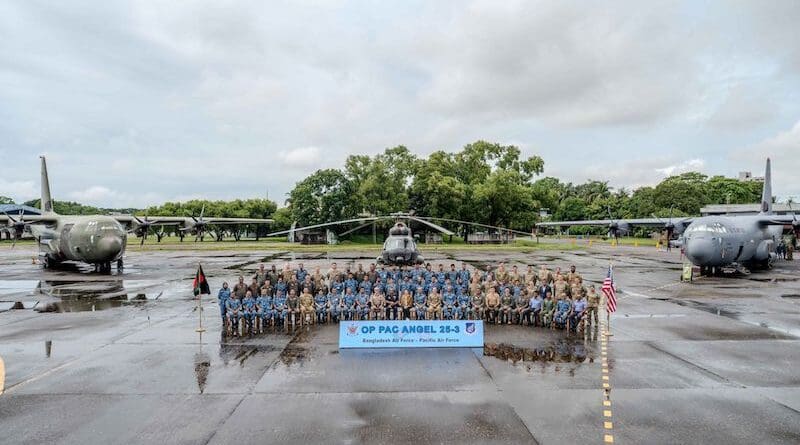
In recent years, Bangladesh has sought to strengthen its security and defense capabilities by organizing joint military exercises with various countries. Among these, the joint exercise Operation Pacific Angel 25-3 with the United States has drawn considerable discussion in international circles.
Some Indian media outlets, including India Today, have suggested that such exercises could pose a security challenge along India’s eastern frontier. In reality, such concerns are unfounded. The United States Pacific Air Forces regularly conducts a wide range of training exercises across the world each year. Bangladesh’s participation in such joint endeavors with the United States is not unprecedented.
Over the years, both nations have engaged in joint exercises involving their army, navy, and air force. For instance, a report by BBC Bangla on September 30, 2015, noted that the Navies of Bangladesh and the United States participated in their fifth joint exercise aimed at enhancing maritime strategic cooperation. More recently, in 2022, similar exercises were carried out.
According to the Inter-Services Public Relations (ISPR), the latest exercise was held from September 14–18 at the Bangladesh Air Force Base Zahurul Haque in Chattogram. Such engagements underscore Bangladesh’s commitment to fostering regional stability, strengthening its defense partnerships, and maintaining constructive relations with international partners while ensuring that these initiatives remain non-threatening to its neighbors.
History and Context of Bangladesh–U.S. Joint Military Exercises
Since its independence, Bangladesh has consistently adhered to the principle of peaceful coexistence. The country is not a member of any military alliance and has long pursued the foreign policy dictum of “friendship to all, malice towards none.” In line with this policy, Bangladesh has been a regular contributor to United Nations peacekeeping missions while also fostering defense cooperation with a variety of international partners.
Bangladesh’s first major joint military exercise with the United States began in the 1990s. Over the years, several exercises have followed, including Cooperation Afloat Readiness and Training (CARAT), Tiger Shark, Pacific Partnership, and the more recent Exercise Disaster Response and Humanitarian Assistance. These exercises have generally focused on a broad spectrum of areas, such as disaster management training, naval and air defense strategies, humanitarian and medical assistance, as well as counterterrorism and maritime security drills.
Most recently, Operation Pacific Angel 25-3, held in 2025, included not only Bangladesh and the United States but also Sri Lanka as a participating nation. This reflects the fact that such initiatives are no longer purely bilateral but rather serve as a manifestation of broader regional security cooperation.
Notable Joint Exercises:
Tiger Shark: A joint special forces training exercise, conducted as part of the Flash Bengal series since 2009. The program focuses on patrol boat operations and enhancing proficiency in short-range weapon targeting.
Tiger Lightning: A realistic field training exercise involving the Bangladesh Army and the United States Army Pacific. It has now been held for four consecutive years, underscoring a sustained partnership in ground combat readiness and tactical coordination.
Pacific Angel: Primarily a humanitarian assistance and disaster response exercise, with emphasis on search and rescue (SAR) operations and aeromedical evacuation. This initiative significantly strengthens Bangladesh’s disaster preparedness and crisis response capacity.
Cooperation Afloat Readiness and Training (CARAT): Since 2010, this annual multinational exercise has been conducted in the Bay of Bengal. It is aimed at improving maritime domain awareness and fostering stronger naval cooperation.
State Partnership Program (SPP): Established in 2008, this program builds enduring ties between Bangladesh and the Oregon National Guard of the United States, facilitating long-term defense collaboration and knowledge-sharing.
Bangladesh’s Interests and Objectives in Joint Exercises
The United States Pacific Air Forces conducts a wide range of training exercises across the globe every year. In Bangladesh, the Air Force’s helicopters and transport aircraft are frequently deployed during emergencies and crises. Operation Pacific Angel 25-3 was designed with a particular focus on enhancing the operational readiness of these assets under adverse and emergency conditions.
During this exercise, the Bangladesh Air Force deployed one C-130J transport aircraft and one MI-17 helicopter, while the Pacific Air Forces contributed two C-130J transport aircraft. A total of 150 personnel from the Bangladesh Air Force and 92 personnel from the U.S. Pacific Air Forces participated. In addition, members of the Bangladesh Army and Navy also took part, underscoring the exercise’s multidimensional nature. Bangladesh’s participation in such exercises serves several key purposes like Enhancing Military Proficiency, Strengthening UN Peacekeeping Capacity, Disaster Response and Humanitarian Assistance, Safeguarding Maritime Security, Ensuring Economic Security.
India’s Concerns and Underlying Factors
Although India remains the predominant regional power in South Asia, its relations with several neighboring countries have recently faced strains. In Bangladesh, the political transition following Sheikh Hasina’s fall, the interim government’s growing closeness with Pakistan, and joint initiatives such as Operation Sindur with Pakistan have created unease in New Delhi. India’s own imposition of trade restrictions on Bangladesh, coupled with anxieties over the Siliguri Corridor, has further complicated bilateral dynamics.
Domestically, ongoing anti-government movements in Manipur and Ladakh add to India’s internal vulnerabilities. On the external front, China’s involvement in the Teesta River project and U.S. interest in the development of Chattogram Port have heightened India’s apprehensions. For New Delhi, U.S. strategic priorities in the Indo-Pacific—particularly when linked with Bangladesh—are seen as geopolitically sensitive. India worries that under the cover of joint military exercises, Bangladesh might be deepening defense cooperation with global powers in ways that could recalibrate the regional balance.
Furthermore, India views South Asia as its traditional sphere of influence. The possibility of rival powers expanding their footprint in the region is therefore perceived as a direct challenge to its strategic position. Against this backdrop, some segments of the Indian media have exaggerated the Bangladesh–U.S. exercises as part of a military encirclement of India. Adding to this narrative, misinformation and rumors circulating on social media have often been reproduced uncritically in Indian outlets—creating a portrayal that diverges significantly from reality.
Why India’s Concerns Are Unfounded
A realistic assessment shows that such exercises pose no threat to India. Bangladesh has never joined any military alliance directed against another country, and its participation in joint exercises is focused solely on enhancing professional skills. The 2025 exercises emphasized disaster response, medical assistance, and counterterrorism training rather than any form of offensive military action.
Moreover, these were not limited to the United States alone—other South Asian countries also participated, highlighting the cooperative and regional nature of the initiative rather than a design against any single state. It is also worth noting that India itself conducts regular joint military exercises with the United States, such as Yudh Abhyas and Malabar. Against this backdrop, concerns over Bangladesh engaging in similar exercises with Washington appear misplaced. Furthermore, Bangladesh and India maintain ongoing defense cooperation, with their armed forces regularly conducting bilateral joint exercises. This underlines the fact that Bangladesh is not a threat to India but rather a partner in promoting regional stability.
Economic Realities
As neighboring countries, the economies of Bangladesh and India remain interdependent. Although India’s unilateral trade sanctions in 2025 dealt a blow to Bangladesh’s economy, the impact was felt on both sides. Bangladesh suffered export losses amounting to nearly USD 7.7 billion, while Indian exports to Bangladesh also declined by around 6.2 percent. This underscores the reality that if mistrust persists on security issues, both nations will face setbacks in their economic relations. Mutual trust, therefore, is the only viable path forward to safeguard shared prosperity.
Regional Geopolitics and Bangladesh’s Position
Bangladesh’s geographic location has positioned it at the crossroads of South Asia, Southeast Asia, and the Bay of Bengal. The country sits within a zone of strategic competition among three major powers: India seeks to maintain its regional leadership; China, through the Belt and Road Initiative (BRI), is investing heavily in Bangladesh; and the United States, as part of its Indo-Pacific strategy, is according greater strategic significance to the country.
Amid this competition, Bangladesh seeks to maintain balance—not aligning exclusively with any single power but rather adhering to its guiding principle of “friendship to all, malice towards none.” From this perspective, India has no reason for alarm. Instead of perceiving Bangladesh–U.S. military exercises as a threat, India would benefit from recognizing them as opportunities for cooperation.
Conclusion
The Bangladesh–U.S. strategic military exercises form part of Bangladesh’s broader effort to enhance its defense capabilities. These initiatives are in no way directed against India. Rather, their primary goals are to strengthen disaster response, humanitarian assistance, and regional security. If India chooses to view such exercises not as a threat but as a platform for collaboration, bilateral relations could be further strengthened. Leveraging Bangladesh’s unique geopolitical position in a spirit of mutual trust will be essential for ensuring regional peace and stability. For its part, Bangladesh remains steadfast in its foreign policy principle: “Friendship to all, malice towards none.”

Like what you read?
Please consider supporting Eurasia Review. Thank you for your consideration!
