
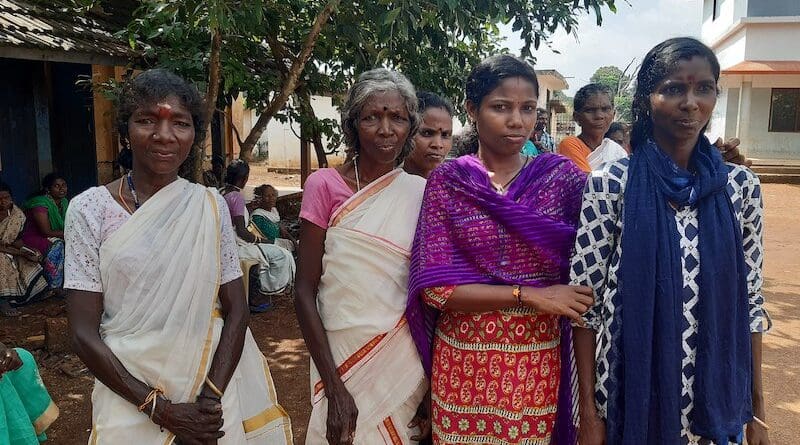
India’s Indigenous Women Demand Justice – OpEd
In the remote villages of Odisha, a 14-year-old Munda girl’s story echoes a pattern of injustice plaguing India’s Indigenous communities. Gang-raped by non-tribal men in 2022, she remained silent for weeks, her family paralyzed by fear of police retaliation and social ostracism. Her case represents thousands of similar stories that never make headlines.
“They told us to keep quiet if we wanted to live in peace,” says her mother, requesting anonymity for safety concerns. “The police station is a four-hour walk. Even if we reported it, who would believe us?”
Despite constituting 8.6% of India’s population, Indigenous women—officially recognized as Scheduled Tribes—face an epidemic of violence hidden behind a veil of institutional neglect and data gaps. While the National Crime Records Bureau tracks violence against women nationally, activists say statistics fail to capture the full extent of abuse in tribal communities.
“We estimate over 40% of Adivasi women experience physical or sexual violence in their lifetime,” says Shalini Gera, a human rights lawyer working with tribal communities in Chhattisgarh. “But the real number is likely much higher due to chronic underreporting.”
Justice Denied
India boasts progressive legislation on paper. The Protection of Women from Domestic Violence Act (2005) and the Scheduled Castes and Scheduled Tribes (Prevention of Atrocities) Act (1989) (PoA Act) should provide robust protection. Reality tells a different story.
In the mineral-rich forests of Bastar, Sunita Markam (name changed) alleges sexual assault by security forces during a routine patrol in her village. When she attempted to file a complaint, officials questioned her character and suggested she was aiding Maoist insurgents.
“They treated me like a criminal,” Markam recalls. “One officer asked why I was in the forest alone. Another said women like me make false accusations.”
Court records from five states with significant tribal populations reveal conviction rates under the PoA Act hovering below 5%. Cases routinely drag on for years, with victims facing intimidation and procedural barriers at every turn.
“The legal system isn’t designed for Indigenous women,” explains Aditi Malhotra, a Supreme Court advocate. “Language barriers, geographic isolation, and cultural insensitivity create insurmountable obstacles. Many victims abandon cases out of exhaustion or fear.”
Grassroots Response
In the absence of state support, grassroots organizations have become lifelines. In Gujarat, the Adivasi Mahila Sangathan operates safe houses for survivors and provides paralegal training to community volunteers.
“When government fails, we must protect our own,” says Kamla Bhaiya, the organization’s founder. “Our women learn to document evidence, accompany survivors to hospitals and police stations, and navigate courts.”
These organizations operate on minimal resources. An RTI application revealed that less than 3% of the government’s Nirbhaya Fund—established after the 2012 Delhi gang rape to support women’s safety initiatives—reached tribal areas between 2015-2022.
Success stories exist despite these constraints. In Nagaland, the Naga Women’s Union successfully advocated for Indigenous women’s inclusion in peace negotiations, leading to decreased incidents of conflict-related sexual violence.
“When we have resources, we create change,” says Rosemary Dzüvichü, a senior member. “The problem isn’t our capacity—it’s that our work is chronically underfunded and undervalued.”
The Missing Piece of Political Representation
Rama Devi, 38, was elected to her village panchayat in Jharkhand three years ago under women’s reservation quotas. Yet her experience illustrates a common pattern.
“The male leaders make all decisions,” she confides. “When officials visit, they direct questions to my husband. If I speak independently, I face hostility at home and in the community.”
Statistics highlight this marginalization. Since India’s independence, only four Adivasi women have served in the Lok Sabha. State legislatures show similarly dismal representation.
“Political exclusion means policies affecting Indigenous women are created without their input,” says Dr. Nandita Haksar, a human rights lawyer and author. “From forest rights to mining approvals, decisions impacting their lives happen in rooms where they have no voice.”
This exclusion has concrete consequences. When the Forest Rights Act was implemented, land titles predominantly went to male household heads despite women’s traditional role in forest management.
Deeper Roots of Violence
Beyond immediate triggers lies structural violence embedded in India’s development model. Massive displacement due to mining, dams, and industrial projects has uprooted tribal communities from ancestral lands, destabilizing traditional protections.
“When communities are displaced, women bear the heaviest burden,” explains Dr. Felix, anthropologist and author of several books on tribal issues. “Economic precarity forces men to migrate, while militarization introduces new forms of violence.”
Environmental degradation compounds these vulnerabilities. Deforestation forces women to walk longer distances for water and firewood, increasing exposure to assault.
The COVID-19 pandemic exposed these fractures dramatically. A survey by the Indigenous Women’s Forum of Northeast India documented a 60% increase in domestic violence cases during lockdowns, with victims unable to access help lines or shelters.
“The pandemic wasn’t just a health crisis—it was a shadow pandemic of violence,” says Manipur-based activist Binalakshmi Nepram. “Government response completely overlooked Indigenous women’s specific vulnerabilities.”
The Path Forward
Activists and experts emphasize that addressing this crisis requires multifaceted approaches.
Legal reforms must be paired with implementation mechanisms, including special courts with Indigenous representation and mobile legal clinics serving remote areas. Police sensitivity training is essential, but must be coupled with accountability measures for officers who dismiss or mishandle cases.
“Laws exist, but enforcement remains captive to prejudice,” notes former High Court Justice Chandru K. “We need structural changes in how justice is delivered.”
Funding structures must prioritize Indigenous-led organizations. International donors increasingly recognize the effectiveness of participatory grant-making, allowing communities to determine resource allocation.
Political representation requires both reserved seats and support systems to help Indigenous women navigate institutional barriers. Several states are considering legislation similar to the model in Nagaland, where tribal councils must include 33% women members.
Most importantly, solutions must center Indigenous women’s agency and leadership.
“We don’t need saviors telling us how to solve our problems,” asserts Meenakshi Munda, addressing a recent gathering of tribal rights activists in Delhi. “We need allies who will stand beside us as we dismantle the systems oppressing us.”
As one Santhal elder from West Bengal put it: “Our struggle is not just against violence. It’s for the recognition that our lives matter—that we deserve justice not as an afterthought, but as our birthright.”
- This article is based on interviews with over 30 Indigenous women activists, legal experts, and survivors across six states conducted between November 2024 and January 2025. Some names have been changed to protect identities.

Like what you read?
Please consider supporting Eurasia Review. Thank you for your consideration!
