
Iranian Women’s Struggle For Freedom: A Call For Global Support – OpEd
Last week, I met my Iranian friend, an intelligent woman who left Iran in 2022. She shared a heart-breaking story about her sister, who was summoned to court and ordered to pay a penalty for not wearing the hijab. Her sister, an educated woman who has worked tirelessly since a young age, now faces punishment simply for choosing her attire. This is just one example of the many injustices Iranian women endure under the regime’s oppressive laws.
As we mark International Women’s Day 2025, a recent report published (1) by the Women’s Committee of the National Council Resistance of Iran exposes the horrifying reality that Iranian women continue to face. The report confirms that penalties for not following the hijab law have intensified. The Iranian regime is enforcing the Chastity and Hijab Law with strict measures.
The regime’s crackdown is particularly targeting female students. Universities are now heavily monitored, with security stationed at entrances, surveillance cameras installed, and “Guidance Ambassadors” deployed to enforce hijab laws. Many female students have been expelled, suspended, or relocated to remote universities for refusing to comply. Some, like Motahareh Gooneii, have even been imprisoned for protesting, while others, such as Shaqayeq Akbari, have been suspended for speaking out against the university’s policies. At Amir Kabir University alone, over 200 students were denied entry for their dress choices.
Despite this repression, student activism remains strong. Women are leading strikes and boycotts, resisting the regime’s efforts to silence them. The government, fearing growing dissent, has launched a full-scale effort to suppress universities, yet the fight for freedom continues. The slogan “Woman, Resistance, Freedom” has become the message of women and Resistance Units in Iran, as well as the Iranian diaspora protests.
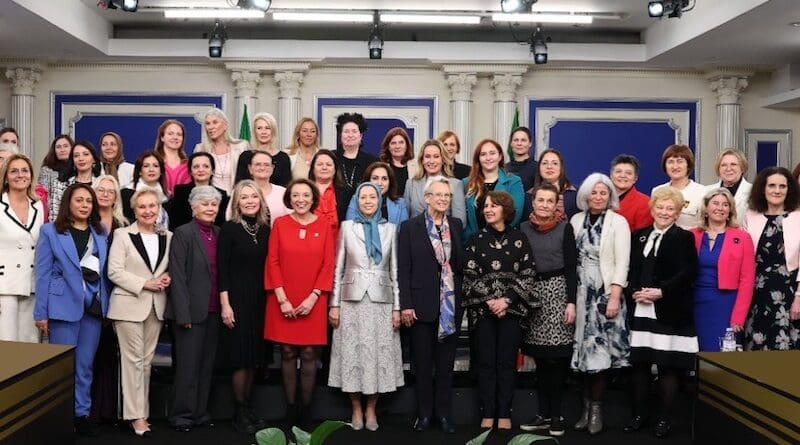
I had the opportunity to attend the International Women’s Day conference (IWD2025) (2) in Paris, which gathered political leaders, activists, and human rights defenders to shed light on the struggle for women’s rights and democracy. Among the notable speakers were: Sharron Davies MBE – Olympic Medalist, UK; Theresa Villiers – Former Minister, UK; Baroness O’Loan – Member, UK House of Lords; and Helen Goodman – Former UK Shadow Minister.
The event showcased the vital role of women in the fight for freedom, with Mrs. Maryam Rajavi, President-elect of the National Council of Resistance of Iran (NCRI), delivering a powerful keynote address. In her speech, “Women, Pioneers of Freedom,” she honoured the countless Iranian heroines who have faced arrest, torture, and execution for resisting the regime.
Mrs. Rajavi emphasised that the fight for women’s freedom is a 44-year-long struggle against religious fascism in Iran. She pointed out that Supreme Leader Ali Khamenei himself acknowledges this battle as a ‘civil war,’ proving the regime’s reliance on oppression and nuclear threats for its survival. However, she confidently declared that the regime’s collapse is imminent, drawing parallels to the Shah’s (former dictator in Iran) overthrow decades ago.
Mrs. Rajavi further criticised the monarchical and clerical systems, both of which marginalise women and exclude them from power. She denounced the absolute authority granted to the Supreme Leader and reaffirmed that Iranian women are at the forefront of the movement to bring democracy and equality to their country.
In February 2025 alone, 100 people were executed in Iran, and currently, political prisoners Behrouz Ehsani and Mehdi Hassani face imminent execution. These cases are not isolated; countless political prisoners are at risk as the regime seeks to silence opposition through fear and death.
The fight of my sisters in Iran will not stop until the country is free. On behalf of Iranian women worldwide, I urge global leaders to stand with the Iranian people and particularly the suppressed women. It is time to end appeasement policies and demand that all negotiations with the Iranian regime be conditional on halting executions, repealing the hijab law, and ending gender-based oppression.
In solidarity, 650 prominent women from 80 countries across five continents have signed a statement supporting Mrs. Maryam Rajavi’s call to condemn the oppressive chastity and hijab law. The statement also endorses her 10-Point Plan for a democratic transition (3) and the 12-point plan (4) for women’s freedoms. It amplifies her message: “No to compulsory hijab, no to compulsory religion, and no to compulsory government.” This movement represents a global stand for women’s rights and democracy.
The women of Iran are leading a revolution. It is our duty to support them in their fight for justice, equality, and freedom.
Endnotes
- https://wncri.org/2025/02/28/annual-report-2025/
- https://wncri.org/2025/02/22/maryam-rajavi-iwd2025/
- https://www.maryam-rajavi.com/en/viewpoints/plan-for-future-of-iran/
- https://www.maryam-rajavi.com/en/viewpoints/women-rights-in-iran/

Like what you read?
Please consider supporting Eurasia Review. Thank you for your consideration!
