
Trump: ‘Indian Missile Attacks On Pakistan Is A Shame’ – OpEd
Pakistan’s Rare Earth Minerals the Brew?
“Trump administration will support of India’s fight against terrorism with energy and resources to combat terrorism.” — Post Pahalgam Terror Attack US House Speaker Mike Johnson
The Indian Armed Forces on May 7, 2025, early hours launched ‘Operation Sindoor’ to hit terrorist infrastructure in Pakistan and Pakistan-occupied Jammu and Kashmir. No Pakistani military facilities have been targeted. Focused strikes were carried out on nine terrorist infrastructure sites in Pakistan and Pakistan-occupied Jammu and Kashmir, targeting the roots of cross-border terror planning,” Terrorist camp said to have been targeted are linked to the various banned terrorist outfits, like Lashkar-e-Taiba (LeT), Jaish-e-Mohammed, and Hizbul Mujahideen.
WHY ‘Operation Sindoor’ – Sindoor is the vermillion powder worn by married Hindu women in the parting of their hair. 26 people killed in the attack after identification were Hindu men whose wives were widowed. A widow stops applying the vermillion powder indicating the women is a widow. The strikes in Terrorists Camps have by design named ‘Operation Sindoor’ for revenge.
Pakistani army resorted to heavy mortar shelling on forward villages along the Line of Control (LoC) in Poonch and Rajouri. Officials said the shelling was reported from Krishna Ghati, Shahpur and Mankote in Poonch, Laam, Manja Kote and Gambeer Brahmana in Rajouri district.
President Trump Condemns Missile Strikes!
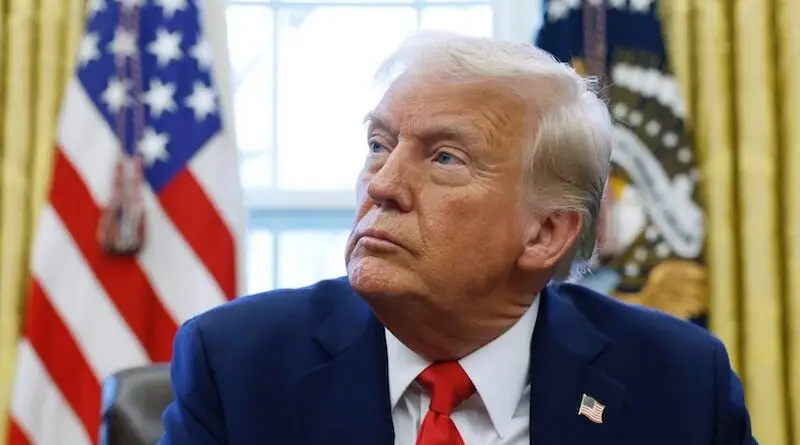
US President Donald Trump has condemned India’s recent missile strikes on alleged terrorist camps in Pakistan, calling the move “A shame.” His remarks need to be questioned, particularly considering the US own history of military interventions.
The US has long been seen as a warmonger, often relying on overwhelming military force and strategic alliances to push its agenda. Yet, despite decades of interventions, from the Middle East to Southeast Asia. The US has acted as a global enforcer, often attempting to resolve international conflicts through overwhelming military force and strategic alliances. However, this approach has rarely achieved lasting peace — instead leaving behind a trail of destruction and instability.
President Trump, now in his current term, has reiterated past claims that he could resolve major conflicts swiftly. He previously declared he could end the war in Ukraine within 24 hours — a pledge that remains unfulfilled. Meanwhile, US support for Israeli military operations in Gaza has drawn widespread criticism amid escalating civilian casualties and thisundermines any moral high ground the US might claim.
Against this backdrop, Trump’s rebuke of India appears contradictory. India’s missile strikes were reportedly in retaliation for cross-border terrorist attacks — a persistent and deeply rooted national security issue. While the use of force is always contentious, Trump’s sudden call for restraint rings hollow given his administration’s ongoing support for aggressive actions elsewhere.
To go back to what US House Speaker Mike Johnson statement on Pahalgam terror attack. Following the deadly Pahalgam terror attack, Johnson assured that the “Trump administration will support of India’s fight against terrorism with energy and resources to combat terrorism.” This development comes after President Donald Trump extended support to Prime Minister Narendra Modi, condemning the attack and expressing solidarity with the victims. India’s Foreign Minister S Jaishankar has said in a post on X that the world “must show zero tolerance for terrorism“.
Now, Trump appears to be criticizing India for retaliatory strikes on terrorist camps in Pakistan. But is this condemnation sincere—or yet another example of American double standards on global conflict? But why this sudden concern?
So why is Trump now preaching restraint to India—especially in response to attacks on Indian soil by Pakistan-based terrorists? When it comes to using force for national security, does the US reserve that right only for itself and its allies? But why this sudden concern? Or some thing is brewing up between US and Pakistan?
Is Pakistan’s Rare Earth Minerals the Brew?
In April 2025, a US delegation led by senior Trump administration official Eric Meyer visited Pakistan to attend the Pakistan Minerals Investment Forum. This marked the first official contact between the US and Pakistan since Trump’s return to office. The delegation’s focus was on exploring investment opportunities in Pakistan’s mineral-rich areas, including copper, gold, lithium, and rare earth elements.
Pakistan possesses vast untapped reserves of critical minerals, especially in regions like Gilgit-Baltistan, Balochistan, and Khyber Pakhtunkhwa. These minerals are essential for modern technologies, including electric vehicles, semiconductors, and defense systems.
The US interest in Pakistan’s mineral wealth is part of a broader strategy to reduce dependence on China for critical minerals. China currently dominates the global supply chain for rare earth elements, and the US is seeking alternative sources to ensure supply chain resilience. However, Pakistan’s close ties with China, particularly through the China-Pakistan Economic Corridor (CPEC), complicate matters. CPEC projects have led to significant Chinese investment in Pakistan’s infrastructure and resource sectors, including mining activities in Gilgit-Baltistan.
President Trump’s administration is actively seeking to engage with Pakistan to access its rich deposits of rare earth minerals, aiming to diversify US supply chains and reduce reliance on China. While this presents economic opportunities for both nations, it also introduces complex geopolitical and local challenges that will require careful navigation.
US Geopolitical Calculus: “America First”
US geopolitical behavior—such as appearing to downplay or balance criticism of Pakistan despite Indian claims of Pakistani-backed terrorism—and economic interests, particularly Pakistan’s reserves of rare earth minerals make Pakistan strategically relevant. The US often balances its relationships in South Asia:
- It supports India as a counterweight to China.
- But it also maintains a functional relationship with Pakistan for regional stability, especially in relation to Afghanistan, counterterrorism, and now, economic interests.
US downplaying Indian military actions against Terrorist Camps in Pakistan, it might not just be about diplomacy—it could also reflect:
- Desire to maintain influence over Pakistan and avoid pushing it further into China’s sphere.
- Resource-related interests, like access to minerals or strategic location benefits, ports and trade routes.
“America First” Doctrine:
- Strategic deals for natural resources.
- Reducing dependence on adversaries like China.
- Prioritizing US economic benefits over purely ideological alliances.
Courting Pakistan for its Rare Earth Metals and avoid pushing it further into China’s sphere potential through my lens perception even if it means appearing less vocal about Indian concerns—could fit that pattern. While it’s all speculative without specific proof, documents or diplomatic cables, economic and strategic interests often inform foreign policy decisions, including how much pressure is applied over security issues like terrorism. Rare earths could indeed be a significant factor in the US’s calibrated approach toward Pakistan.

Like what you read?
Please consider supporting Eurasia Review. Thank you for your consideration!
