
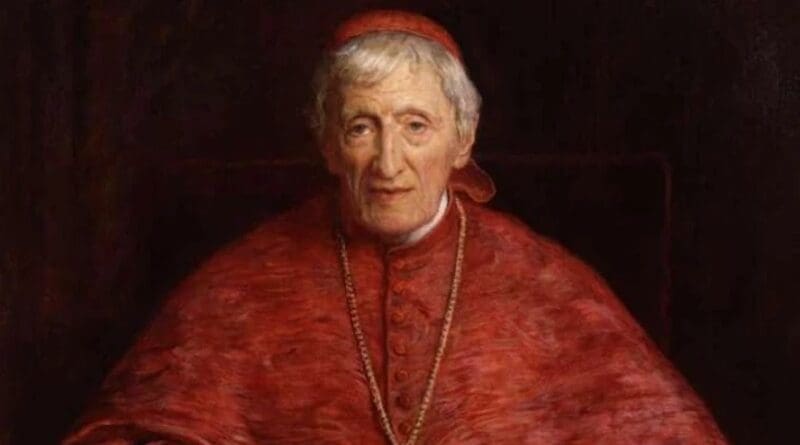
Saint Newman’s Light Guides Us Through Modern Doubt – OpEd
It was a crisp evening last July when Pope Leo XIV stepped onto the balcony overlooking St. Peter’s Square, his voice carrying across the crowd with a message that felt both urgent and timeless. “In our world of constant noise and shifting opinions,” he said, “John Henry Newman shows us that seeking truth is not weakness—it is the bravest thing we can do.” With those words, he announced that this November 1st, the brilliant 19th-century thinker would become a Doctor of the Church, joining the ranks of saints whose wisdom lights the path for generations. For those of us juggling bills and worries, raising kids or caring for aging parents, it might seem like distant church business. But Newman’s story is really about something we all know: the struggle to believe when nothing makes sense, and the courage to keep searching anyway.
Born in London in 1801 to a banking family, young John grew up much like many of us—faith was there, tucked into Sunday routines and bedtime prayers, but not particularly passionate. He was a thoughtful boy who loved wandering the countryside, turning over big questions in his mind like stones in a stream. God existed, sure, but did it matter?
Everything changed during his teenage years when, walking alone through Oxford’s fields, he felt something shift inside. It was not thunder or visions, just a quiet certainty that God was not some distant idea but a real presence calling him personally. Later, when illness struck him during a trip to Italy, he wrote the words that became his lifelong anthem: “Lead, kindly Light, amid the encircling gloom.” He was not asking for blinding clarity, just enough light for the next step. That is faith for most of us, isn’t it? Not floodlights, but a candle in the dark.
Oxford University became his home, where he threw himself into teaching and ministry as an Anglican priest. He was the kind of teacher students remembered—passionate about ideas but even more passionate about souls. With a handful of friends, he sparked what history calls the Oxford Movement, trying to reconnect the Church of England with its ancient Christian roots. Newman believed faith was not a fossil trapped in amber; it was alive, growing like an oak from an acorn.
In his book on the development of doctrine, he explained that Christian truth unfolds across centuries without losing its core, the way a child becomes an adult while remaining herself. For us today, wrestling with questions about science or suffering or social change, this is freeing. Our faith can breathe and respond to new challenges without betraying the Gospel.
But following truth wherever it leads can be costly. The deeper Newman studied the early Christians, the more their beliefs looked Catholic, not Anglican. Doubt gnawed at him. Friends who once admired him now called him a traitor. Newspapers mocked his agonising. His health crumbled under the weight of it all. Yet in 1845, at forty-four, he made the hardest choice of his life: he left the Anglican Church and became Catholic.
“To live is to change,” he wrote later, “and to be perfect is to have changed often.” It was not about winning an argument; it was about following his conscience, that inner voice he believed God plants in every heart. He lost his position at Oxford, his reputation, his security. But he gained something money cannot buy—integrity.
Starting over in the Catholic Church was not glamorous. He founded schools, established a community called the Oratory where priests lived like brothers, and spent years writing dense books that changed how Christians think. But what made Newman extraordinary was not just his brilliant mind; it was his warm heart. He understood that we do not arrive at faith through logic alone. Reason, feeling, experience, and grace all work together, what he called the “illative sense”—a God-given instinct for truth.
His letters overflow with fatherly tenderness, encouraging ordinary believers that their doubts and questions are not obstacles but part of the journey. Even as an old cardinal in Birmingham, he spent hours answering letters from strangers searching for hope.
Now Pope Leo XIV has chosen All Saints’ Day to honour Newman as a Doctor of the Church, a title reserved for teachers whose wisdom transcends time. In our frantic world of scrolling screens and shouting voices, Newman whispers something radical: slow down, listen, pray. Truth is not a trophy to win but a person to love—Jesus himself. Your morning coffee, that kind word to a stranger, sitting with someone who is hurting—these everyday moments become sacred when offered to God.
On November 1 and church bells rang from Rome to rural parishes, Newman’s message feels urgent. We do not need all the answers before we start walking. We just need enough light for one more step, trusting that the path leads home. In an age that prizes certainty, Newman teaches us that faithful doubt can be holier than arrogant knowledge. And that is good news for all of us stumbling forward, trying to love God in the mess of ordinary life.

Like what you read?
Please consider supporting Eurasia Review. Thank you for your consideration!
