
Breaking Resistance Through Administration: The Hidden Purpose Of UNSC 2803 – OpEd
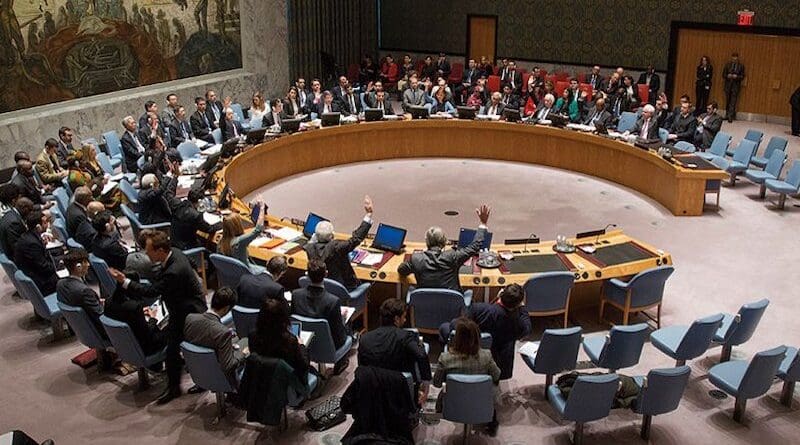
On November 17, 2025, the United Nations Security Council adopted Resolution 2803. On paper, the document promises stability and reconstruction for a devastated Gaza. It establishes a “Board of Peace” and authorizes an “International Stabilization Force” (ISF) to secure the enclave. However, a closer examination reveals a far more troubling reality. This resolution is not a roadmap to Palestinian sovereignty. Instead, it serves as the diplomatic architecture for the permanent partition of Gaza and the systematic dismantling of Palestinian political will.
The Illusion of Stabilization
The core of UNSC 2803 is the endorsement of the U.S.-backed “Comprehensive Plan to End the Gaza Conflict.” While the text speaks of peace, the implementation on the ground points toward indefinite occupation by proxy. The resolution authorizes the deployment of the ISF, a multinational force that will operate in “close consultation” with Israel.
This arrangement effectively grants Israel veto power over security operations within Gaza without requiring its soldiers to patrol every street. The ISF provides a layer of international legitimacy to what is essentially an Israeli security cordon. By delegating internal control to a non-Palestinian body, the resolution strips Palestinians of the most basic right of any people: the right to police themselves and secure their own communities.
The Partition Strategy: Green Zones and Red Zones
The most dangerous aspect of the scheme is the physical division of the Gaza Strip. Under the guise of “safe reconstruction,” the plan divides the territory into two distinct categories: “Green Zones” and “Red Zones,” separated by a militarized boundary known as the “Yellow Line.”
The Green Zones are areas designated for reconstruction and aid distribution. These areas will be heavily policed by the ISF and subject to strict surveillance. To enter a Green Zone and access food, water, or housing, Palestinians must undergo rigorous “screening” processes managed by the Board of Peace.
In contrast, the Red Zones—which cover vast swathes of the territory, including many historic refugee camps—are designated as “security risks.” No reconstruction is planned for these areas. They are to be left in ruins, effectively uninhabitable. This creates a coercive geography. Palestinians are forced to choose between starvation in the Red Zones or submission to intense surveillance and control in the Green Zones. This is not reconstruction; it is population engineering designed to depopulate specific areas and concentrate Palestinians into easily manageable enclaves.
A Conspiracy of Silence and Complicity
This architectural dismantling of Gaza was made possible by a convergence of global inaction and regional complicity. Russia and China, despite their anti-hegemonic rhetoric, opted for abstention rather than a veto, likely trading Palestinian interests for concessions in other geopolitical theaters. European powers provided the humanitarian veneer to legitimize the scheme, while key Arab states, prioritizing regional stability over solidarity, have tacitly agreed to fund the “Green Zones” without demanding a political horizon. Consequently, the Palestinian Authority is reduced to a spectator hoping for administrative scraps, while Hamas remains isolated and contained in the uninhabitable “Red Zones,” leaving the Palestinian people bereft of any effective international ally or unified local leadership.
The Board of Peace: A Tool for Disenfranchisement
The resolution establishes a “Board of Peace” to administer civilian affairs. This unelected body is tasked with everything from distributing aid to managing public services. Crucially, it completely bypasses existing Palestinian political factions.
By creating a technocratic administration answerable to international donors rather than local voters, UNSC 2803 severs the link between the Palestinian people and their leadership. The Board acts as a barrier, preventing the re-emergence of any unified Palestinian political entity in Gaza. It reduces the Palestinian cause from a struggle for national liberation to a mere humanitarian file managed by foreign bureaucrats.
Breaking the Will Through Dependency
The ultimate objective of this US-Israeli scheme is psychological. The plan weaponizes basic survival. By making food, shelter, and medicine conditional on acceptance of the new security order, the architects of UNSC 2803 aim to break the spirit of resistance.
The logic is simple and brutal; if you want to rebuild your home, you must accept the Green Zone rules. If you want your children to eat, you must submit to the ISF’s authority. This creates a society entirely dependent on external validation for its survival. It turns rights into privileges that can be revoked at any moment.
UNSC 2803 is widely hailed in Western capitals as a diplomatic breakthrough. In reality, it is the formalization of a prison structure. It partitions Gaza into viable and unviable zones, outsources the occupation to an international force, and uses humanitarian aid as a lever of control.
This resolution does not end the conflict. It merely changes its shape. It moves the war from the battlefield to the administration of daily life. The “peace” it offers is the peace of a pacified population, stripped of its land, its voice, and its political future.

Like what you read?
Please consider supporting Eurasia Review. Thank you for your consideration!
