
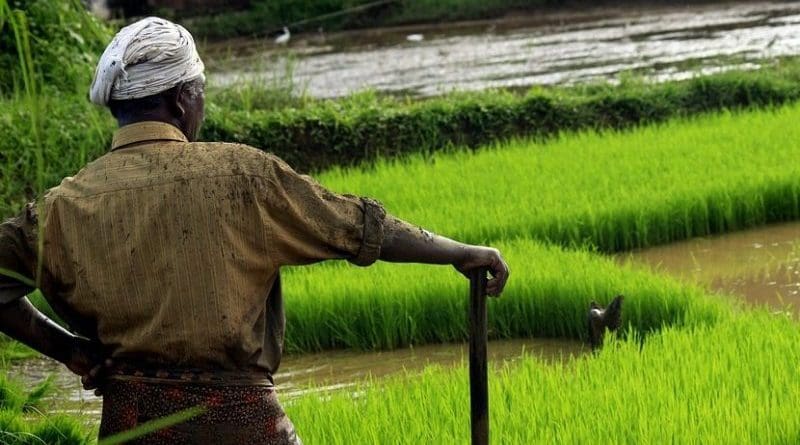
India Becomes World’s Largest Rice Producer In 2025 – OpEd
India has overtaken China as the world’s largest rice producer, reaching 150.18 million tonnes in 2025 as compared to China’s 145.28 million tonnes, marking a historic milestone in the nation’s agricultural journey, Indian Union Agriculture Minister Shivraj Singh Chouhan said at New Delhi recently, The Tribune newspaper reported.
Meanwhile, experts emphasise that emerging rice-producing states should draw lessons from Punjab’s experience.
“Surpassing China is a remarkable achievement. We have filled our granaries to capacity, and are no longer a nation dependent on others for sustenance. Today, we are a country that supplies rice to the world,” The Tribune reported quoting Chouhan as saying.
He unveiled 184 new crop varieties spanning 25 field crops at a function.
Addressing scientists and agricultural experts, the minister said, “It is our duty to contribute our utmost to building an Aatmanirbhar and Viksit Bharat.”
Meanwhile in an exclusive interview with The Tribune, Vice-Chancellor of Punjab Agricultural University (PAU), Dr Satbir Singh Gosal, offered a complex perspective — celebrating the achievement, while cautioning against its ecological costs.
Gosal noted that the government had been working to replicate Punjab’s success in eastern India and had even launched a movement the ‘Green Revolution in Eastern India’, targeting states like Assam, Bihar, Chhattisgarh, Jharkhand, Odisha, eastern Uttar Pradesh and West Bengal.
“The government has given a push to agriculture in these states with incentives, subsidies and high-quality manures,” he said, adding that the effort aims to overcome constraints limiting rice-based cropping systems.
Calling Punjab, the “national laboratory for agriculture”, Gosal emphasised that innovations were tested in the state first.
“Punjab has already suffered the loss in the form of depleting water tables. Now the same pattern will be repeated in other states, with stubble burning cases also being reported there,” he warned.
Another factor driving India’s record output is the adoption of short-duration, high-yielding rice varieties. For instance, PB126 matures in 123 days, and is disease-resistant and also requires less water. PR131 and PB121 are also gaining popularity in Punjab, Haryana and Uttar Pradesh.
“These varieties have boosted yields while reducing water demand, making them attractive to farmers across northern states,” Gosal explained.
The PAU is now working on developing flood-tolerant rice varieties, aimed at supporting cultivation in eastern India’s flood-prone regions. “These innovations will help sustain productivity while addressing climate-related challenges,” Gosal added.
India ranks first in the production of rice worldwide, but the purpose it serves is equally vital. Unlike China, India not only grows rice for its massive home market but is also among the biggest exporters.
Millions of metric tons are exported to Africa, the Middle East, and beyond annually. One particular variety—Basmati—has become globally famous, particularly from areas such as Punjab and Haryana. Talk to any rice trader, and they’ll inform you India is one nation that balances consumption with trade more than most.
According to the Torg website, rice is the staple of daily meals for over half of the world’s population. In Asia’s bustling cities to Africa’s rural towns, rice is at the forefront of food security, culture, and survival.
Such is the reason why rice production is among the highest priorities in world agriculture. The biggest rice producing nations determine how billions of people eat, trade, and plan ahead.
For growers, growing rice is part of the tradition and their way of life. For governments, it is stability and feeding the population. And for traders, the international rice trade is a lifeline that connects Asia’s huge producers with those areas that can’t produce enough to satisfy demand.
According to the Worlldometer, India also surpassed China in population with 1.47 billion people few years back. China has 1.41 billion people.
According to the Wikipedia, the Green Revolution in India was a period that began in the 1960s during which agriculture in India was converted into a modern industrial system by the adoption of technology, such as the use of (HYV) seeds, and fertilisers.
Mainly led by famous agricultural scientist M.S. Swaminathan in India, this period was part of the larger Green Revolution endeavour initiated by Norman Borlaug, which leveraged agricultural research and technology to increase agricultural productivity in the developing world.
Varieties or strains of crops can be selected by breeding for various useful characteristics such as disease resistance, response to fertilisers, product quality and high yields.
In a related development, Indonesia is targeting rice exports this year after reaching self-sufficiency and securing domestic supplies, Agriculture Minister Andi Amran Sulaiman said recently, marking a potential policy shift for one of the world’s largest rice consumers, the Antara news agency reported.
“If Bulog’s absorption this year mirrors 2025 levels, we can certainly export rice,” Sulaiman said, referring to purchases by the state logistics agency that underpin government food reserves and farmer price stability.
He said exports would represent a historic milestone following sustained supply stability, stronger harvests, and improved management of strategic food reserves as domestic rice production continued to rise nationwide.
Indonesia’s government rice reserves currently stand at 3.2 million metric tons, after peaking at four million tons in mid-2025, Sulaiman said, describing the stockpile as the strongest in the country’s history.
He contrasted the current situation with 1984, when Indonesia received recognition from the United Nations Food and Agriculture Organization despite holding government rice stocks of only about two million tons at the time.
Beyond state reserves, rice consumption by hotels, restaurants and catering businesses has also reached a national record of 12 million tons, reflecting robust demand alongside rising production, the minister added.
Sulaiman credited President Prabowo Subianto’s policy direction and coordination among ministries for enabling Indonesia to move from self-sufficiency toward the ambition of becoming a rice exporter.

Like what you read?
Please consider supporting Eurasia Review. Thank you for your consideration!
