
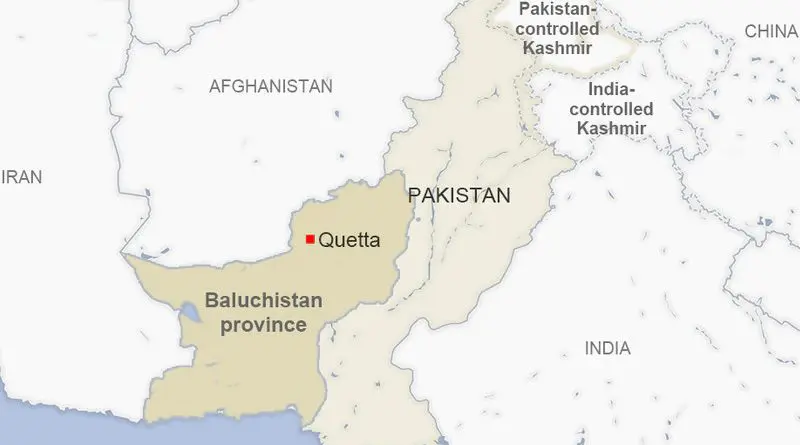
Pakistan Military And Baloch Liberation Army Confrontations: The Fate Of Balochistan – OpEd
Since the Islamic Republic of Pakistan gained independence from the strong fists of Great Britain in August 1947, Pakistan has experienced unending political chaos. After gaining independence from the shackles of iron fists (Great Britain) through political slogans, marches, political approaches, and the never-ending struggle of the then-leaders.
Concerns arise: what was the point of struggling for independence if this is the end result? Decades have passed, but uncertainty and instability continue to dominate Islamabad’s political behaviour within Pakistan. With a crippled economy, high inflation, and violations of human rights, anti-state elements would inevitably emerge. However, Pakistani politics has gotten into full swing, and anything is possible at any time. But most concerning of all, there have been severe clashes between the Pakistani military and the Baloch Liberation Army (BLA) for decades and the neglected provience, Balochistan.
The Baloch Liberation Army (BLA) is a separatist organisation that was founded in opposition to government policies at the beginning of the twenty-first century. The group believes that the killings of innocent people and the disappearance of people (Baloch) have violated their fundamental rights. However, by giving opportunities to a particular group (Baloch), including jobs and other higher positions in the Pakistani and Balochistan’s governments, the organization’s efforts and claims have been discredited through many means. According to the organisation, a mouse morsel cannot fit inside an elephant’s stomach.
An incident involving the BLA (separatist group) hijacking a train occurred on March 11th in the Mashkaf tunnel, Bolan District, Balochistan. Both military personnel and civilians were to be transport by train to Peshawar, a Pakistani province. Through social media accounts (X used to be Twitter), the BLA disclosed that their primary goal was to imprison Pakistani military personnel. However, it was said that they nearly gave other Jaffar Express (400) passengers safe passage. Why only military personnel raise concerns? It is assumed that the incident occurred as a result of the BLA exchanging captives with the Pakistani military. However, a military operation was conducted to free civilians and military personnel from the BLA’s hold, the situation deteriorated. Although a precise number of dead has not been disclosed by either side, it is presumed by reliable news outlets that there was a fierce firefight between the two sides during which many people were killed, yet the deaths remained a misery.
The hijacking shocked the public’s feelings and caused alarm across the nation. In this instance, the legislators gathered in Pakistan’s parliament to voice their grievances and denounce this terrible incident. Numerous ministries and lawmakers expressed their worries over Pakistan’s ongoing and worsening security and instability.
The aforementioned facts gave rise to a number of notions among respectable Pakistani leaders. Through various political parties, including Baloch leadership, the topic and ongoing conflicts continued to be the subject of intense debate in Pakistan’s parliament. Before the honorable speaker of the assembly, Mashar Mohammad Khan Achakzai, a well-known figure in Pakistani politics and the current minister of the national assembly, voiced his concerns about the dire consequences of the country’s current problems. He debated before the house that circumstance must be managed carefully before losing the grip and supremacy of the constitution must be properly observed. He went on to say that the constitution must be upheld as supreme and that all organisations must be held responsible in accordance with it. If it does not, there will be bloodshed and things will get worse in the future for this nation. Furthermore, he presented documents that demonstrated in accordance with Pakistan’s independence act, Balochistan and a few other regions were not a part of the country. Forceful annexations would give nothing but bitter fruits.
In contrary, state and national integrity is our main goal, according to DG Inter Services Public Relations (ISPR), which contradicted the statements of several lawmakers. He believed it was the most heinous form of terrorism to take over a civilian and instill fear in the hearts of innocent people. He determined that these kinds of events ought to be handled based on the current circumstances and available choices.
Certainly, great empires have fallen throughout history due to their savage policies and colonial mentality. Even at that time, movements remained steadfast and united against the oppressors, whether they were the state or the king of the revered nation. “Every man is born free, but he is everywhere in chains,” according to the famous philosopher Jean Jacques Roseau. This demonstrates that independence in practice differs from independence in theory. In this situation, contemporary states and nations ought to recognize the value of independence and the importance of public opinion and will.
In conclusion, it seems that the Pakistani military and government have managed the security situation in Balochistan improperly. However, they have also done nothing to address the growing alienation and animosity that are pushing people to join organisations like the BLA. Until the Pakistani government drastically changes its approach to Balochistan, beginning with holding those responsible for human rights abuses accountable, accusations of official exploitation and neglect will not end. The Human Rights Commission of Pakistan claims that the inhabitants of this province live in “a climate of fear,” and only then can confidence be restored. In a similar vein, BLA ought to take a reasonable stance in order to address pressing issues and its organisational goals.
About the authors:
- Sheraz Wahid is a Scholar of MS-International Relations (IR) from Department of Politics and International Relations (DP&IR), International Islamic University Islamabad (IIUI). The author’s area of interest covers global politics and geo-political and strategic affairs of South Asia.
- Maryam Baloch is perusing her Bachelor of Law (LLB) degree from Quetta Law College (QLC), Balochistan. Her area of interest covers the protection of human rights, law and justice.

Like what you read?
Please consider supporting Eurasia Review. Thank you for your consideration!
