
Will Putin Come To Meeting With Tokayev In Oral, Which Is Lately Being Overflown By Ukrainian Drones? – OpEd
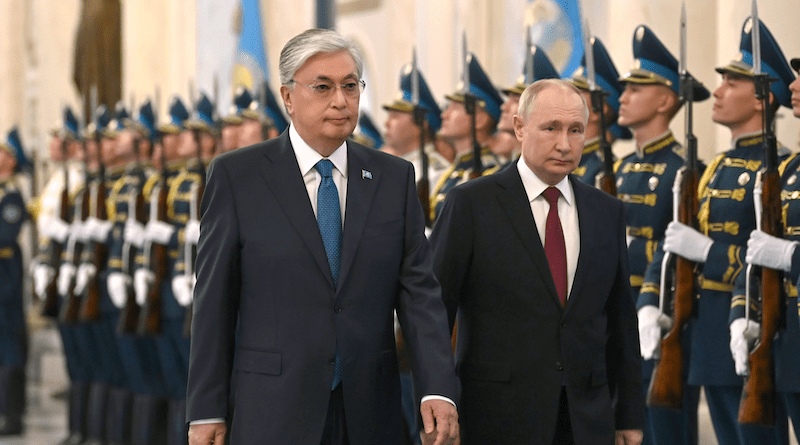
President of Kazakhstan Kassym-Jomart Tokayev is expected to pay a state visit to Russia on November 12. One must assume that there, he is to be hosted by his Russian counterpart, Vladimir Putin. This raises the question of whether these two presidents will directly participate in the 21st Forum of Interregional Cooperation between Russia and Kazakhstan, which is scheduled to take place in Oral, Kazakhstan, on November 11-12, 2025.
The precise format of their participation (in-person or via video link) is yet to be officially confirmed, though in recent years leaders have often attended via video conference. That practice is most likely to be repeated this time. And besides, Oral, as well as the West Kazakhstan province, of which it is the administrative center, does not appear to be the most convenient place for hosting summit meetings in light of recent developments. Here’s what this is about.
A drone of unknown origin exploded on 23 October near the village of Kyzyltal in the Burlinsky district of West Kazakhstan province. The following is what Reuters reported on what had then happened: “In a statement on Telegram, the [country’s defense] ministry said that the explosion occurred in a remote area around 180km (111 miles) west of the Russian city of Orenburg, which was hit by Ukrainian drones last week [on October 19]. The ministry gave no indication as to the drone’s origin, but said: “Consultations are also underway with foreign partners who may potentially own these devices”. Kazakhstan has been hit by the fallout of an escalating campaign of Ukrainian drone strikes against Russian energy targets. The drone strike on Russia’s Orenburg gas plant, which processes gas from Kazakhstan’s Karachaganak field, sharply reduced the plant’s capacity for several days. Kazakh officials earlier this month announced sweeping price freezes on fuel and utility tariffs, with the country’s energy minister on Wednesday blaming Ukraine war fallout for issues on the fuel market”.
According to official reports, the blast occurred in a remote area, far from residential zones. Here’s how the Uralskaya Nedelya newspaper, based in Oral (Uralsk), referred to what had happened in Kyzyltal: “Some residents of the West Kazakhstan province heard the explosion of a drone that crashed in the steppe, while others saw drones flying overhead. Authorities claim the debris fell “outside the residential area”. Yet the situation turned out to be much more serious than initially thought.
An explosive-laden combat drone crashed and exploded on the outskirts of a village in [Western] Kazakhstan. That same morning, air raid sirens sounded in the neighboring [Russian] Orenburg province due to a threat of [Ukrainian] drone attacks, and the Carpet plan was introduced at the airports of Orenburg and Orsk.
The village of Kyzyltal, near which the drone crashed this morning, is on the outskirts of Aksai, a town of 40,000 people.
“We were standing at the bus stop and heard an explosion. We felt the ground shake”, Aksai residents shared in the comments under the drone crash report.
“We also heard an explosion in the 13th micro-district”, other users confirmed.
“It was a drone that exploded near my house”, – wrote a resident of Kyzyltal.
Aksai residents claim the drone crashed and exploded no more than one kilometer from the outskirts of the settlement.
These claims have questioned the official report by Kazakhstani authorities, who issued the following statement: “The wreckage has been found in a remote area, far from residential zones, and no casualties or property damage were reported”.
According to the map, the drones are flying over Uralsk, near settlements in the Terektinsky and Burlinsky districts, and over the Karachaganak oil and gas field operated by Karachaganak Petroleum Operating [KPO] B.V.
Meanwhile, yesterday, October 22 in the evening, and this morning, the 23rd, drones were seen by residents of Uralsk, as well as the villages of Darinskoye and Pokatilovo”.
It’s worth clarifying that Aksai, near which the Karachaganak, one of the world’s largest gas and condensate fields, operated by Karachaganak Petroleum Operating B.V., is located, is the second largest settlement of the West Kazakhstan province after its capital, Oral (Ural’sk). It is also called the hometown of the KPO. The village of Kyzyltal, near which the drone crashedon October 23, was annexed to the town of Aksai in 2013 and is considered one of its micro-districts since then.
In a statement on Telegram, Kazakhstan’s defense ministry gave no indication as to the drone’s origin, but said: “Consultations are also underway with foreign partners who may potentially own these devices”.
Uralskaya Nedelya, in a report entitled “Drones over Uralsk and Aksai: one exploded near residential buildings”, commented on this statement as follows: “The talks [on this] are apparently being held with Ukraine. On fragments of the drone that crashed in Aksai, a sign in Ukrainian reads: “Ne chipati. Rukhoma chast’ina” – “Do not touch, moving part”.
At least five drone incidents occurred in Western Kazakhstan in 2025 before the October event. All but one of these were in the West Kazakhstan province. Plus, there was a drone crash in the Atyrau Province in June 2025. The effects of such development threaten to become far from innocuous. This trend has been observed for quite some time in Moscow-Astana relations.
On June 21, the Russian Ministry of Foreign Affairs spokesperson Maria Zakharova released a statement accusing Ukraine of using Kazakhstan’s territory to attack Russia. On June 23, through its spokesman, Aibek Smadiyarov, Kazakhstan’s Foreign Ministry dismissed allegations that the country’s airspace was used by Ukraine to launch drone attacks on Russia. “Information that drones are being launched from or over Kazakhstan towards Russia does not correspond to reality”, the official said at a news briefing.
Moscow clearly shrugged off that kind of response out of the Kazakh capital, having continued to stick to its story. On June 30, 2025, answering the question by a journalist, “Last week, there were facts on record that Ukrainian drones passed through Kazakhstan’s airspace to deliver strikes at facilities in Russia. Moreover, it is not the first time that these flights were recorded. Did you discuss this with the Foreign Minister of Kazakhstan, Murat Nurtleu?”, Russian FM Sergey Lavrov said: “We have mentioned this. We have taken into consideration the fact that the relevant services in our countries, specifically the military and the security services, are in contact over this matter. Our Kazakhstani friends have assured us that they are taking measures, in their contacts with Ukraine, to put an end to this practice”. Thus, the allegation by Mme Zakharova about the use of Kazakhstan’s airspace by Ukrainian drones to carry out strikes on Russian territory has been affirmed at the highest Russian diplomatic level. On the same day, the Kazakh Foreign Ministry’s spokesperson Aibek Smadiyarov said that the claim “about [Ukrainian] drones being launched from our territory”, as well as the claim “about overflight by Ukrainian UAVs’ over Kazakhstan’s territory, does not correspond to reality”. Then, there was the impression that Astana initially let the Russian officials know that they could not hope for any consensus with their Kazakh peers on this point.
There now seems to be a different situation concerning it. Following the October event, neither the Russian nor the Kazakh Foreign Ministry has commented publicly on the topic of the Ukrainian military drones’ alleged or actual intrusion into the airspace of Kazakhstan. The latest developments seem to have provided incontrovertible proof, leaving no room for continuing to insist that the claim “about flight by Ukrainian UAVs over Kazakhstan’s territory, does not correspond to reality”. Especially as the Ukrainians themselves do not disprove that the explosive-laden combat drone, which crashed and exploded on the outskirts of Kyzyltal, has been theirs.
Here’s what Alexander Kovalenko, a military analyst, had to say in regards to that UAV: “The wreckage of a Ukrainian combat drone, presumably an FP-1, was found near the village of Kyzyltal in the Burlinsky district of Kazakhstan. Apparently, the drone was targeted by Russian electronic warfare while flying over the territory of either the Saratov or Samara provinces, possibly heading toward Orsknefteorgsintez [Russia’s Orenburg gas plant, which processes gas from Kazakhstan’s Karachaganak field].
As a result, the aircraft lost control and, deviating approximately 20 km from its route, crashed in Kazakhstan.
And the Russians, instead of admitting that the drone was jammed by Russian electronic warfare systems and flew into Kazakhstan for that very reason, do you know what Russian sites are now saying? That Ukrainian drones are being launched into Russia from Kazakhstan!..
For my own part, I’d like to note, the situation is far from being comme il faut. May it not turn out that in Moscow, they’ll begin to consider a new “SVO” [spetsialnaya voyennaya operatsiya, i.e., Special Military Operation] to create a security buffer in northern Kazakhstan, and be preparing a relevant narrative for such an intervention. Kazakhs help Ukrainians, they even have flags of similar colors!”.
The essence of Alexander Kovalenko’s vision of what happened near the village of Kyzyltal in Kazakhstan on October 23 is as follows: the Ukrainian drone flew into Kazakhstan because it had been diverted from its flight path by Russian electronic warfare facilities. And if that’s true, it means that in such cases, the principal danger to a country bordering Russia lies in the fact that the Ukrainian combat UAVs, which have lost control and entered its airspace, could potentially fall and explode anywhere along the way forward. And here’s the question: who would be to blame if that happened and the consequences were very serious?

Like what you read?
Please consider supporting Eurasia Review. Thank you for your consideration!
