
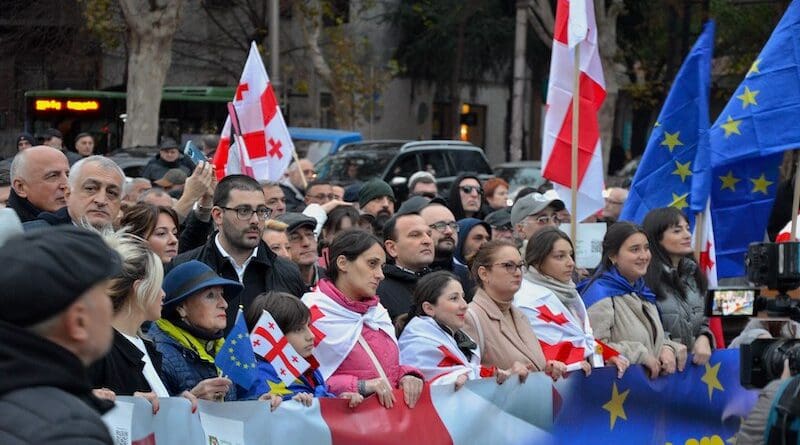
Takeaways From The Georgian Opposition’s 365-day Permanent Protest – OpEd
The socio-political situation in Georgia by the end of the year can be characterized as “stable instability,” where the authorities are more or less in control of the situation in the country, while the opposition is trying to undermine this stability, sometimes inflicting “pinpricks” on the authorities, and even then with the help of Western allies.
Georgian opposition forces, comprising political parties, non-governmental organizations, and youth movements positioning themselves as “pro-European,” are summing up their 365-day protest on Tbilisi’s central avenue. This new form of civil and political resistance in Georgia, largely borrowed from Western textbooks and unlike all previous rallies, has failed to translate into the concrete political results they had hoped to achieve. They failed to persuade the ruling Georgian Dream (GD) party, now in its fourth term, to call new parliamentary elections or release those convicted of offenses committed during the violent rallies of early December 2024. As is known, rallies in Georgia erupted after 28 November 2024 – when the GD announced the suspension of negotiations on EU integration of Georgia, under the pretext that the European Union (EU) structures use this factor as an instrument of pressure on the country.
The 365-day civil protest in central Tbilisi has failed to translate into any tangible and measurable political results. It gradually began to fizzle out. The political menu proposed by the opposition proved largely incomprehensible and unacceptable not only to the public, but also to the protest and opposition voters, most likely due to its unrealistic nature and not meeting the pressing interests of society. The opposition’s claims that the persistent protests in Tbilisi led to the Georgian Dream’s international isolation are naive, to say the least. The freeze in relations between the European Union and Georgia, as well as the pause in relations with the United States, are caused by far more serious and deep-seated reasons. The West cannot overlook the dramatic decline in the number of protesters in recent months. However, lacking any other reliable support in Georgia, they are forced to pay tribute to these street protests. Moreover, after suspending the activity of USAID and NED in Georgia, the EU has become instrumental in funding the Georgian civil sector, which in recent years have become an appendage of the political opposition. European Commissioner for Enlargement Marta Kos openly stated that the EU has doubled its funding for Georgian NGOs and is now looking for alternative ways to deliver funds to them in circumvention of the regulations, by which the Georgian government has greater control over the foreign funds to the local recipients.
The opposition is increasingly finding itself in unenviable situation politically, morally and institutionally. It simply has nothing to offer the protesting electorate other than garish slogans that the ruling Georgian Dream party is allegedly bringing Georgia back into the fold of Russia. However, these slogans are slowly beginning to exhaust themselves. Respectively, continued street actions remain the sole bargaining chip for the opposition they can present to the West and prove their viability on the ground. It seems that in the West this is accepted so far. Radical actions are called “pro-European”, and Western politicians and diplomats in Tbilisi consider it their duty to come to the protesters and publicly express support for them,
Operating in disparate groups that often clash with one another, the opposition is currently unable to present a united front, which would give it greater credibility in the eyes of the protest electorate. But beyond this problem, the opposition faces a far more serious and, as yet, intractable one: it is unable to offer an effective and acceptable alternative to the ruling party. This is affecting the effectiveness and results of its activities. A vivid example of this was the rally held to mark the anniversary of November 28, 2024, when the Georgian Dream announced the suspension of EU integration negotiations, which triggered mass protests. Despite all the efforts of the opposition, they failed to gather a critically large number of participants, and the rally, which had been hoped for a massive turnout, was quickly shut down. Once again, the opposition failed to deliver messages acceptable to its audience.
By the end of the year, the opposition had suffered a significant blow. It had lost one of its main arguments, which it had successfully exploited that parliament was a one-party, and therefore undemocratic and illegitimate. This argument evaporated after the former Prime Minister Giorgi Gakharia’s party “For Georgia” entered parliament and formed an opposition faction. Now, parliament has become, one way or another, a venue for political debate, sometimes quite heated. For the West, this is an indicator that pluralism does exist in the parliament of Georgia. But perhaps the strongest blow against the opposition was an unsuccessful attempt to dismantle the government on October 4, when a radical opposition group largely stemmed of the former ruling party Unified National Movement (UNM) attempted to topple the power by yet another “velvet revolution.” The rapid revolution, however, did not happen. In addition to the lack of widespread public support, the law-enforcement agencies, unlike the “rose revolution” of 2003, have proved loyal to the authorities. This confirmed the important fact that the Georgian public, even if it is critical of the government, does not accept revolutionary methods of government change, since the experience of the “Rose Revolution” brought far more negative results than positive ones. The opposition was not helped by a BBC investigative report suggesting that Georgian authorities used banned chemicals during the suppression of anti-government protests in Tbilisi last year. The report was published just as the opposition’s protests were beginning to fizzle out, and was likely intended to give the Georgian opposition a new tool and incentive to increase the effectiveness of their resistance. The majority of the public perceives the BBC investigation as yet another “fakeness.”
Perhaps one of the main, if not the crucial, reasons for the opposition’s failures is the acute shortage of vibrant and credible leaders. It’s noteworthy that over the 365 days of protests, led primarily by youth and non-political social groups, no credible new leaders have emerged who could provide a convincing alternative to the old leaders, or lead the protest electorate. The absence of a sound alternative program also represents a problem, as citizens are willing to see realistic suggestions.
Meanwhile, the ruling Georgian, which has long complained on the absence of a “healthy opposition,” is preparing to purge the political field. After the establishment of the first proxy party “People’s Power” last year, another public movement “United Neutral Georgia”, which is close to the GM, and has a pronounced anti-Western platform, has transformed into a political party. The party opposes Georgia’s European integration and demands a referendum on this issue. In addition, the ruling party, after investigating the activities of UNM within the framework of a parliamentary commission, brought an action before the Constitutional Court, demanding the ban of this party and its offsprings.
This year’s events suggest that a situation of “stable instability” will continue next year. The degree of this instability will be determined by local, regional, and international processes, including the outcome of the war in Ukraine, possible new Western sanctions, including suspending the visa-free regime with the EU. The long desired by Georgian Dream reset in relations with the United States will largely depend on the passage of MEGOBARI Act in the US senate. The act, which the opposition tried to push through its lobbyists in the United States, to harm the Georgian Dream politically, however has not been included in the 2026 National Defense Authorization Act, as pre-planned. This is a serious setback for the opposition. Nevertheless, the opposition there, which enjoys open support from the West, will attempt to maintain even small in number anti-government protests to the extent possible, since it has not yet been able to present the West with tangible signs of public support.
The West, especially the EU, will attempt to pour financial and other resources to the opposition cluster in Georgia, and do so through the civil sector.
If the Georgian Dream fails to extricate itself from the extremely painful situation created by BBC investigation, domestic protests and Western pressure are likely to mount, and new parliamentary elections are theoretically possible. A worsening economic situation, despite optimistic forecasts, and the resulting deterioration of the social climate could also fuel protests, along with other factors.
Naturally, the outcome of the war in Ukraine will also influence processes in Georgia, especially if Russia emerges victorious. Moscow is unlikely to allow anti-Russian forces to come to power in Georgia.
In 2026, it’s unlikely we should expect any breakthroughs or even positive changes in relations between Georgia (more precisely, the Georgian Dream) and the West. This is due to the fact that neither the EU nor the Georgian Dream has yet shown a willingness to engage in dialogue to resolve the accumulated problems in bilateral relations.
If the Constitutional Court rules banning the UNM and its affiliated parties (the likelihood is 50/50 and depends on the political climate within and outside the country), it will create a new political reality in 2026. The resulting vacuum in the political field will most likely be filled by newly created parties and other systemic opposition, which Georgian Dream considers a “healthy opposition.” However, such an artificial cleansing of the political field could give rise to a new opposition movement—outside of Georgian Dream’s control—if only strong, charismatic leaders emerge, or individuals with significant financial resources enter politics, as Ivanishvili once did. However, such a scenario depends on how favorable the circumstances are for this to be, and whether this hypothetical new leader will be supported by the West. The latter is now intensively engaged in the search for such leaders in order to introduce them into the political game, since the previous leaders on whom the West placed its bets (including former President Salome Zurabishvili) have practically exhausted themselves in this capacity.

Like what you read?
Please consider supporting Eurasia Review. Thank you for your consideration!
