
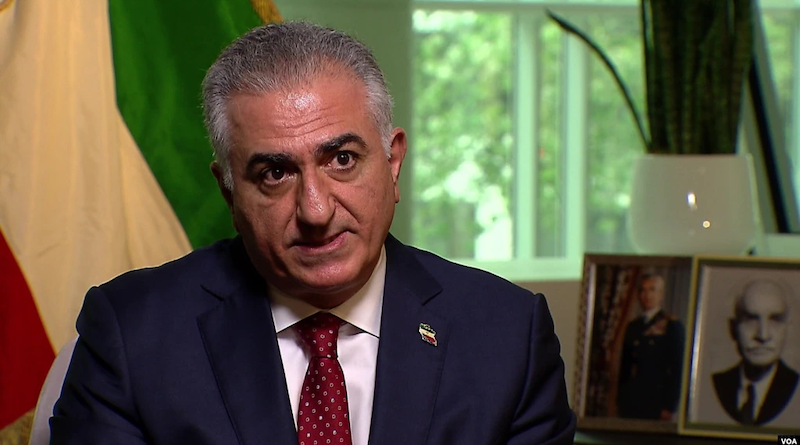
Between Past And Future: What Reza Pahlavi’s London Visit Means For Iran – OpEd
Reza Pahlavi, the son of Iran’s former dictator, has acknowledged connections with members of the Islamic Revolutionary Guard Corps (IRGC), has not condemned the human rights violations committed during his father’s rule, and is reportedly advised by former members of SAVAK (the secret police to suppress political dissent and to monitor opposition groups, under the Shah, Mohammad Reza Pahlavi).
The recent visit of Reza Pahlavi to London, and his meetings with former British Prime Ministers Boris Johnson and David Cameron, have generated considerable media attention. For some, it may appear as a diplomatic milestone or a sign of international recognition.
However, for many Iranians, both inside the country and across the diaspora, this show is deeply troubling. It raises urgent questions about the nature of leadership, legitimacy, and the future of Iran’s democratic aspirations.
As a women rights’ activist, I find the timing and tone of this visit particularly disconcerting. Iran is at a historic crossroads. The 2022 uprising, led by women, students, and workers, was not merely a protest the barbaric regime in Iran, it was a wholesale rejection of authoritarianism in all its forms. The chant starting from universities, that echoed across the country: “Down with the oppressor, be it the Shah or the Mullah,” was a powerful repudiation of both theocratic and monarchical rule.
A Platform for the Repressive State
In June 2025, Reza Pahlavi launched a secure platform inviting members of Iran’s most repressive institutions: the IRGC, the Ministry of Intelligence, and the Basij militia to join his initiative. According to his own announcement, over 20,000 members of the repressive forces have already registered after only a few days after announcing the campaign via one of the Persian speaking TV channels, that has been promoting a return to Shah’s dictatorship’s era, while censoring the genuine opposition groups.
This move has sparked alarm among Iranians who view it as a potential infiltration mechanism, possibly even coordinated with the regime itself. Pahlavi’s past statements praising the IRGC and suggesting they could play a role in a post-regime Iran only deepen these suspicions. This is particularly concerning given that the IRGC is not merely a military force, it is the backbone of the Iranian regime’s power structure. The regime’s security apparatus is so deeply embedded in its political and economic systems that it is virtually indistinguishable from the regime itself.
Authoritarian Echoes and Historical Amnesia
Pahlavi’s rhetoric and behaviour reflect an authoritarian mindset. He has declared himself the leader of the opposition without any democratic mandate, and his small group of supporters: remnants of the Shah’s dictatorship who fled abroad after the 1979 revolution, often glorify the legacy of his father’s regime, which was marked by censorship, torture, execution, and the notorious SAVAK secret police.
At a 2023 rally in Munich, posters of Parviz Sabeti, a former SAVAK deputy chief, were proudly displayed. Reports suggest Sabeti even served as an advisor to Pahlavi. Such associations are not consequent; they signal a willingness to rehabilitate the very forces that once terrorised the Iranian people.
Neo-Fascist Tendencies and Online Intimidation
Pahlavi’s campaign has also attracted elements with neo-fascist leanings. His supporters frequently attack advocates of a democratic republic with slurs, threats, and coordinated harassment, often in tandem with the regime’s cyber army. This toxic environment stifles open debate and mirrors the very repression Iranians are fighting to overcome.
No Grassroots, No Legitimacy
Despite his media visibility, Pahlavi lacks any meaningful grassroots support within Iran. His strategy—relying on foreign powers and elements of the regime is fundamentally disconnected from the lived reality of Iranians. The people have made it clear: they will not accept another foreign-backed ruler or a recycled version of the past.
The Pahlavi dynasty’s history of foreign dependency from Reza Shah’s British-backed rise in 1921 to the CIA-MI6 coup that restored Mohammad Reza Shah in 1953 has left a deep scar. Today’s movement is not about replacing one tyrant with another. It is about reclaiming sovereignty and building a democratic, secular republic.
The Path Forward
Iran’s future will not be shaped by exiled royalty or recycled elites. It will be forged by the courage of students, workers, women, and everyday citizens who continue to risk everything for freedom. The 1979 revolution was betrayed by theocracy. It was a demand for justice, dignity, and self-determination.
Reza Pahlavi’s ambitions, ties to repressive forces, and lack of democratic legitimacy make him an obstacle not an alternative to real change. Those who are crying for the “lack of unity” among the opposition often do so by including Pahlavi in that equation. But the truth is, he is not part of the democratic opposition. He is a distraction from it.
The Iranian people deserve better than a return to the shadows of thrones and turbans. They deserve a future built on democracy, human rights, and the will of the people.

Like what you read?
Please consider supporting Eurasia Review. Thank you for your consideration!
