
Srebrenica At 30: A Tragedy Remembered, A Hypocrisy Exposed – OpEd
Thirty years ago, on July 11, 1995, Bosnian Serb military leader Ratko Mladic walked through the streets of Srebrenica, signaling the fall of the Bosnian enclave to his forces. “Here we are, on July 11, 1995, in Serb Srebrenica,” Mladic said during his walk at just after 4pm local time. “On the eve of yet another great Serb holiday, we give this town to the Serb people as a gift. Finally, after the Rebellion against the Dahis, the time has come to take revenge on the Turks in this region.”
Some historical context may help clarifyMladic’s statement. On July 12, the Serbian Orthodox Church observes the feast of Saints Peter and Paul, a major religious holiday. The date also recalls a darker chapter in Balkan history tied to the rise and fall of the Dahis (also spelled Dahijas or Dahije)—renegade Janissary officers who seized control of the Sanjak of Smederevo (also known as the Belgrade Pashaluk) in December 1801 after assassinating the Ottoman Vizier Hadzi Mustafa Pasha. Their brutal rule provoked widespread fear among the Serbian population, which sent a petition to the Sultan, culminating in the infamous “Slaughter of the Knezes” in January 1804, when dozens of Serbian community leaders were executed by the Dahis. The massacre sparked outrage and resistance.
In August 1804, Ottoman forces under Bekir Pasha, the Vizier of Bosnia, aided by Serbian rebels, defeated the Dahis. However, tensions persisted as the Janissaries still controlled key towns like Uzice when Bekir Pasha wanted the Serbs to be disbanded. When the Sultan ordered surrounding pashaliks to suppress the Serbian uprising, the rebels turned to Russia for support. A delegation sent to St. Petersburg, Russia in September 1804 returned with financial aid and diplomatic backing—marking the beginning of the First Serbian Uprising and the broader Serbian Revolution.
By “Turks”, Mladic means the Bosniaks (i.e., the Bosnian Muslims), implying they are to “pay” for centuries of Ottoman rule, associated with Islam, over Orthodox Christian populations in the Balkans.
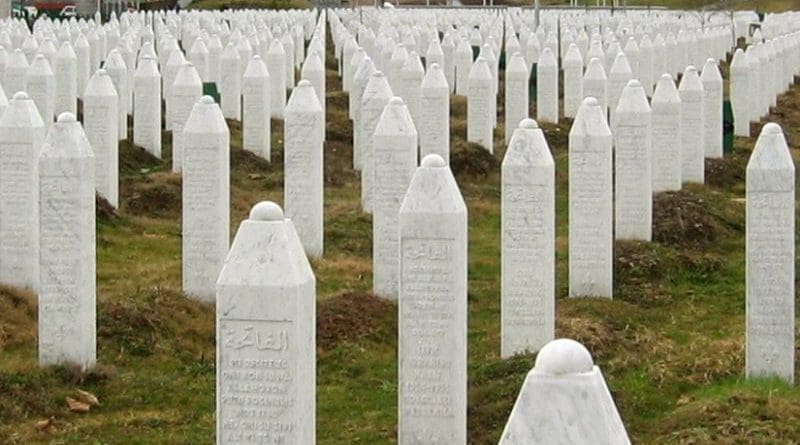
And what a ‘gift’ and what a ‘revenge’ promised by the Serbian monster! His chilling words, invoking historical grievances, masked the brutal reality that was about to unfold. The Bosniaks of Srebrenica were not Ottoman Turks, but civilians—men and boys—who would soon be systematically executed. Within days, Mladic’s forces, the Bosnian Serb Army of Republika Srpska, murdered 8,372 Bosniak Muslims in what would become the first legally recognized genocide in Europe since World War II.
Ironically, Srebrenica was meant to be a UN-protected “safe area.” Instead, it became a killing field. Despite clear warnings and the presence of Dutch UN peacekeepers, the international community—particularly NATO—failed to intervene. Just as the lives of Palestinians in Gaza and the Occupied West Bank are treated as expendable by today’s Western leaders, so too were the lives of Bosniaks in Srebrenica thirty years ago. The pattern of selective outrage and inaction continues to cast a long shadow over the credibility of global humanitarian principles.
This week Bosnia and Herzegovina marks the 30th anniversary of the Srebrenica genocide. Thousands have gathered in Srebrenica and at the Memorial Center in Potocari to honor those victims of July 1995. Among those being laid to rest this year are seven newly identified victims, including two 19-year-olds. For many families, the grief remains raw, as they continue to bury partial remains recovered from mass graves—grim evidence of a crime that shattered generations.
Survivors and families still seek closure, and the silence of the world in 1995 continues to echo today.
While the International Criminal Tribunal for the Former Yugoslavia (ICTY) secured convictions against high-profile figures like Ratko Mladic, justice has been partial. Only 18 individuals were convicted for crimes at Srebrenica, with just five receiving life sentences. In contrast, Bosnian courts have handed down more verdicts—27 convictions, including 14 for genocide—yet over 1,200 victims remain missing.
The Srebrenica genocide exposed the limits of Western resolve and the consequences of political hesitation. The tragedy of Srebrenica is not only a Bosnian wound—it is a global indictment of western hypocrisy and double standards. As Western powers now speak of justice in places like Ukraine and Gaza, many Bosnians recall how those same voices were silent during their darkest hour. Legal experts like Geoffrey Nice (who prosecuted Slobodan Milosevic) and Janine di Giovanni (who reported from Srebrenica as a journalist) have pointed to the West’s selective enforcement of humanitarian principles, warning that political settlements may once again shield powerful leaders like Bibi Netanyahu of Israel from accountability. Geoffrey Nice expresses skepticism that current international efforts will lead to meaningful convictions in Ukraine or Gaza. “The settlement would almost inevitably include, as clause one, in either case, that President Putin or Prime Minister Netanyahu will not be tried for any alleged offense,” he said, adding that national courts may offer a more realistic path to justice.
Srebrenica challenges the world to confront its failures—not just with remembrance, but with a commitment to consistent moral action. Until that happens, the legacy of betrayal and the hypocrisy it revealed will remain unresolved.
In 1995, the world failed Srebrenica largely in silence. The massacre of over 8,000 Bosniaks happened under the watch of UN peacekeepers, in a so-called “safe area,” with little real-time global awareness or media coverage. It was only after the fact that the full horror came to light.
In contrast, the Gaza crisis is unfolding in real time, with the world watching. UN officials have described Gaza as a “graveyard of children and starving people”. As of July 2025, over 57,000 Palestinians have been killed, including more than 17,000 children. Entire neighborhoods have been flattened, hospitals bombed, and mass graves uncovered—all broadcast live on global news and social media. Hundreds of thousands of Palestinians remain unaccounted for.
Yet, despite this visibility, international leaders have largely failed to intervene meaningfully. As a matter of fact, the US and NATO leaders are rewarding the very executers of the Gaza genocide.
Both tragedies expose a pattern of Western hypocrisy. In Bosnia, the West’s failure was one of hesitation and denial. In Gaza, it is one of complicity and selective morality. As Imam Abdul Malik Mujahid of Justice For All put it: “Srebrenica teaches us that genocide never occurs in isolation. It is always preceded by dehumanization, enabled by silence, and followed by denial. We are witnessing this same deadly sequence unfold in Gaza—again.”
The lesson of Srebrenica was supposed to be “Never Again.” But Gaza shows that “Never Again” has become a hollow slogan. The world’s failure to act—despite seeing the suffering unfold in real time—raises a painful question: If not now, when?
- About the author: Dr. Siddiqui is the author of the book – 64 Hours in Sarajevo: A journey through the historic landscape of the Balkans.

Like what you read?
Please consider supporting Eurasia Review. Thank you for your consideration!

Very strong and couregeous write-up, reminding us what happened 30 years ago and even going back to 1801 – 1804, informing us how the ‘revenge’ was completely misplaced. Dr. Habib Siddiqui pointed out the western hypocrisy (which many people came to see now) with clear mirror events. The hypocrisy and selective morality are more evident now, as the visibility of Gaza genocide is more realtime and widespread now.
Thanks for this article and true journalism.