
Generation Z Or Geopolitical Proxy? Unpacking Nepal’s Political Crisis – OpEd
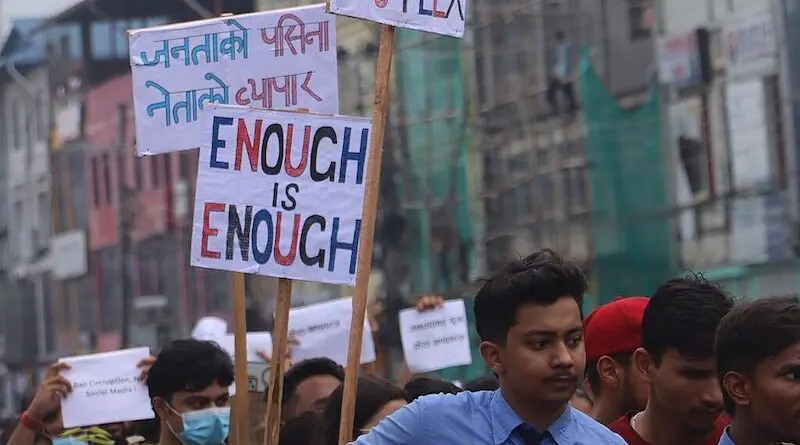
Nepal, often described as the “buffer state” between India and China, has once again become the stage of political upheaval. The September 9 unrest, triggered by the government’s controversial social media ban, rapidly escalated into violent protests that culminated in the ouster of Prime Minister K.P. Sharma Oli.
To many observers, this episode reflected the raw anger of Generation Z, galvanized by digital mobilization and growing disillusionment with corruption and government overreach. Yet, for others, the speed and scale of Oli’s downfall raise serious questions: Was this truly an organic uprising, or a carefully orchestrated turmoil shaped by India’s long history of meddling in its neighbors’ affairs?
The immediate cause of unrest was the government’s decision to ban social media platforms, justified as a step to curb disinformation and hate speech. For Nepal’s digitally connected youth, this move struck at the heart of their freedom of expression. Generation Z, who grew up in a politically unstable Nepal but found identity and voice through digital platforms, saw the ban as a symbol of authoritarian overreach. Protests quickly morphed from anger at censorship to broader grievances: endemic corruption, elite nepotism, and a perception that Nepal’s political leadership had failed to deliver stability or prosperity. As demonstrations spread, the state’s heavy-handed response—arrests, curfews, and crackdowns—only intensified public fury.
Indian media covered the unrest with unusual vigor, framing Oli’s ouster as a natural consequence of public anger. Commentaries celebrated the removal of a “pro-China” leader, echoing New Delhi’s strategic preference for governments more aligned with its own regional vision. This alignment between media framing and geopolitical ambition has fueled suspicions in Kathmandu that India’s hand was not far removed from the turmoil. For many Nepalese, the crisis mirrors Bangladesh’s August 5 upheaval, when Sheikh Hasina’s downfall was framed by Indian outlets as part of a “democratic awakening.” In both cases, India’s amplification of unrest narratives coincided neatly with its broader strategic calculus—weakening governments seen as too close to Beijing or unwilling to toe New Delhi’s line.
Nepal’s history provides further grounds for suspicion. From the 1989 economic blockade to frequent political interventions, India has consistently used leverage—economic, political, and media—to steer Nepal’s trajectory. Given Oli’s assertive stance on territorial disputes, particularly Kalapani and Lipulekh, and his pivot toward Beijing in trade and infrastructure projects, his ouster aligns closely with India’s desire to roll back Chinese influence in South Asia.
The defining feature of the September unrest has been its characterization as the “Generation Z Movement.” Young Nepalese, mobilized through digital tools, confronted state institutions and challenged entrenched political elites. Their defiance reflected genuine frustrations: lack of jobs, corruption scandals, and generational exclusion from decision-making. However, analysts caution against reducing the unrest to a purely domestic, youth-led phenomenon. The rapid political consequences—the resignation of a sitting prime minister and the collapse of his government—suggest coordination beyond spontaneous street mobilization. Digital protests, no matter how powerful, rarely translate into regime change without organizational and geopolitical scaffolding.
Beyond realpolitik, many critics interpret India’s approach through the prism of Hindutva ideology. Oli’s defiance on territorial disputes, particularly over Kalapani and Lipulekh, challenged India’s expansionist claims. His push for closer ties with Beijing further antagonized Hindutva-driven ambitions of projecting Indian dominance across the Himalayas. By exploiting Nepal’s internal discontent, India has effectively removed a leader who resisted its influence while reinforcing its narrative of regional supremacy.
Nepal now faces a precarious transition. The Generation Z protesters who spearheaded the movement may expect systemic reform and accountability. Yet if external manipulation played a decisive role, their democratic aspirations risk being co-opted into a geopolitical game. Regionally, Oli’s ouster underscores the fragility of smaller South Asian states in the face of India’s interventions. For China, the episode signals the limits of its influence in Nepal, despite growing economic and infrastructure ties. For Pakistan and others, it is a reminder of how New Delhi leverages unrest to undermine sovereign decision-making in its neighborhood.
The September 9 unrest in Nepal cannot be dismissed as mere youthful exuberance, nor can it be fully explained without reference to India’s strategic ambitions. It was both an organic uprising and an orchestrated turmoil: organic in its popular anger, orchestrated in its geopolitical outcome. For Nepal, the challenge lies in reclaiming sovereignty over its political destiny, ensuring that popular movements remain genuinely national rather than co-opted by external forces. For South Asia, the crisis serves as yet another reminder of the destabilizing potential of hegemonic ambitions cloaked in the rhetoric of democracy.

Like what you read?
Please consider supporting Eurasia Review. Thank you for your consideration!
